
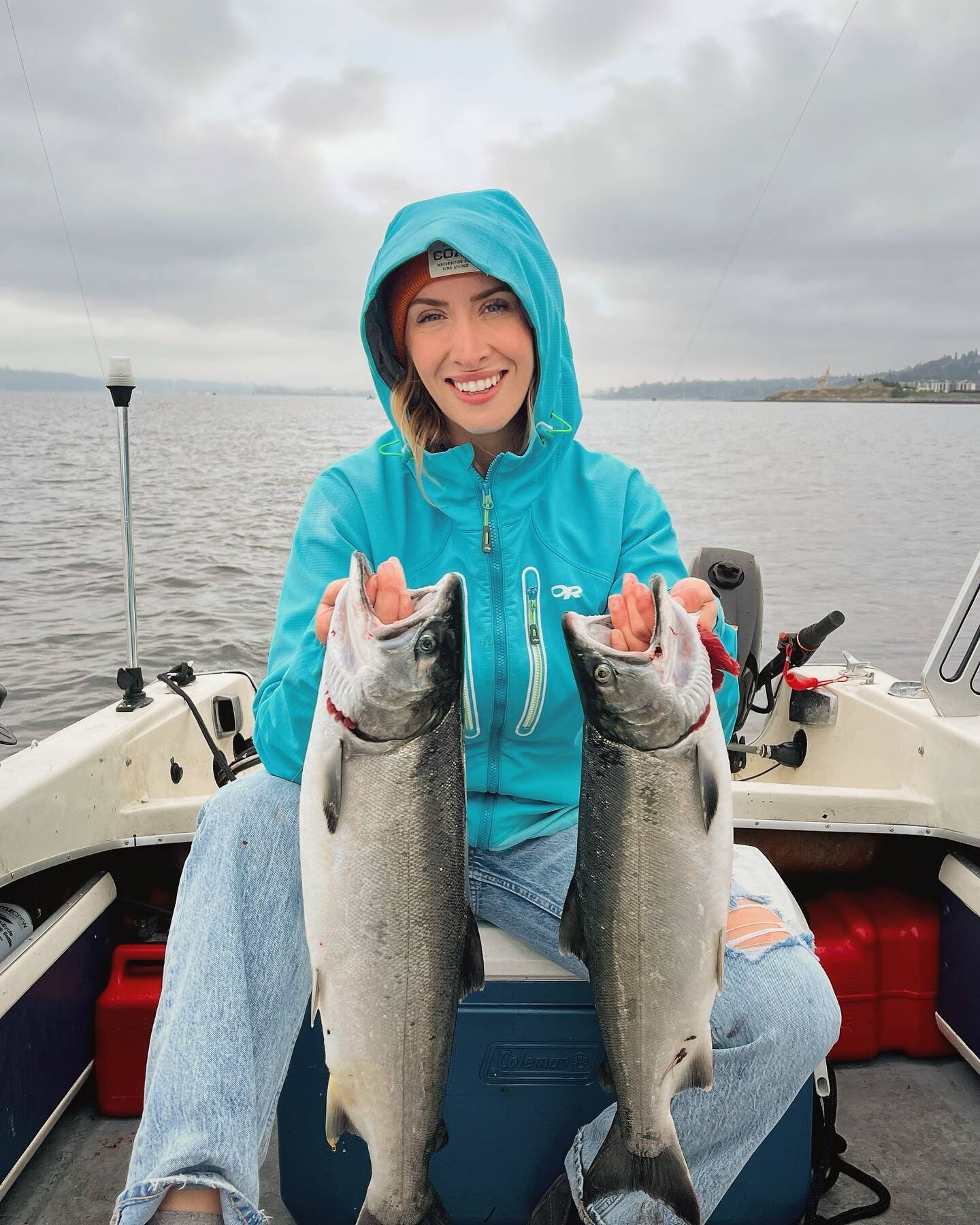
CALM BLUE OCEAN water right around the 60-degree mark on the thermometer is what bluefin tuna anglers are seeking right now off of our coastline.
Typically, the warm currents off the California coast make their way north through Oregon and into our waters in July and August, providing tuna opportunity through October in some productive years.
This summer has the chance to go along with the stellar tuna summers of 2015 and 2019, when the correct conditions provided ocean-going opportunity around 30-35 miles off of La Push.
Quilcene’s Ward Norden, a former fisheries biologist and retired tackle maker, loves to track ocean temperatures and has been hearing the longfin gospel from commercial anglers working off the coast.
“Over the last couple weeks I have been getting some amazing reports from my contacts with tuna trollers working off our coast who are getting extraordinary catches,” Norden said. “If the right weather conditions occur (a series of cloudy, cooler days in Portland, Ore.) which bring the tuna within range of sports anglers, this might become the best season of the last 25 years.
“One common comment is that the albacore are larger than usual. Portland might get such weather this coming weekend.”
Norden has previously advised jigging with jigs or live bait where the blue ocean water is at or above 60 degrees.
“Albacore tuna are generally 15 to 25 pounds and be caught with fast-moving jigs or live bait,” Norden said.
Salmon tackle isn’t the best equipment.
“Salmon tackle doesn’t usually have the sturdy drag system necessary and is not designed to cast and retrieve jigs at the speed required,” he said.
“The classic albacore setup is a Penn 500 Jigmaster reel loaded with 20-pound monofilament or 50-pound new generation braided line and an 8- to 9-foot stiff jig casting rod.”
Tacoma’s Lorin Bell, a frequent Sekiu-bound angler, went out for tuna on his own boat for the first time earlier this month, but had to travel for the pleasure.
“Got a late start and traveled a lot farther than expected, but mission success,” Bell said. “Sixty-four miles one way out of Westport south/southwest until we hit 61.5-61.8 degree water.
“Dropped the troll lines, and the rest was history! We didn’t have enough ice to keep fishing, so we packed it home with 10 fish. Could’ve easily fit another 10 more, but I’m still happy we managed to bloody the deck with tuna.”
Other anglers advise checking multiple forecasts before departing.
Do not look at the surf forecast or just the forecast out to 10 nautical miles. You need to look at the offshore forecast out to 60 nautical miles.
Conditions can be really calm in close but be very ugly far out. Watch the winds and keep tight lines.
Coho opens Saturday
All salmon fishing in the eastern part of the Strait of Juan de Fuca is closed until Saturday after the state Department of Fish and Wildlife announced over the weekend that anglers reached the summer salmon legal encounter number of 6,550 chinook.
Despite estimates approaching 90 percent the previous Monday, state fisheries managers delayed the decision, leading to a lack of communication and empty trailers at boat launches Sunday.
This affects Marine Area 6, which runs from Low Point (Lyre River) to Point Wilson (Fort Worden, Port Townsend).
Marine Area 6 will reopen for hatchery coho and pink salmon on Saturday.
Halibut also will be available seven days a week starting Saturday.
Anglers meeting
State Department of Health Marine Biotoxin Program lead Jerry Borchert will speak to the North Olympic Peninsula chapter of Puget Sound Anglers on Aug. 20.
The meeting will be held at the Sequim Elks Lodge, 143 Port Williams Road, with doors opening at 6:30 p.m. and the meeting starting at 7 p.m.
Borchert is an expert on the 12 types of bivalves found in state waters and the biotoxins that are associated with them, including paralytic, diarrhetic and amnesic shellfish poisons.
His talk will cover all of these topics as well as vibriosis, shellfish myths and misconceptions and shellfish handling.
A short business meeting, fishing reports and raffle drawings will follow Borchert’s presentation.
Raffles are for members only, but the public can join that night to participate in the raffle.
An annual individual membership is $25, and a family membership is $35.
Membership also includes a subscription to The Reel News monthly newspaper.
________
Sports reporter/columnist Michael Carman can be contacted at sports@peninsuladaily news.com.
