
TOO MUCH OF a good thing has led to shortages of medium-sized, green-label herring at bait shops, resorts and marinas around the Pacific Northwest.
This isn’t an incredibly new phenomenon; green label have always been the tried-and-true method for cut-plug chinook anglers. Two prime factors led to this popularity: the perception of success anglers using them discovered, and the value aspect of paying a similar price for larger herring sizes and receiving more bait fish and thus more opportunities to fish with green label.
And that popularity has always made green label-sized herring a quick seller.
I know from experience, having packed, vacuum-sealed and frozen thousands of green label herring during a summer working at Jerry’s Bait at Mats Mats Bay near Port Ludlow. As soon as they were frozen, they were out the door to distributors.
Freezers were lacking green label all during the winter and spring months, impacting halibut fishing, and the shortage has hit the bartering stage, with at least one angler recently offering up two packs of clandestinely sourced green label in exchange for some productive spoons.
Thankfully, the issue isn’t a lack of herring overall; it’s a lack of those medium-sized fish. Massive spawns were witnessed in March and April 2020, including Dabob Bay near Quilcene.
“Our Sound-wide total for 2019 was just under 8,000 metric tonnes,” said Adam Lindquist, a biologist with the state Department of Fish and Wildlife. “If you take what happened at Quilcene and the Port Orchard-Port Madison stock, this year [2020] is going to beat the total that we had for all of Puget Sound last year.”
The 2020 herring biomass estimate was the agency’s highest since 1983, although the department has vastly expanded its stock surveys in the decades that followed.
The advice? Be patient as those herring grow to size and adapt to a smaller or larger presentation. Herring of any size will still smell of herring, and the action of the presentation will be what draws an interested bite.
Heating up off Neah Bay
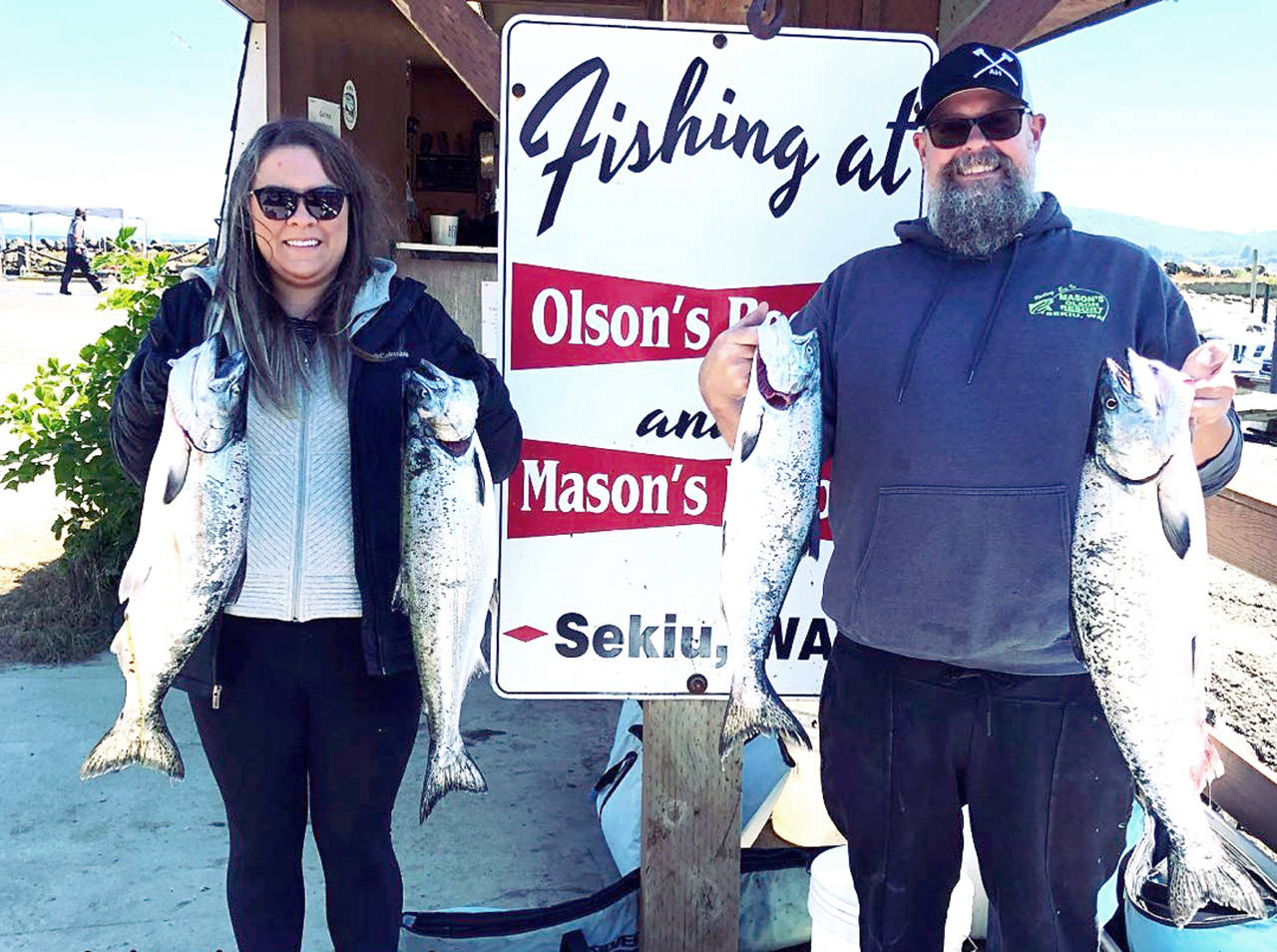
The first week with an increased chinook limit off Neah Bay reeled off an impressive 21-percent of the area’s chinook guideline of 5,825 fish.
A total of 1,604 anglers caught an estimated 1,228 chinook from July 5-11 to bring the number of chinook caught so far to 2,268, 39-percent of the overall guideline.
Fishing spots on the inside of the Strait of Juan de Fuca near Neah Bay continue to prove the most productive for anglers with not much of anything happening far offshore for those eyeing a trek out to Swiftsure Bank.
More coho also were in the mix with 134 silvers landed. Only 2 percent of the 5,730 coho quota has been caught through July 11.
Marine Area 2 (La Push) didn’t record any fishing activity July 5-11, but that will change thanks to Monday’s re-opening of Quileute Tribal lands, including the marina, to the public.
Pinks start push
The odd-year run of pink salmon also are beginning to travel through the Strait of Juan de Fuca ahead of their August peak.
The number of pinks caught off Neah Bay jumped from four the week of June 28 to July 4 to 49 for July 5-11.
Some have found their way farther east, including off Ediz Hook and as far away as Everett.
“No doubt that there are a few humpies in the bay near Everett, but humpies are nothing if not punctual,” Quilcene’s Ward Norden said.
“The peak is always about Aug. 10, plus-or-minus five days. The humpy run is shaped like a bell curve with the bigger it is, the farther out it spreads. Humpies in the bay now are a good sign that the run into the Snohomish River system may exceed 1 million fish.”
Shellfish closure
Discovery Bay beaches in Jefferson and Clallam counties are closed to all shellfish harvest after recent samples were found to contain elevated levels of the marine biotoxin that causes Diarrhetic Shellfish Poisoning (DSP).
Danger signs have been posted at public access points warning people not to consume shellfish from this area.
DSP can cause gastrointestinal illness, and symptoms include nausea, vomiting, abdominal pain and diarrhea. The onset of symptoms can range from ½ to four hours after consumption.
To find out which areas are safe to harvest shellfish in Washington, check the map at www.doh.wa.gov/ShellfishSafety.htm or call the Biotoxin Hotline at 800-562-5632.
For the latest information on regulations and seasons, visit wdfw.wa.gov/fishing or call the Shellfish Rule Change Hotline at 866-880-5431.
________
Sports reporter Michael Carman can be contacted at 360-406-0674 or mcarman@peninsula dailynews.com.
