
Chinook fishing opened slowly over the first weekend of the season off Neah Bay as wind and choppy seas limited catch totals.
Estimates from last weekend’s opener show 628 anglers caught 234 chinook for a 0.37 catch rate, eating up 3 percent of the 8,710 king quota in Marine Area 4.
Last year’s weekend opener saw a nearly 1:1 catch rate with 761 anglers taking 758 chinook for comparison.
But there were good signs for increased angler success this summer.
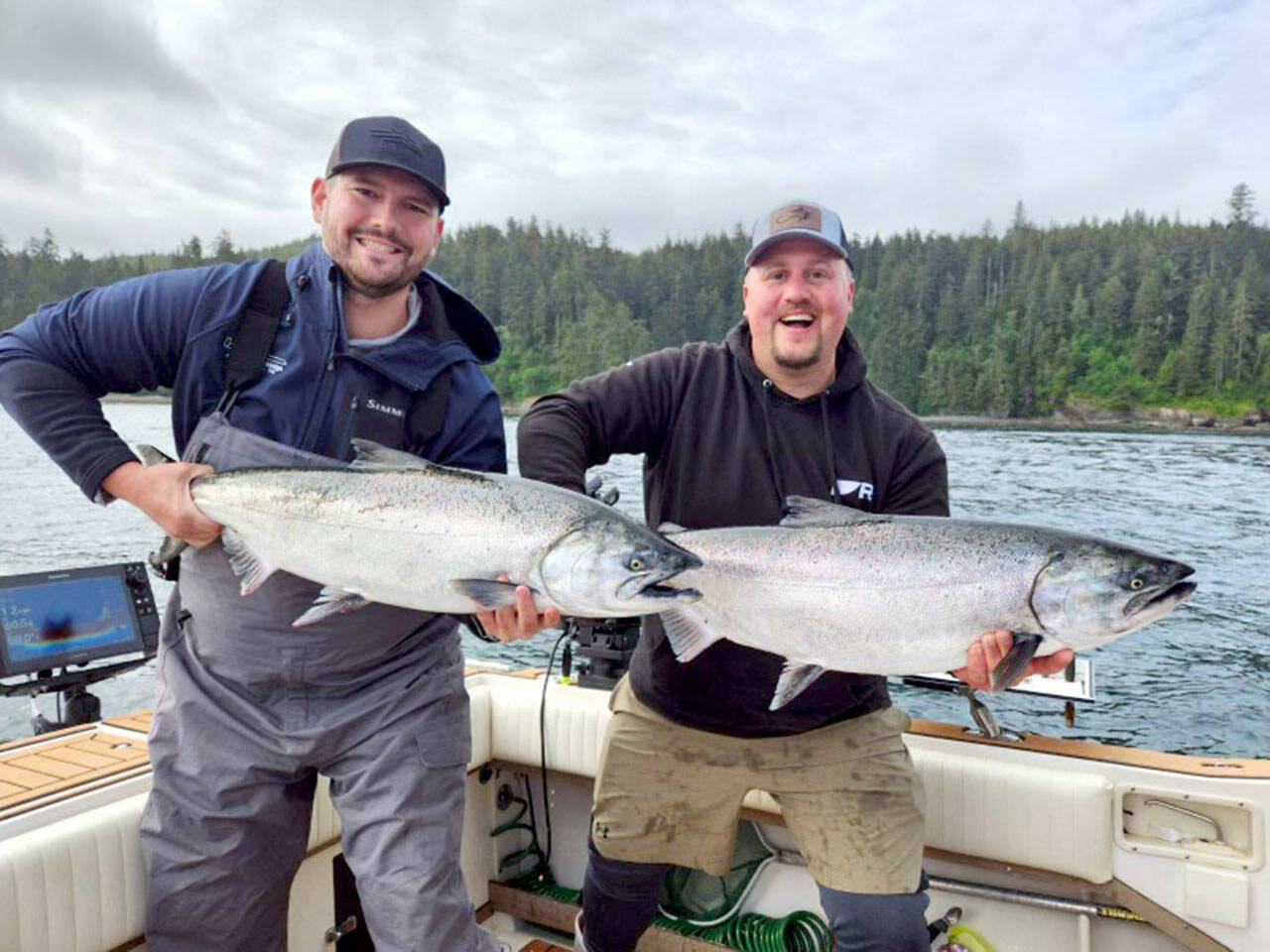
Snohomish’s Mike Surdyk and his fishing buddy Anthony Nillson each reeled in some killer kings last Saturday while fishing the inside portion of the Strait of Juan de Fuca off Neah Bay.
“We had our first fish in the boat by 6 a.m. on the outgoing tide and another at 8:30 a.m. on the minus tide when everything was rushing out,” Surdyk said.
“We like to fish tight on the beach next to the kelp and find and explore structure [differences in depth or contours of the bottom, points, flats, etc.].”
Surdyk said they were both rigged up with a cut-plug herring and caught the fish at 30 feet on the downrigger in 60 feet of water.
“We were on the inside at Mushroom and Midway rocks, then we went down south and fished around Skagway,” he said.
Surdyk said the boat’s sonar showed plenty of bait fish near shore.
“There was a big surplus of bait, candlefish, needlefish and herring,” Surdyk said.
And Surdyk, who fishes Neah Bay often, noticed a drastic difference in water temperature.
“The water temperature around the beach from Waadah to Tattoosh was significantly cooler than we’ve seen in recent years,” Surdyk said. “Inside it was about 49 or 50 degrees, when it has been 52 or 53. And deeper water off shore has been up to 61, 62, 63 degrees, and it’s down eight degrees or so.”
So lots of potential feed and cool water to attract kings is what anglers should find out west.
Surdyk said his group didn’t encounter too many coho.
“Guys in the deeper water were catching some coho,” he said. “But the bigger fish were definitely in close.”
Big Salmon Resort said that trend has continued this week as “close fishing to rocks and the kelp has been the trick for bigger fish,” with herring again attracting kings.
A reminder that wild coho must be released off Neah Bay. Sport fishing advisors said the state Department of Fish and Wildlife had interviewed some anglers who were unaware of that portion of the area regulations and kept some wild coho last weekend.
Hatchery coho bigger than 16 inches can be kept.
Shellfish harvest closed
Recreational harvest of all species of shellfish is closed along the east Strait of Juan de Fuca, from Lyre River/Low Point to the Jefferson County line, including Dungeness Bay.
The closure does not apply to shrimp.
Kayak derby planned
Big Salmon Fishing Resort in Neah Bay announced a lingcod and sea bass (rockfish) derby for kayak fishermen will be held June 30 through July 2.
Kayakers must register at the shop with a $25 entry fee. Seventy percent of the pot will go to the lingcod winner, while 30 percent of winnings will go to the biggest sea bass.
The derby will end with a final weigh-in at 2 p.m. July 2.
Shrimp news
The recreational catch in Marine Area 12 (Hood Canal) has exceeded preseason expectations, and to stay within quota, the final announced opening on Wednesday is canceled. The next planned opening Saturday from 9 a.m. to 1 p.m. will be the final opening for spot shrimp in Hood Canal this year.
White-nose syndrome
White-nose syndrome, an often-fatal disease of hibernating bats that does not affect humans, livestock or other wildlife, has been discovered for the first time in Jefferson County.
White-nose syndrome is caused by the fungus Pseudogymnoascus destructans, which attacks the skin of hibernating bats and damages their delicate wings, making it difficult for them to fly.
Infected bats often leave hibernation too early, which causes them to deplete their fat reserves and become dehydrated or starve to death.
Humans can unintentionally spread the fungus as well. People can carry fungal spores on clothing, shoes or recreation equipment that touches the fungus.
The state Department of Wildlife instructs that if you find sick or dead bats or notice bats acting strangely, report sightings at tinyurl.com/PDN-Bats23 or call 360-902-2515.
To learn more and to get the most up-to-date decontamination protocols and guidance on limiting the spread of white-nose syndrome, visit www.whitenosesyndrome.org.
________
Sports reporter/columnist Michael Carman can be contacted at mcarman@peninsuladailynews.com.
