
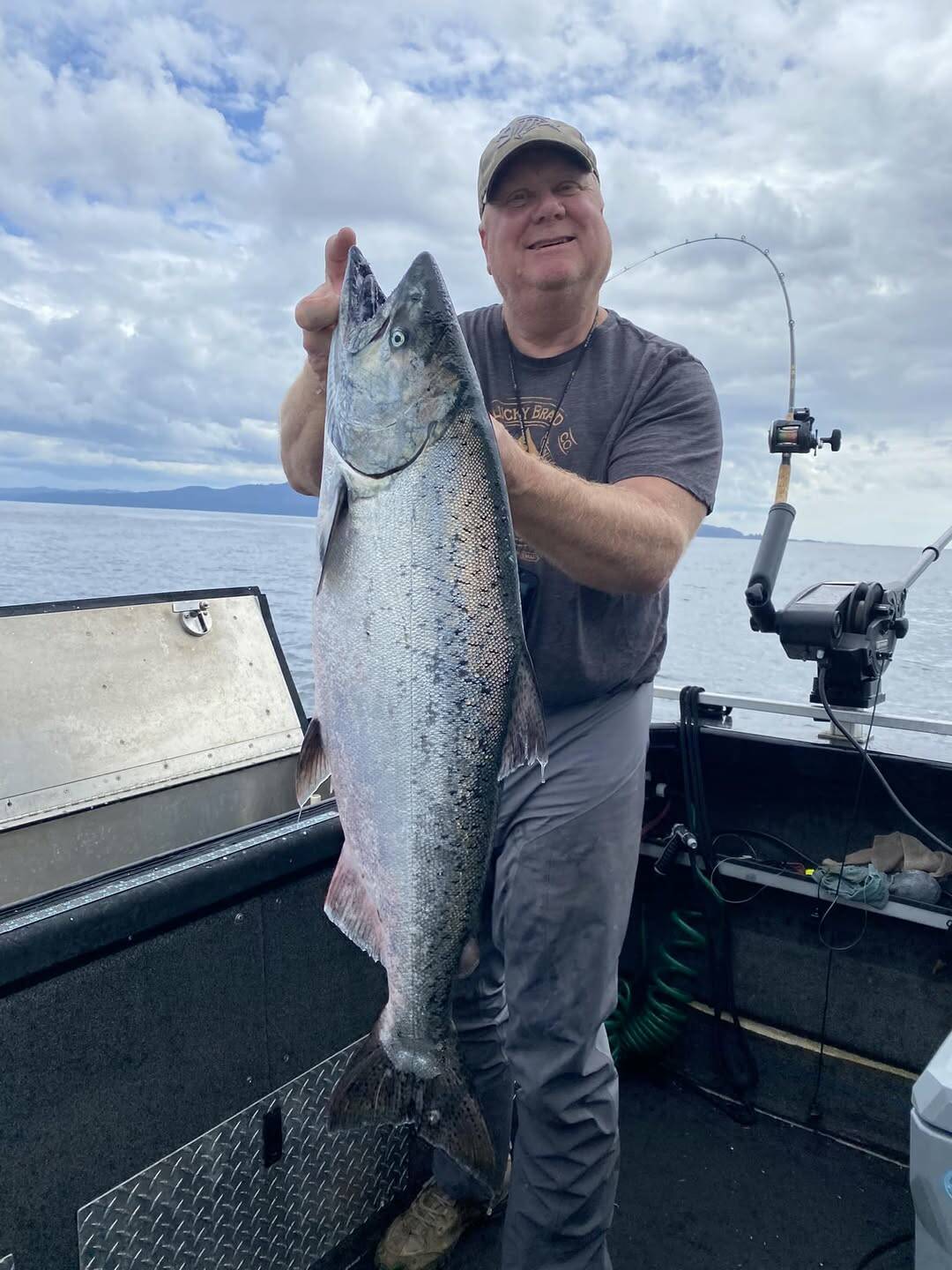
ANOTHER STATE FISHING record fell over the weekend, as spear gunner Gunnar Fjelstul entered the record books for the third time in as many years after he speared a 58-pound halibut off Neah Bay.
Fjelstul also spearfished for a state record lingcod (31.34 pounds) and blue rockfish in summer 2023 — also off Neah Bay.
More impressively, Fjelstul is a freediver, relying on holding his breath rather than using a breathing apparatus to explore the underwater world with minimal gear, such as a mask, snorkel and fins.
It offers mental and physical benefits like stress relief and improved fitness but also carries significant risks, requiring proper safety protocols, training and a buddy system to prevent dangerous situations like blackouts.
Freediving includes various disciplines, from static breath-holding to competitive deep-diving, and it requires a passion for the activity and a desire to understand the human body’s potential.
Sockeye swarm
Sockeye retention is allowed through Aug. 31 as part of the daily salmon limit in Marine Areas 5 (Sekiu), 6 (Eastern Strait of Juan de Fuca) after northwest salmon managers revised the Fraser River sockeye forecast to nearly 10.2 million fish, the largest return since 2018 and nearly 31/2 times as many as initially predicted to return to the British Columbia river.
The upgrade was made by the international Fraser River Panel earlier this week, although catch totals are expected to be exceedingly small at best.
During last winter and spring’s season setting, managers said they only expected 2.95 million sockeye back to the Fraser this year, but the run has fared far better.
Reasons for the surge in sockeye include successful spawning for this year’s parent class, the 2021 return, work by federal, provincial and First Nations governments to improve passage around a 2019 landslide and better environmental conditions for the fish.
The salmon return every four years, which would appear to mean that this year’s return is the largest for its component since at least the end of the last millennium.
The daily limit is two, plus two additional pink salmon. Release chinook, chum and wild coho.
Baker Lake in Whatcom County is seeing a record return of about 90,000 sockeye back.
Unfortunately, the sockeye surge has not stretched to the south. Returns for the Lake Washington system near Seattle were looking exceedingly grim, but thanks to a late July run, what had been projected to be the worst returns in 50-plus years of record will only be the second worst.
Budget cuts
A recent Seattle Times editorial focused on the Trump administration abruptly eliminating $1.3 million in federal funding for Washington’s Regional Fisheries Enhancement Groups, jeopardizing salmon restoration across the state.
The editorial said the administration should reverse course.
The 14 community-based RFEGs have been a linchpin in the fight to save salmon for three decades. Bringing together volunteers, Native American tribes and experts, they have removed barriers to fish passage, reopened more than 1,500 miles of stream, restored habitat and released hatchery salmon into state waterways. Their efforts have led to healthier and more abundant salmon, but work remains.
Leveraged support
The $1.3 million had come from the U.S. Fish and Wildlife Service. The enhancement groups leveraged that support to raise up to eight times as much from donors. Without it, dozens of habitat restoration and education projects across the state are at risk of cancellation.
Restoring salmon populations is more than an ecological and moral imperative. The United States has treaty obligations with Native American tribes related to salmon management.
Salmon are also an important economic driver for the state. Washington’s fishing industry employs more than 23,000 people and generates more than $1.5 billion in commercial and recreational economic activity.
________
Sports reporter/columnist Michael Carman can be contacted at sports@peninsuladaily news.com.
