
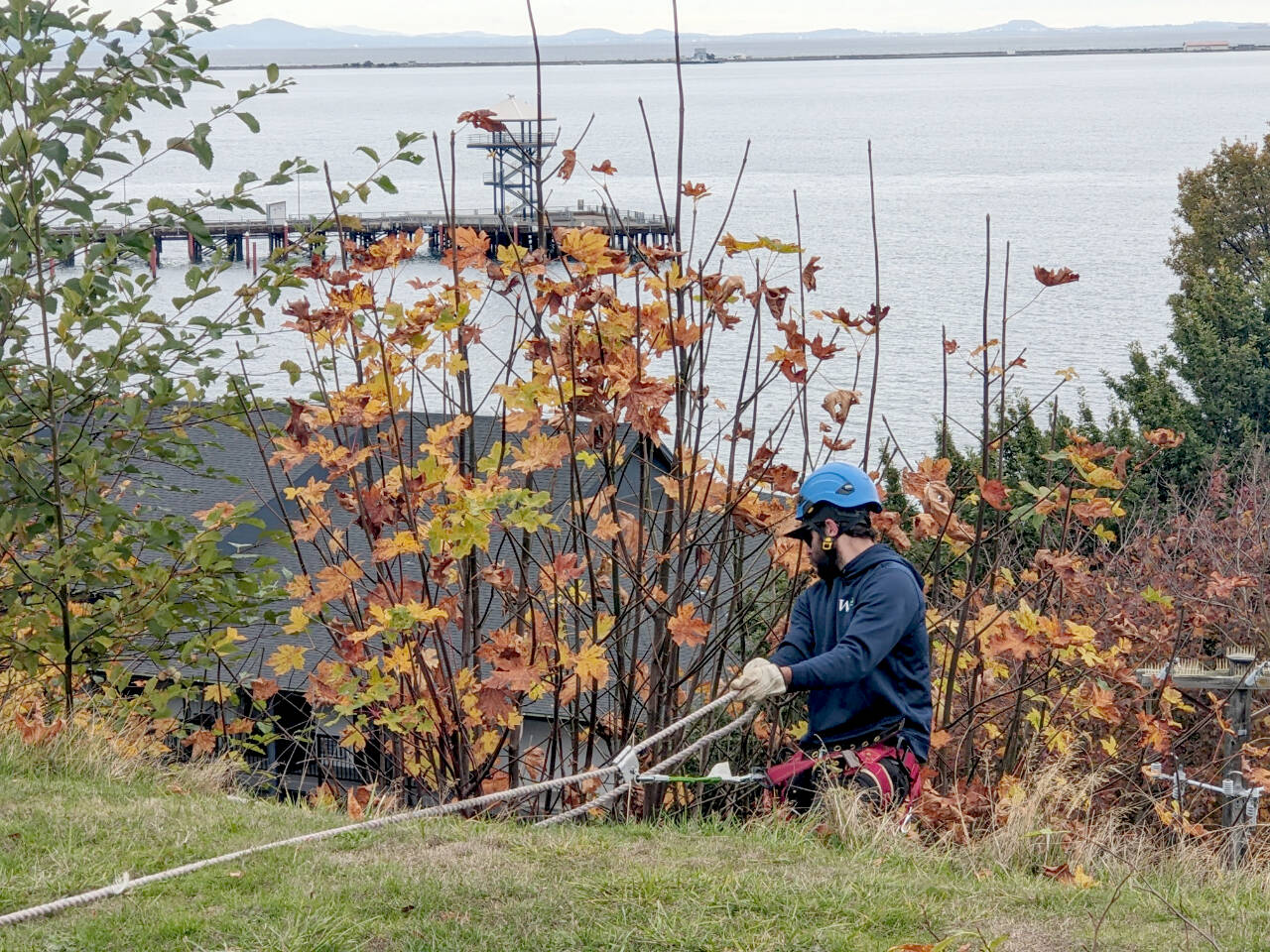
PORT ANGELES — Work performed at Waterfront Vista Park is part of the plan to stabilize the bluff.
A crew from the Washington Conservation Corps worked from the park starting Nov. 3, when they repelled down to the hillside to remove plants that have been blocking the view from the park while also not stabilizing the bluff, Port Angeles Waterfront District Executive Director Sam Grello said.
The Waterfront District paid a little more than $6,000 to get the work done.
“This work is part of a 10-year plan to restore the downtown waterview on the welcoming vista bluff and to also stabilize the bluff,” Grello said. “The reason that we’re working on this project is there were a bunch of meetings that took place five years ago when Elevate PA was being formed (and) a lot of people expressed frustration about the lack of view from Waterfront Vista Park.”
The Washington Conservation Corps (WCC) was brought in to do work that was either too dangerous or laborious for the regular volunteers who work at the park on weekends, Grello said.
The project is a collaborative effort between the Waterfront District and the city of Port Angeles, as well as volunteers and other organizations. Lissy Moriarty is steering the project, Grello said.
Moriarty, a landscape designer who owns Brambles Design Studio, said the WCC crews worked last week to remove Himalayan blackberry from the bluff as well as Japanese knotweed and ivy.
“Like a lot of invasive species, they can be airborne with seeds blowing into the space, or a root somehow ended up there,” Moriarty said. “I would assume these plants were not planted on the bluff and definitely not the blackberry.”
The work being done on the bluff will remove the “undesirable understory plants that have shallow root structures that don’t do a good job of stabilization” and replacing them with plants that do have stabilizing roots, which also won’t take away from the view from the park.
With the bluff cleared of those plants, the Waterfront District plans to host a volunteer work party from 9 a.m. to noon on Saturday to plant 43 dogwood trees in the area.
“Dogwoods are specifically our native dogwoods,” Moriarty said. “It’s always good to vegetate natural spaces with native species. They just adapt to the space really well. Another reason is dogwoods are just beautiful. They’re also appropriate for the lighting conditions there because dogwoods like a little shade but can also take full sun, and that’s a north-facing bluff.”
Fall is the perfect time to plant these trees, she said, because it will give the roots time to get established.
“In the springtime, everything above the ground is growing, and in the fall, everything below the ground is growing, so next summer when there’s no water, the trees are going to have a better root system and not need to be watered as much or at all,” Moriarty said.
This project is important for three main reasons, Grello said. The first is that the existing bluff needs to be stabilized to prevent a collapse, which would significantly affect U.S. Highway 101/Front Street at the top of the bluff. A collapse also would pose a potential danger to the Red Lion Inn at the base of the bluff.
The second reason is community pride.
“When there is no ‘view’ at the Haynes ‘viewpoint’ park, locals gripe,” Grello said. “We live in a picturesque location and deserve to enjoy the view.”
Finally, the project might help with tourism, Grello said.
“The 101 skirts downtown, taking a left at Lincoln and Front, so some visitors would potentially stop to visit Port Angeles if they saw the view from the Welcoming Vista,” Grello said. “We’ve essentially covered up a natural billboard (downtown) with the wrong type of foliage that does not stabilize the bluff.”
________
Reporter Emily Hanson can be reached by email at emily.hanson@peninsuladailynews.com.
