
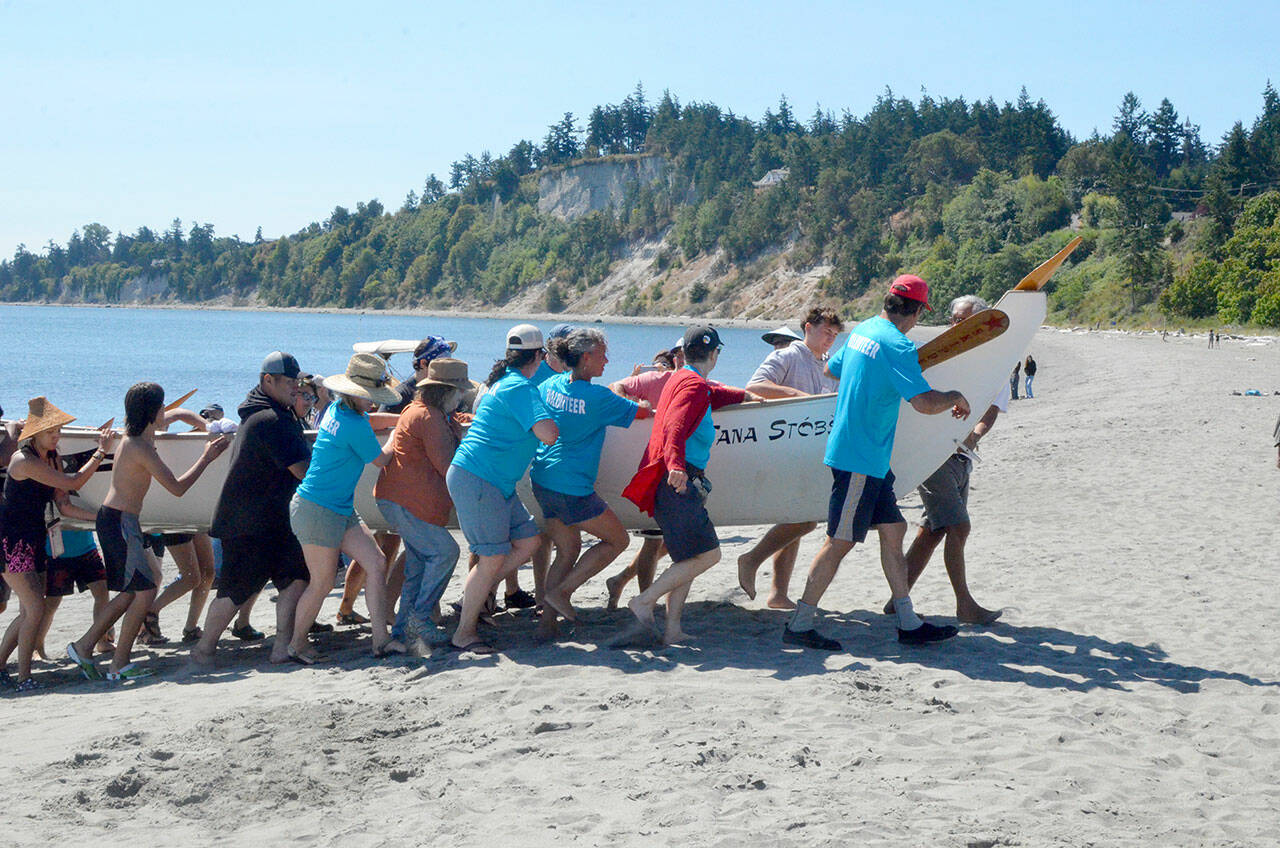
PORT TOWNSEND — Canoes from tribes across the region descended upon the beach at Fort Worden to connect with each other and keep traditions alive.
When the canoes arrive, they come to shore but do not land, said Jamestown S’Klallam elder Celeste Dybeck.
The captain will stand up, say their name and their tribe’s name, how long they’ve been pulling (or paddling), express that they are hungry and tired and request to come ashore, she said.
“Whoever is greeting will say, ‘Welcome, yes, we have food and drink,’ and welcome them to come to shore.”
The annual canoe journey is a way of keeping traditions alive, said Ricky Johnson, a Jamestown S’Klallam tribal council member.
“The federal government shut down all indigenous activity in the late 1800s and into the 1900s,” Dybeck said.
The tradition was revitalized in 1989 with the paddle to Seattle, she added.
“It’s been an annual event, every year, trying to resurrect our traditions, our highways,” Dybeck said. “We call the canoes our cars and the waterways our freeways.”
After the crew comes to shore, volunteers help to carry the canoe up the beach and come with white buckets to gather recycling and garbage from food.
A tent with water, fruit and snacks was set up on Tuesday to receive the pullers, who took shuttles to the Jefferson County Fairgrounds where they would spend the night. Crews and their support groups camp together each night.
“I always consider (the trip) like a longhouse mentality where we check in on each other, we figure out how people are doing,” Johnson said.
It’s like an ancient way of checking in on one another, Johnson said.
“I can imagine 1,000 years ago a big environmental catastrophe and or event where someone loses their fishing habitat, or some sort of river run, we would travel to different villages to check in on folks and bring them gifts or help them out in some sort of way.”
On Tuesday, the Jefferson County Fairgrounds were densely packed with campers. Beyond the paddlers, family members and friends travel and camp following the canoe trip’s itinerary.
On Thursday, canoes are expected to arrive at their final destination, the Elwha, where they will do protocol, have celebrations, share food and perform traditional dances for five or six days, Johnson said.
“Every tribe has a chance to perform and sing and dance,” Dybeck said.
“It’s a good chance for our youth and people who are looking to gain a good spiritual or cultural connection,” Johnson said.
When the canoes arrived at Port Gamble on Monday, some of the tribe’s youth welcomed them coming ashore in S’Klallam language, Dybeck said.
“Which is very impressive to see these little kids,” she said. “I got teary eyed.”
When he was 11, Johnson traveled with his mom, who was covering the paddle event as a videographer. That year, the event was hosted at Bella Bella, British Columbia.
Johnson and his mom traveled up the coast of Vancouver Island, welcoming pullers ashore and staying at bed and breakfasts.
“We listened to Rod Stewart. We were going 90 miles an hour on the highway because we didn’t realize it was kilometers per hour until halfway through the trip,” he said.
The trip stands out as a core or stackable memory, he said.
“I used to call them stackable memories because they lay the foundation for how you view people, how you view situations. It’s kind of the cultural lens through which you utilize your value system.”
Tribal youth attending the events will see respect toward elders, the respect that people show when they enter new territory, the generosity of volunteers, the way tribes participate in meals. They’ll see the songs and the dances, the drumming, the singing and the spiritual connections.
“All of these things are going to help guide them when they’re in their 20s, 30s and 40s,” Johnson said. “It’s just a really beautiful part of our culture.”
Joey Holmes, 15, was born in 2009 and pulled on the Tana Stobs, a family memorial boat with members from the Port Gamble and Suquamish tribes. The Tana Stobs pulled 22 nautical miles in about 4 1/2 miles, Holmes said.
“Suquamish hosted in 2009, I was born two months after that journey,” Holmes said. “2010 was in Neah Bay. I was almost a year old for that one. I’ve been going ever since.
“Our canoe family is named after the late Santana Ives. We’re a memorial canoe family. People do it to honor people who can’t paddle anymore.”
Ives was a Port Gamble S’Klallam tribal member, said Nic Armstrong, Ives’ brother.
“This canoe family has been together, this is its 25th year,” Armstrong said.
There will be a tribal dinner tonight at the Jamestown S’Klallam tribe’s pavilion, 1272 Jamestown Road. There will be several food trucks for elders who arrive early, Johnson said.
“The main meal will be seafood boils,” he said. “They’ll be potatoes, onions, carrots, crabs, halibut, shrimp, all boiled in. It’s going to be really good. They made enough for 2,500 people, I think.”
The event is open to the public. Food will be served to canoe crews and support crews starting at 5 p.m.
________
Reporter Elijah Sussman can be reached by email at elijah.sussman@sequimgazette.com.
