

PORT ANGELES — After a 1,700-mile journey around the Pacific Northwest, a totem pole has reached its final destination.
The “Bear-Becomes-Person” transformation totem pole arrived at the Elwha Tribal Center on Saturday, Lower Elwha Klallam Chairwoman Frances Charles said. The totem pole was carved by Master Carver Jewell James from the House of Tears Carvers, according to a press release.
“We’re really grateful and honored and humbled to receive it,” Charles said. “We’re thankful for the sharing of the knowledge and for taking the journey (James) had taken around the country. He made a big presence in all of the areas that we went. That was really something that was inspiring. The Master Carvers group really shares their knowledge and their abilities.”
The totem pole and its journey were to bring attention to the potential harms posed by the Trump administration’s plan to repeal the Roadless Rule, according to a press release.
The Roadless Rule “established prohibitions on road construction, road reconstruction and timber harvests on nearly 60 million acres of national forests and grasslands,” according to the U.S. Forest Service. “Today, the 2001 Roadless Rule pertains to nearly 45 million acres of national forests and grasslands.”
The movement of the totem pole was arranged by members of the Native-led conservation organization Se’Si’Le and was called “Xaalh and the Way of the Masks: Honoring the Spirit of the Lands, Waters, and Forests,” which was an “Indigenous-led event series and journey of ceremony, resistance, and restoration to protect forests, salmon habitat, and tribal sovereignty,” according to a press release.
“The ancient forests provide our people with sәla-exʷ, the strength that comes from the old ones,” James said in the press release. “They are integral to our ancestral cultural ways of knowing nature and our spiritual beliefs and practices.”
Charles said the tribe plans to raise the totem pole by their store. A date is to be determined.
The totem pole’s journey began Sept. 6 at Maritime Heritage Park in Bellingham.
From there, it traveled to a rally on the Capitol steps in Olympia, to the EcoTrust Building in Portland, Ore., to the Unitarian Universalist Church in Eugene, Ore., down to the Yurok Country Visitor Center Amphitheater in Klamath, Calif., then north to the Rockford Grange in Hood River, Ore., then to Chief Looking Glass Park in Asotin, Wash., and finally to Woodland Park Zoo in Seattle before its final stop behind the tribal center in Port Angeles.
The purpose of the campaign was to “bring attention to the emergent and urgent threats of the Trump Administration to indigenous lands, waters, forests, and lifeways in the Pacific Northwest,” according to se-si-le.org.
“More than 95 percent of the areas under the Roadless Rule are in 10 Western states, including roughly 2 million acres in Washington state and an additional 2 million acres in Oregon,” according to the Washington State Standard. “Washington lands protected by the Roadless Rule include forests around the edges of Olympic National Park and Mt. Rainier National Park, near Lake Quinault, Mt. Baker and Washington Pass, and much of the Kettle Range in northeast Washington.”
U.S. Secretary of Agriculture Brooke L. Rollings announced Aug. 27 that the U.S. Department of Agriculture had taken the next step in the rulemaking process for rescinding the 2001 Roadless Rule by opening a public comment period. The public comment period ended Sept. 19.
________
Reporter Emily Hanson can be reached by email at emily.hanson@peninsuladailynews.com.
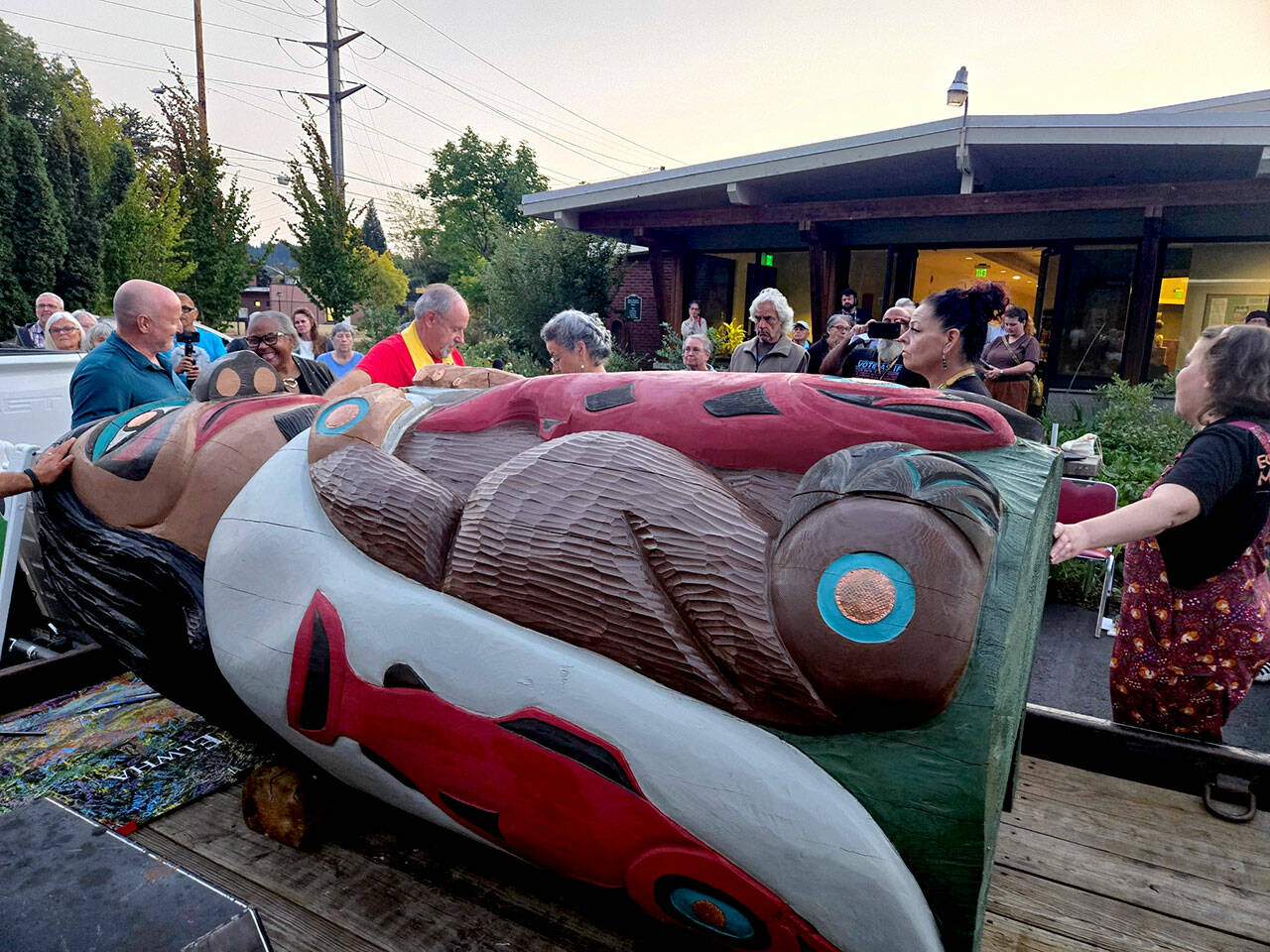
The “Bear-Becomes-Person” transformation totem pole is shown Sept. 6 at Maritime Heritage Park in Bellingham. (Se’Si’Le)
