
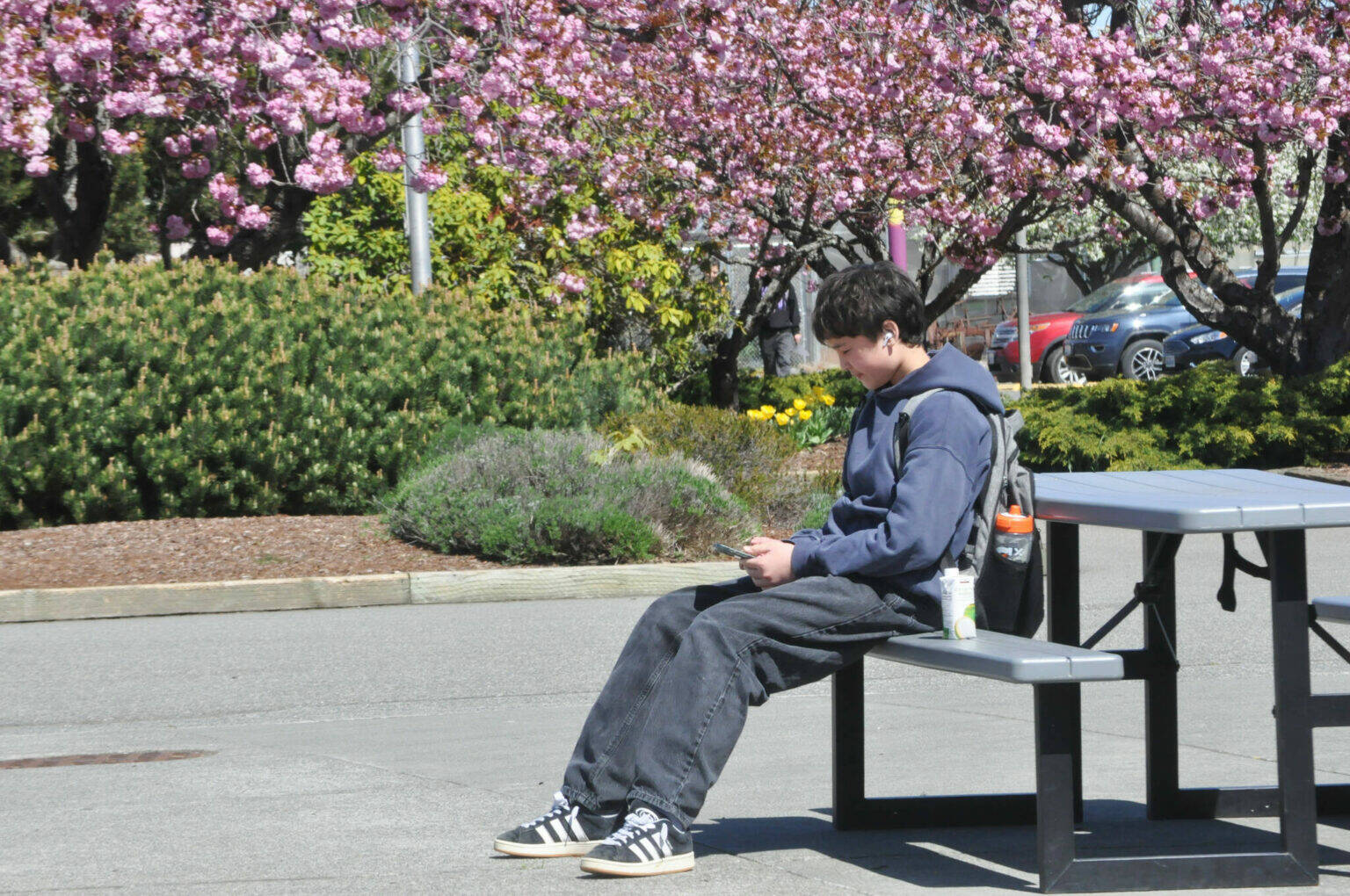
SEQUIM — The Sequim School Board received two surveys earlier this month from the district’s Balancing Technology and Learning surveys.
One was for district staff and the other for families.
The surveys were meant to examine the impact on classrooms and learning of students’ use of cell phones, smart watches and other personal devices.
A similar survey was distributed to students on Oct. 9. The results of that questionnaire will be discussed at 5:30 tonight at the district’s regular school board meeting.
Many school districts across the nation have been examining ways to address students’ use of cell phones and other electronic devices during school hours.
Last year, Sequim superintendent Regan Nickels told school board members that her staff would look into the issue with an eye toward a more firm approach for addressing student cellphone use.
The district currently has Policy 3245 and Procedure 3245a, commonly known as “Off and Away,” that address phones and other telecommunication devices.
According to the policy, “Telecommunication devices will be turned on and operated only before and after the regular school day and during the student’s lunch break, unless an emergency situation exists that involves imminent physical danger or a school administrator authorizes the student to use the device.”
The policy also states, “Students will not use telecommunication devices in a manner that poses a threat to academic integrity, disrupts the learning environment, or violates the privacy rights of others.”
Students who violate the policy may be subject to discipline, including possible expulsion.
When Nickels spoke of her plans to the board in September 2024, she recommended the school district conduct a survey.
In kicking off the discussion of the recently completed surveys on Oct. 6, Nickels said “there is nothing in the survey that’s meant to be necessarily decisive about our action. It’s supposed to be informative about what could come next.”
Among the key takeaways are that the majority of school district staff — more than 84 percent — said they are concerned that student device use is a distraction from learning. For their part, a majority of parents and guardians — almost 78 percent — indicated they would support a policy limiting or restricting device use at school.
Here are breakdowns from both surveys. Not every question is reflected here, but the full results can be found on the school district’s website, sequimschools.org.
Staff survey
The breakdown of staff who filled out the survey was Elementary (PreK-5), 47.27 percent; middle school (grades 6-8), 32.73 percent; and high school (grades 9-12), 36.36 percent.
Answers were provided by staff at Greywolf Elementary, Helen Haller Elementary, Olympic Peninsula Academy, Dungeness Virtual School, Sequim Middle School and Sequim High School.
The survey applied to cell phones, smartwatches or other wearable devices, tablets and personal laptops or chromebooks.
Of those surveyed, 67.5 percent indicated that students “often” bring cell phones to class.
Here are responses to most of the questions on the staff survey:
How effective is the current “Off and Away” policy in managing phone use in your classroom/area/bus?
Highly effective — 24.79 percent
Somewhat effective — 41.88 percent
Not effective — 12.82 percent
Unsure — 20.51 percent
Are you concerned about any of the following related to student device use? (Select all that apply)
Distraction from learning — 84.03 percent
Cyberbullying or social pressure — 68.91 percent
Safety and communication issues — 51.26 percent
Impact on social development — 78.99 percent
None of the above — 6.72 percent
In your experience, do personal devices benefit students in any of the following ways? (Select all that apply)
Staying organized — 26.05 percent
Social connections — 26.05 percent
Feeling safe — 21.01 percent
Communicating with family — 62.18 percent
Supporting learning activities — 33.61 percent
None of the above — 24.37 percent
Should students be allowed to use phones during class?
Yes — 11.57 percent
No — 71.90 percent
Unsure — 16.53 percent
Should students be allowed to use smart watches during class?
Yes — 5.88 percent
No — 73.95 percent
Unsure — 20.17 percent
Should elementary (K-5) students be allowed to use devices during lunch or recess?
Yes — 3.33 percent
No — 81.67 percent
Unsure — 15 percent
Should secondary (6-12) students be allowed to use devices during lunch or recess?
Yes — 47.11 percent
No — 34.71 percent
Unsure — 18.18 percent
Would you support a policy that limits or restricts student device use during the school day?
Yes — 86.78 percent
No — 3.31 percent
Unsure — 9.92 percent
Parts of the survey involved “themes” rather than respondent percentages. Here are some of those themes:
What are the most common distractions caused by phones in your classroom/area/bus?
Feedback themes:
Texting with friends and family members
Watching videos, scrolling social media and apps
Sharing content with other students
Sneaking games
Bathroom visits to go on phones
AirPod use
Phones and alarms ringing during class
Photos being taken
What does phone-related enforcement typically look like?
Feedback themes:
Constant reminders of Off and Away
Verbal warnings
Phones put away in pockets or backpack
Request to turn phones off
Reporting to office
Reminders to remove AirPods
What approach by administration helps you feel supported when enforcing the ‘Off and Away’ phone policy?
Feedback themes:
Being willing to confiscate phones
Communication with parents
Holding phones to end of day
Family education and communication of policy
Monitor bathrooms for out-of-class use
Prompt follow-up
Do you think students understand and exercise digital safety and responsible phone use? Why or why not?
Feedback themes:
Developmentally dependent
Too young to recognize or be aware of safety pitfalls
Addiction to screens overcomes the knowledge of safety
Family survey
Parents or guardians who participated in the family survey have students at Greywolf Elementary (13.19 percent), Helen Haller Elementary (19.61 percent), Olympic Peninsula Academy (8.56 percent), Sequim Middle School (23.71 percent) and Sequim High School (34.94 percent). Here are some of the questions that were asked, along with the breakdown of responses:
Does your child bring any of the following to school?
Cell phone — 50.27 percent
Smart watch or wearable device — 5.17 percent
Both — 4.99 percent
Neither — 39.47 percent
To your knowledge, how often does your child use devices during the day?
Never — 40.29 percent
Rarely — 25.67 percent
Sometimes — 18.72 percent
Often — 9.98 percent
I’m not sure — 5.35 percent
Are you concerned about any of the following related to your child’s device use? (Select all that apply)
Distraction from learning — 53.08 percent
Cyberbullying or social pressure — 41.15 percent
Safety and communication — 37.77 percent
None — 34.39 percent
Do you believe phones or smart watches help your child in any of the following ways? (Select all that apply)
Staying organized — 18.09 percent
Feeling safe — 42.35 percent
Communicating with family — 75.15 percent
None of the above — 23.66 percent
Should your child be allowed to use phones during class for educational purposes?
Yes — 27.63 percent
No — 56.26 percent
Unsure — 16.10 percent
Should your child be allowed to use phones during class for communication?
Yes — 19.80 percent
No — 67.40 percent
Unsure — 12.72 percent
Should your child be allowed to use smart watches during class for communication?
Yes — 18.09 percent
No — 68.59 percent
Unsure — 13.32 percent
Should secondary (6th-12th) students be allowed to use devices during lunch or recess?
Yes — 56.06 percent
No — 33.60 percent
Unsure — 10.34 percent
Would you support a policy that limits or restricts device use during the school day?
Yes — 77.73 percent
No — 9.15 percent
Unsure — 13.12 percent
In response to the survey’s question about what they would like the school district to consider when updating its device policy, the following themes emerged:
Consider the research
Limit cell phone use in schools
Use modes: airplane or school modes
Allow parent contact for emergencies
Tiered policy by age group
Help teachers not to have to police this alone
________
Kathy Cruz is the editor of the Sequim Gazette of the Olympic Peninsula News Group, which also is composed of other Sound Publishing newspapers Peninsula Daily News and Forks Forum. She can be reached by email at kathy.cruz@sequimgazette.com.
