
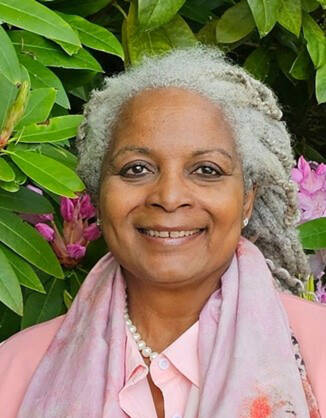
PORT ANGELES — Clallam County Public Utility District commissioner Phyllis Bernard urged residents and business leaders to take a more active role in shaping the county’s power future, saying public participation is essential as the PUD plans long-term investments and prepares for regional electricity challenges.
Bernard, who spoke Tuesday at the Port Angeles Business Association meeting at Jazzy Joshua’s, said community involvement is important as the utility faces higher costs, escalating demand, rural vulnerabilities and state-level directives that often don’t reflect local conditions.
Bernard, who joined the board in 2024 and has decades of experience in regional grid governance, spent much of her presentation explaining how the Northwest grid works, how close it already operates to its margins and how those dynamics affect Clallam County.
She said the county’s position at the end of the Bonneville Power Administration transmission system leave it exposed when weather, equipment failures or regional imbalances strain the grid.
Bernard said one of the PUD’s continuing challenges is that state agencies and the Legislature designed energy policy around the needs of the Interstate 5 corridor. Many lawmakers didn’t understand rural realities, she said, such as long-distance transmission and limited backup.
While urban areas typically experience brief power outages, she noted that residents in rural areas — particularly those who live on the West End — routinely endure days or even weeks without electricity when storms or fallen trees take out transmission lines.
“They completely do not get it,” she said.
Bernard said the electrical grid must maintain an almost perfect balance between generation and load, a tolerance that has markedly narrowed. If the region slips too far out of balance, it risks brownouts, unplanned blackouts or, in worst cases, cascading outages that could spread across the West Coast.
She noted that Clallam County’s electric system is closely linked to Canada’s, since both countries operate on the same transmission network and depend on one another to keep the regional grid in balance.
“We have a responsibility to make sure the system continues to work,” she said.
Bernard also framed the county’s challenges within the broader history of public power, noting that Washington’s PUDs were created because private utilities bypassed rural communities, leaving residents to fend for themselves. She said that dynamic persists today in the form of private equity firms looking to acquire vulnerable water and utility systems.
“They come in and they will tell people, ‘The public can’t do anything right,’” she said, adding that such promises often give way to steep rate increases.
Bernard walked through several elements of the PUD’s 2026 budget, including rising personnel costs, the higher price of transformers and other grid materials and long lead times required to procure equipment.
The PUD’s cost-of-service analysis — completed by an outside consultant — recommended a 3.75 percent electric rate increase for 2026. Bernard said the increase was lower than the PUD’s “pass-through” cost pressures from the Bonneville Power Administration, which she said were increasing at 5 percent or more.
Bernard pointed to $4.9 million in grid-resilience grants and the need to improve aging water and wastewater systems that date to the 1940s, ’50s and ’60s. She said upgrades in those systems are among the PUD’s most significant long-term vulnerabilities.
One of the PUD’s major ongoing interests, Bernard said, is investigating the feasibility of building local power generation so the county would be less dependent on the long transmission corridor from Shelton. Any decisions would require broad public input.
Bernard urged residents to follow the PUD commissioner meetings online and encouraged them to attend informal commissioner coffee sessions — posted as public meetings — to ask questions and offer feedback.
“This is your public utility district,” she said. “We answer to you.”
Bernard said economic stability, healthcare access, communications and basic safety all depend on reliable electricity — and that rural communities have to work together to protect it.
“We are all in this together,” she said.
The PUD will hold a hearing at 1:30 p.m. Monday at 104 Hooker Road in Sequim, regarding a proposed change to district elections. The meeting also can be accessed via Zoom.
________
Reporter Paula Hunt can be reached by email at paula.hunt@peninsuladailynews.com.
