
PORT TOWNSEND — Part one of a special city council meeting saw the city of Port Townsend heavily criticized for its approach to the removal of a homeless encampment, planned for Monday.
Later in the evening, council members passed a temporary ordinance which will allow city staff to expedite permits that relate to sanctioned encampments.
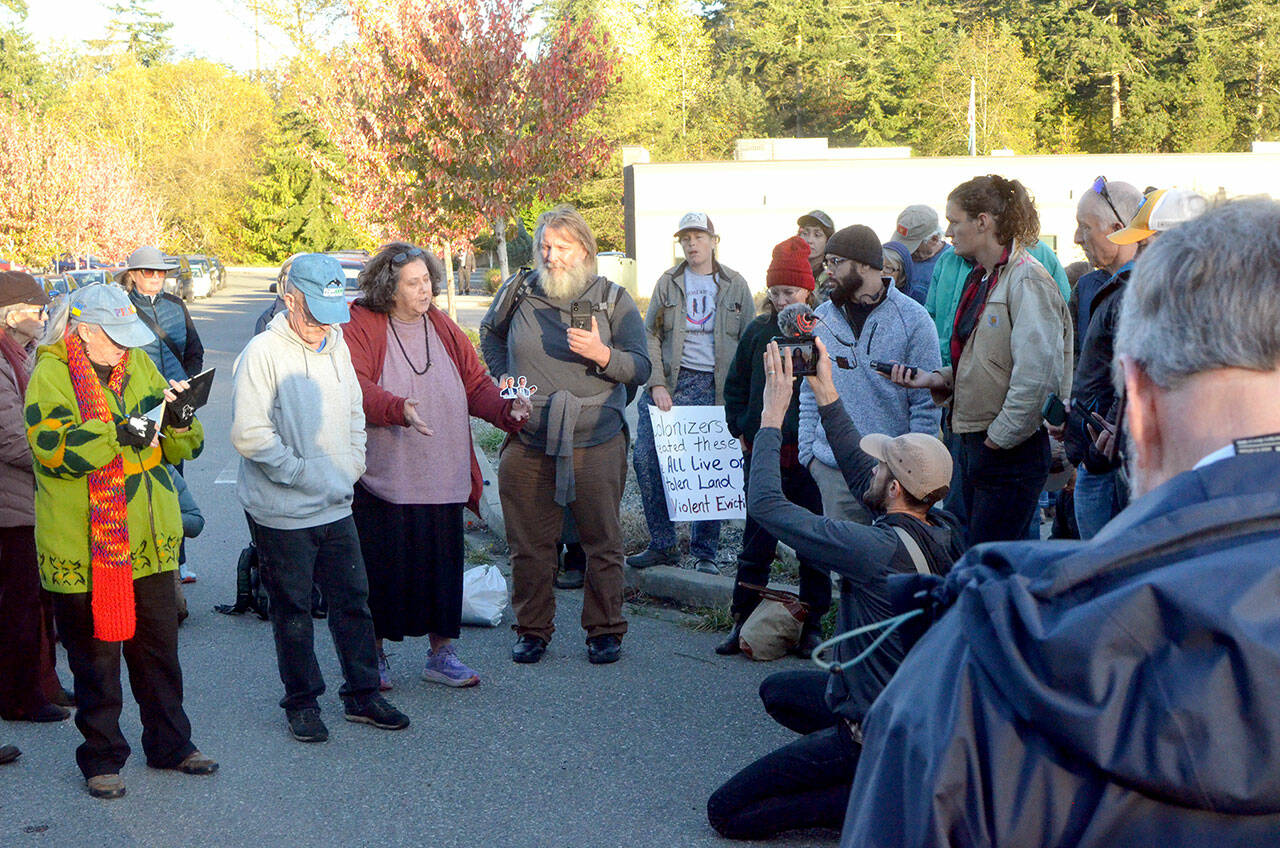
A group of more than 50 city staff, city council members, service providers and community members, including at least one member of the encampment, gathered at the cul de sac at the end of Evans Vista on Monday afternoon.
Police Chief Thomas Olsen introduced service providers, who shared quick recaps on their relationship to the encampment as well as any plans to support the residents moving forward.
Among the service providers were Bayside Housing and Services Executive Director Gary Keister, Discovery Behavioral Healthcare’s Chief Operating Officer Jessica MacKinnon, with members of the REAL Team and Jefferson County Public Health Director Apple Martine.
Blanchard Alice of Port Townsend addressed the group, saying she was shocked by the level of ignorance with which the homelessness issue was being addressed.
“Why are we having this meeting over here when everyone’s over there?” Alice asked.
Jefferson County Public Health Community Health Educator Anya Callahan responded, saying she invited the residents before the meeting and that they expressed not feeling safe or welcome to be a part of the meeting.
“I have relationships with people over there,” Callahan said. “After this meeting, I’m going to relay what we talked about here. But this isn’t a time to go parade through people’s homes.”
The fact that the residents did not feel comfortable attending the meeting was a disturbing point that those hosting the meeting seemed to miss, Alice said in a telephone interview Tuesday.
At the meeting, Alice shared that she had previous experience with homelessness in Port Townsend and requested a show of hands, asking who in attendance had experienced homelessness for a significant amount of time.
A significant number of hands were lifted.
David Griffiths, who addressed the group Monday, is now a Jefferson County homeowner through what he calls a string of what seemed like miracles.
In a phone interview, Griffiths said he has been diagnosed with arthrogryposis, a congenital neuromuscular condition which affected the development of his joints. He has experienced homelessness multiple times in his adult life since his parents basically kicked him out of their house more than 30 years ago, he said.
“I was put out into the world, totally unprepared for life in the real world as an adult, especially an adult with a disability,” Griffiths said. “There were no support services, at least not that I was aware of at the time.”
Griffiths lived in shelters on and off until 10 years ago when, as he lived in Portland, Ore., he spent the whole winter outside.
“These are the people that you should be listening to,” Alice said.
Alice shared some about her experience with homelessness with the group.
“I cannot explain to you what it feels like to be homeless in this town,” Alice said. “I used to walk around here and I cannot explain to you how desperate I was to just live in someone’s shed. To have anyone notice me and not just see right through me.”
Alice, who said she has experienced homelessness multiple times, is a business owner and a hard worker. Her experience happened while she was working 80 hours a week, she said.
“This town eats people alive,” she said.
The sweep of the DSHS encampment, set for Monday pending a preliminary injunction hearing at 1 p.m. Friday in Jefferson County Superior Court, likely would ruin people’s lives and could kill some, Alice said.
“We’re talking about murder,” she said. “We are knowingly doing something with a predictable outcome.”
Many in the group applauded that point.
Comments continued in support of extending the city’s timeline until a suitable alternative can be prepared.
A break was called by Mayor David Faber as a second portion of the meeting was planned for 6 p.m. in council chambers on Water Street.
That’s where Emma Bolin, the city’s director of planning and community development presented the council with an ordinance which would temporarily help to expedite permitting timelines for permits related to sanctioned encampments.
Changes made to Port Townsend Municipal Code (PTMC) 17.62 subbed all references to permit process types — outlined in PTMC 20.01 — with process type 1A.
“A type 1A would not require a public hearing,” Bolin said. “It is administrative. It does not require public comment. Language requiring a ‘Good Neighbor’ presentation to city council has been struck as well. It also will limit appeal rights. The only appeal rights are with the applicant.”
The city retains the right to modify, withdraw or revoke permits if there is non-compliance, Bolin said.
Faber acknowledged that passing the ordinance could lead to others in the community coming in numbers to city council if or when an encampment is permitted in their neighborhood, but he said it’s a risk he is willing to take.
The majority of public comment addressed the timeline for the encampment’s removal.
“I only have one question, two words: Why now?” asked Pat Keaty of Port Townsend. “Why not several months ago? Why not four months from now? Why are we doing this now with the weather changing the way it is? I understand about safety and hygiene, but if we’re not able to help with that, it’s more a comment about the city than it is the people who are living in that encampment.”
Keaty said he doesn’t buy the city’s messaging around the move being compassionate, adding that warmer weather months would be better timing for the transition.
Kiester said in public comment that he saw passing the ordinance as an important step which would allow an added capacity of four to six additional residents for the Bayside-managed Pat’s Place.
Kiester also noted that an additional five beds for males and three for females would be made available as the cold weather encroaches.
Further, the organization is contemplating expanding its capacity in Port Hadlock locations by 12 to 14 beds.
In a phone interview Tuesday, Kiester said the organization was expecting to submit an application with the city Tuesday or today for the Pat’s Place expansion, which would only be temporary, as construction on two 32-unit apartment buildings is planned to break ground on the property in six months.
At an Emergency Shelter Coalition Meeting, Callahan said Bayside Housing and Services housing options outside of the city were unlikely to appeal to residents of the encampment.
“Also, I don’t know if one person is going to trust the Bayside name because I know people living out there now who have already been evicted from your establishment for using substances or for not following behavioral guidelines,” Callahan said. “I am so in support of this as an option and I’m cheering you on and I want it to work, and I want to help you develop policies for people who are active in substance use and this is not an option for everybody.”
Kiester said Bayside does not allow substance use at its establishments, but if someone comes in high, they are welcome, so long as their behaviors do not pose a threat to staff or fellow inhabitants.
Bolin said in a phone interview Tuesday that city leaders agreed that proactive, not reactive, measures were needed due to unsafe conditions present at the encampment.
Between the conversation at the Evans Vista cul de sac, comments given at council chambers and the 14 written comments submitted for the meeting, many people acknowledged that the location is less than ideal for safety and sanitation, but opposed the decision to move people without a suitable alternative.
Over the course of the last year, East Jefferson Fire Rescue has been to the site to put out five fires, including one on Sunday, Community Risk Manager Robert Wittenberg said.
“Generally they tend to be smaller campfires that, as we arrive, are just kind of smoldering, which don’t take much to extinguish,” Wittenberg said. “None of them have actually spread or caused significant damage.”
Unreported fires involving some of the tents have been indicated in the location as well, he added.
While ingress and egress is important for emergency response vehicles access, the location, which is on a utility easement, has been sufficiently accessible for the fire agency.
Of the 31 people identified as residents of the encampment, 24 have left since the removal was announced in September, leaving seven in the encampment, according to Viola Ware, Olympic Community Action Programs’ director of housing and community development.
“That we know of, four have been placed so far,” Ware said.
Ware said 260 households — some families and couples — have been identified as experiencing homelessness in Jefferson County.
________
Reporter Elijah Sussman can be reached by email at elijah.sussman@peninsuladailynews.com
