
PORT TOWNSEND — The state Department of Natural Resources awarded the city of Port Townsend about $350,000 to restore two parks, part of a larger effort to increase tree cover in urban settings.
DNR is allocating $8 million statewide to plant trees, remove invasive species and work to improve tree canopy cover in urban areas using funds from the state Climate Commitment Act and the federal Inflation Reduction Act.
DNR’s Urban and Community Forestry Grant Program’s previous single-year record for funding was $550,000 statewide, but the department is making an effort to address urban forests as well as rural ones, said Hilary Franz, the state commissioner of public lands who was in Port Townsend on Tuesday to visit one of the parks that will benefit from the grant.
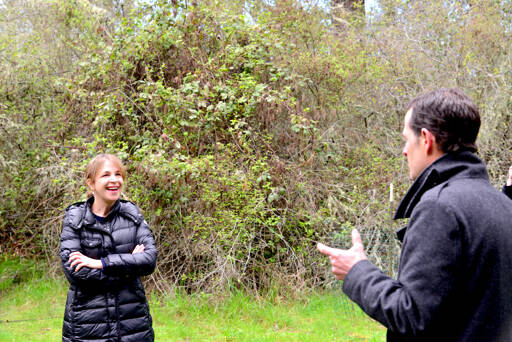
“Most people don’t know that heat is our nation’s deadliest weather disaster right now,” Franz said during a visit to Sather Park with city officials and local volunteers. “We remember the 2021 heat dome, and it’s going to keep going.”
According to the University of Washington, the 2021 heat dome set 128 all-time high-temperature records statewide and killed 126 people. But neighborhoods with adequate tree canopy can be as much as 14 degrees Fahrenheit cooler during heat events, DNR said.
The urban forestry program is meant to plant new trees to create additional canopy and restore areas where the canopy may be declining. That’s the case in Sather Park, where many of the trees are infected with laminated root rot, a disease that causes root systems to decay and trees to die prematurely.
The grant, which will be spread out over three years, will pay to plant 75 trees per year, said Bre Ganne, lead parks operator for the city’s parks, recreation and community services department, as well as fund vegetation removal, planting of native species and irrigation.
Without the grant, restoration work would be a part of the parks department’s general budget.
”We don’t have any capital funds for restoring,” Ganne said. “There’s tons of deferred maintenance. We just have a very small budget for operating all of the parks.”
Port Townsend’s grant, a total of $349,350, will be split between Sather Park and Bishop Park, the city’s two largest forested parks.
The neighborhood around Sather Park has committed significant volunteer hours to removing invasive species and brush from the area, but that’s not the case for Bishop Park, where plant removal work still needs to be done.
DNR received 122 applications for the urban forestry grants, with requests totaling more than $23.5 million, but the department selected only 45 recipients, including Port Townsend.
Franz said the department looked at several things when choosing applicants, including factors such as community engagement.
Sather Park is within walking distance of Port Townsend High School and the Port Townsend School District has an interest in augmenting its environmental science, statistics and math curriculums with a unit on environmental justice and equity with field-work experience. Students from the high school already have completed projects on tree inventory and soil samples.
There are no current plans to have the grant program funded at this level in the near future, but Franz said state, local and federal governments need to see the value of urban forestry, and programs like Washington’s could demonstrate the projects’ worthiness.
“We need the federal government to continue to see the value of this and part of that, it’s our job to prove its value,” Franz said. “It’s not only helping the environment, but it is also helping the health of communities, whether it’s heat or physcial and mental and emotional health.”
________
Reporter Peter Segall can be reached at peter.segall@peninsuladailynews.com.
