
By Gillian Flaccus
The Associated Press
THE DALLES, Ore. — Two prominent Pacific Northwest tribes said Monday the U.S. government needs to remove three major hydroelectric dams on the Columbia River to save migrating salmon and starving orcas and restore traditional fishing sites that were guaranteed to the tribes in a treaty more than 150 years ago.
The Yakama Nation and the Lummi Nation made the demand on Indigenous Peoples Day, a designation that’s part of a trend to move away from a day honoring Christopher Columbus.
Tribal leaders said at a news conference along the Columbia River that the Treaty of 1855, in which 14 tribes and bands ceded 11.5 million acres to the United States, was based on the inaccurate belief that the U.S. had a right to take the land because of a Christian mandate.
Under the treaty, the Yakama Tribe retained the right to fish at all their traditional sites. But the construction of the massive concrete dams along the lower Columbia River between the 1930s and 1960s to generate power for a booming non-native population destroyed critical fishing spots and made it impossible for salmon to complete their migration.
“The Columbia River dams were built on this false legal foundation and decimated the Yakama Nation’s fisheries, traditional foods and culture sites,” Yakama Nation Chairman JoDe Goudy said near the site of now-vanished Celilo Falls near The Dalles, Ore.
Celilo Falls was a traditional salmon-fishing site for the Yakama for centuries, but it was swallowed by the river in 1957 after the construction of Dalles Dam.
There have been calls by environmentalists and others over the years to remove Columbia River dams, an idea opposed by agricultural and business interests.
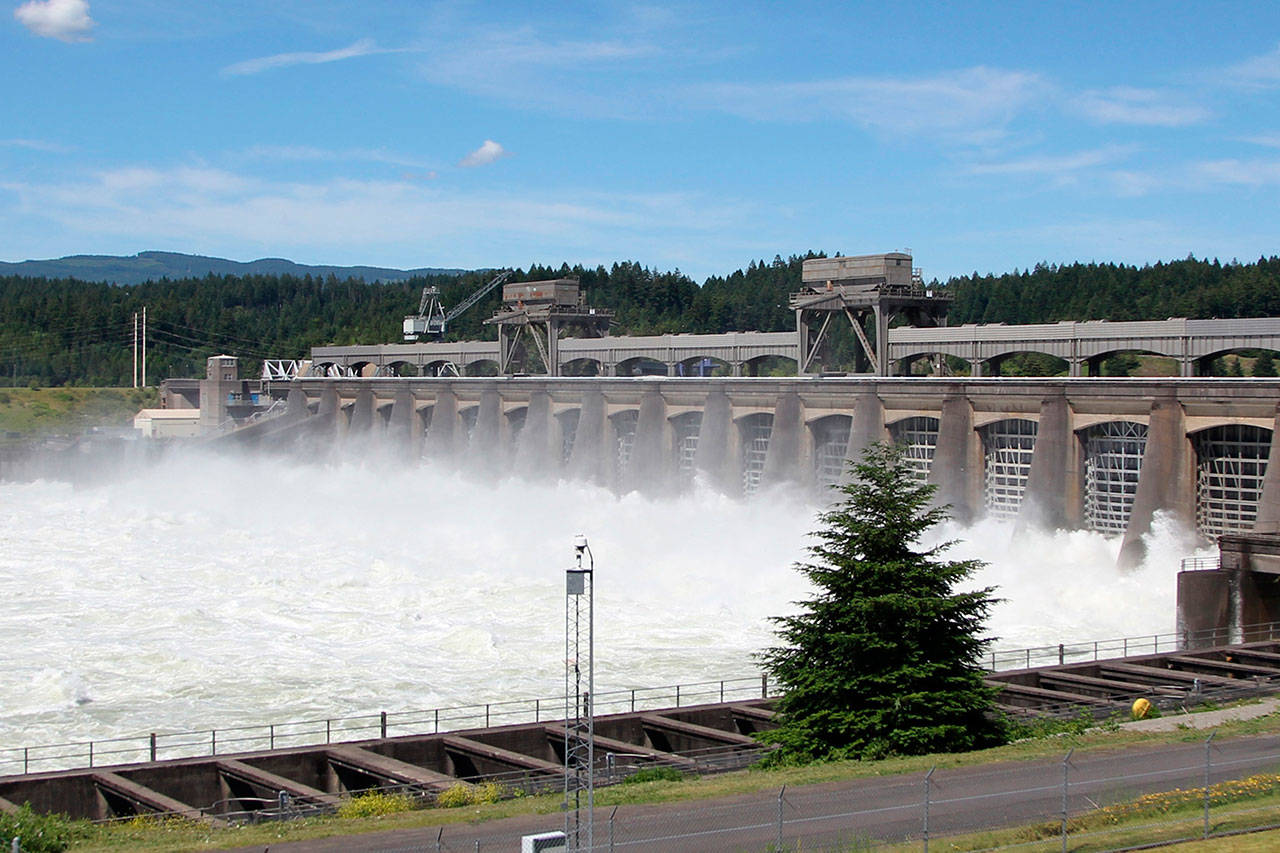
The three dams operated by the U.S. Army Corps of Engineers are a critical part of a complex hydroelectric network strung along the Columbia and Snake rivers in Washington, Oregon and Idaho that powers the entire region.
Government officials were unavailable for further comment Monday due to the holiday.
The Lummi Nation is located in northwestern Washington state, far from the Columbia River, but it has also been touched by construction of the dams, said Jeremiah Julius, Lummi Nation chairman.
Chinook salmon are the preferred prey of endangered orcas but just about 70 orcas remain in the Pacific Northwest — the lowest number in three decades — because of a lack of chinook, as well as toxic contamination and vessel noise. The orcas were hunted for generations by the Lummi Nation in the Salish Sea for food, he said.
“We are in a constant battle … to leave future generations a lifeway promised our ancestors 164 years ago, he said. “Our people understand that the salmon, like the orca, are the miner’s canary for the health of the Salish Sea and for all its children.”
The Bonneville Dam was constructed in the mid-1930s and generates enough electricity to power about 900,000 homes — roughly the size of Portland, Ore. Dalles Dam followed in the 1950s and John Day Dam was constructed in the 1960s.
Environmental groups applauded the tribes’ demand and said efforts to save salmon without removing the dams aren’t working because without the free flow of the Columbia, the entire river ecosystem is out of balance.
“The stagnant reservoirs behind the dams create dangerously hot water, and climate change is pushing the river over the edge. Year after year, the river gets hotter,” said Brett VandenHeuvel, executive director for the nonprofit group Columbia Riverkeeper. “The system is broken, but we can fix it.”
Fish ladders built into the dams allow for the passage of migrating salmon and migrating fish are hand-counted as they pass through. But the number of salmon making the arduous journey to the Pacific Ocean and back to their natal streams has declined steeply in recent decades.
The Columbia River Basin once produced between 10 million and 16 million salmon a year. Now there are about 1 million a year.
