
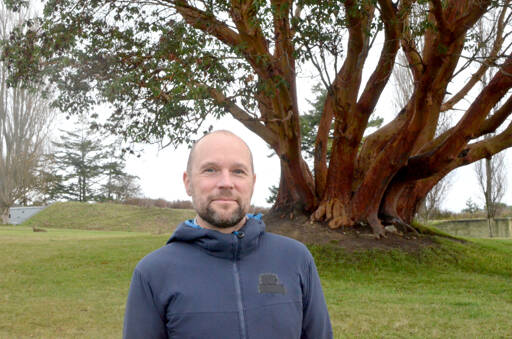
PORT TOWNSEND — Erik Kingfisher received the 2025 Eleanor Stopps Environmental Leadership award at the Port Townsend Marine Science Center’s annual stewardship breakfast Tuesday.
Kingfisher is Jefferson Land Trust’s Director of Stewardship and Resilience. Presenting him the award was Nan Evans, a former land trust board member.
Addressing the full room of attendees at the Fort Worden Commons, Evans said she remembered hearing Kingfisher speak at a similar breakfast for the land trust years ago.
At the event, Kingfisher reflected on the “think globally, act locally” adage and extended it, Evans said.
“I coined that phrase ‘Think forever, act now’ as a parallel to ‘think locally, act globally,” Kingfisher said in an interview following the breakfast. “Both of those things are nice umbrella frameworks for what I’ve chosen to dedicate my professional life to, this conservation work.”
In her remarks announcing Kingfisher’s award, Evans noted a few of his accomplishments: Kingfisher designed a natural history course called ‘Tidelands to Timberline’, he was a persistent and driving force behind the realization of the Chimacum Ridge Community Forest and in partnership with North Olympic Land Trust, he spearheaded a Geographical Information Systems (GIS) project aimed at identifying land across the North Olympic Peninsula which is expected to retain its ecological value through the effects of climate change on the Peninsula.
Kingfisher’s class, which takes place on nine full Fridays every Spring, has become so popular that a lottery is required to dole out the opportunities to participate. Sign-ups for the lottery start in December and participants are pulled in January. The class itself starts up in late April.
The course is an opportunity to connect people to the plants, animals, fungi and geology of the Peninsula.
“We start in the marine environment and work our way all the way up to the subalpine,” Kingfisher said.
Kingfisher continues to lead the course with Heather Harding and Dave Rugh, as well as several volunteer naturalists.
The first class takes place on the water and includes a trip around Protection Island. Subsequent classes take place on rocky, sandy and high bluff shorelines, in rainshadow forests, on prairies, at riparian areas near rivers and lakes, in the temperate rainforest of East Jefferson County and in the Montane forests of the peninsula. The final class takes place at Hurricane Ridge.
Kingfisher devoted thousands and thousands of hours to seeing the Chimacum Ridge Community Forest through to the resource it is now, he said. He identifies deeply with the project, which he is by design no longer heavily involved with, he said.
“I feel really grateful for it,” he said.
With the many challenges that face society, Kingfisher said he appreciates that his work is on a community level. Seeing people connect to permanently protected land is meaningful, but it’s also necessary, he said.
“It’s going to take all of us to take care of (these lands) over time,” he said.
Growing up in nature
Kingfisher grew up in the Woodinville and Duvall areas as well as on Whidbey Island.
“I spent a lot of time in the woods and on the water, tidepooling and stuff like that,” he said.
He was, by his nature, drawn into the landscape, feeling connected to it from a young age, he said.
He studied environmental education, focusing on natural history, at Western Washington University (WWU).
Starting in 1999, he worked as an interpretative ranger at Olympic National Park for a few years, where he devoted extensive efforts to honing in on his understanding of natural history.
Often, he would share drives up to Hurricane Ridge with his supervisor Janice Berger, who he called one of the best naturalists he’s ever met. The two would spend every minute in the car talking mostly about natural history, he said.
“Describing what we see and what we know and understand about the National Park or the Olympic Mountains,” he continued. “I learned a ton from her.”
Following working at the park, Kingfisher began working at Olympic Park Institute, now Nature Bridge, where he continued to study natural history, and as much as he could, he would host field seminars and teach classes to youth.
After 2½ years, Kingfisher decided to pursue his master’s degree.
“I knew I didn’t want to be an educator full time for the rest of my life,” Kingfisher said. “I wanted to learn about the way the world works and how we were going to try to turn the tide in this trajectory we’re in with biodiversity loss and climate change.”
In graduate school at Keele University in England, Kingfisher got a master’s degree in environmental politics. He thought he would join many of his peers in bringing expertise and direction to international dialogue between nations on stewardship and conservation.
Kingfisher learned about some of what was happening at the macro level, which he called valuable.
“I was also seeing some of that not working on the ground,” Kingfisher said.
His thoughts were consistently turned back to something he had first learned about towards the end of his undergraduate studies at WWU, local and regional land trusts.
Whatcom Land Trust had partnered WWU to protect 2,200 acres at Canyon Lake Community Forest, he said.
“I couldn’t believe that that was permanently protected and it was private land,” Kingfisher said.
Kingfisher ended up framing his dissertation on the transformative potential of conservation trusts.
“I came to this work pretty deliberately,” Kingfisher said.
In Arcata, Calif., Kingfisher worked at North Coast Regional Land Trust, where he started doing his conservation work, before joining Jefferson Land Trust in 2008.
The land trust, which conserves land for a number of ecological values, has preserved over 18,000 acres of Jefferson County land in perpetuity. The protection takes place through conservation easements and agricultural easements on privately owned land, purchasing or receiving gifted land, which the trust owns and manages, or through facilitating protections on land it is no longer directly involved with.
The trust holds about 71 easements, owns around 30 properties and has facilitated protections on about 12,000 acres of now-public land, Kingfisher said.
Since joining the trust, Kingfisher has been involved in all of the conservation projects, he said.
“Land trusts are really doing something that I believe in, that I believe will make a difference for future generations,” Kingfisher said. “It’s so durable and it’s creating a ripple effect through our communities, the culture of our communities and our relationship to the land.”
________
Reporter Elijah Sussman can be reached by email at elijah.sussman@peninsuladailynews.com
