
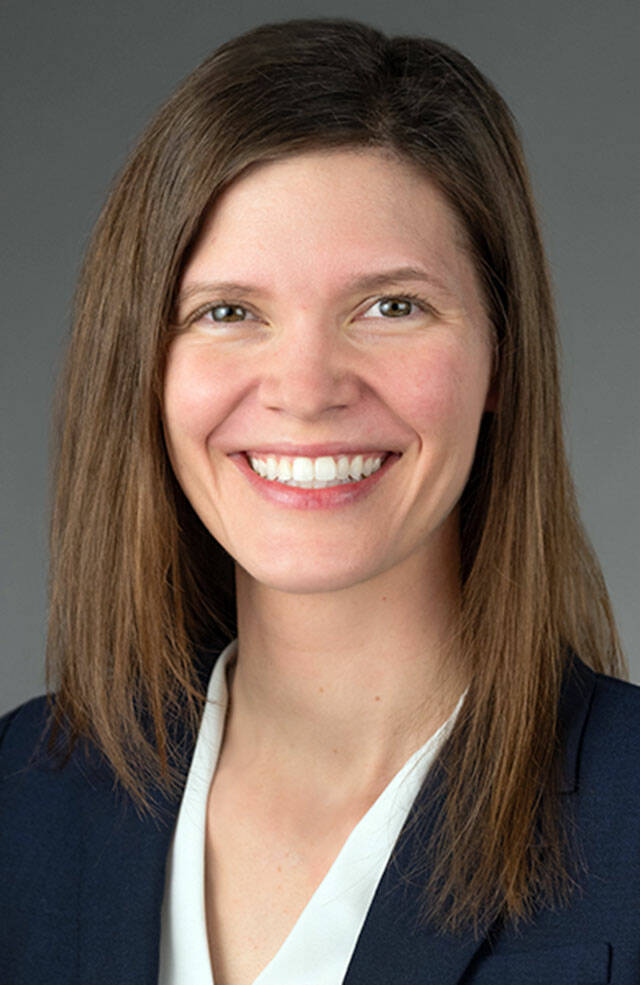
PORT TOWNSEND — Jefferson Healthcare has hired Dr. Sabrina Prime to lead its new radiation oncology department.
Prime, a board-certified radiation oncologist, said her interest in working with cancer patients became clear early on in her medical training.
“I wanted to work with patients that were recently diagnosed with cancer or had been dealing with the cancer diagnosis for a period of time,” Prime said. “In those visits, time slowed down for me. I just love to hear their stories and where they were at with things emotionally.”
Prime brought those patients’ stories home with her, thinking about them for days, weeks and months, she said.
“Since I’ve left my residency institution, I haven’t gathered a new set of patients to foster and watch along the way, but that’s just a very special interaction,” Prime said.
The department will start seeing patients in October, Prime said.
Having identified her interest in working with cancer patients, Prime said she thought she would pursue becoming a medical oncologist, as most medical students interested in working with cancer patients do.
Prime called her exposure to radiation oncology serendipitous. She worked with an intern who was going into radiation oncology, who encouraged her to consider the specialty.
Upon researching the field, she found it was an amalgam of things she loved: Close interactions with patients and creating treatment plans that are individualized to patients.
Where someone’s chemotherapy treatment might look very much the same regardless of the hospital, practitioner or patient, radiation is more customized depending on the patient and the practitioner, Prime said.
“A lot of people, I think, are confused and think that we are radiologists,” she said. “We do use imaging a lot, but it’s a different training pathway for us. It’s very artful and it’s actually very much like surgery.”
Prime’s work starts with an initial consultation to determine whether radiation is appropriate for a patient’s diagnosis. If treatment is appropriate, she collaborates with a team that includes a nurse lead and radiation therapists, who perform a CT simulation — a planning scan that maps the patient’s unique anatomy to help design a precise, focal treatment plan.
The scan is uploaded to a radiation planning system, where a dosimetrist develops treatment angles and dose distributions for the hospital’s new linear accelerator (LINAC) machine, which delivers targeted, high-dose X-rays to the tumor.
Prime reviews and refines the plan to ensure it delivers the correct biological dose while protecting healthy organs.
“I look at it from a biological perspective,” Prime said. “We have a lot of information about what normal organs can tolerate from a radiation dose perspective.”
Medical physicists have the job of making sure the machine is delivering the plan she intends it to deliver, Prime said.
Once the plan is finalized, the LINAC is operated by radiation therapists to administer the treatment.
Patients often will have daily treatments, Monday through Friday, which can range from 15 to 45 minutes, Prime said. Those treatments can go for as long as 7 1/2 weeks, she added.
Prime said the standard-setting National Comprehensive Cancer Network (NCCN) is working on making courses shorter.
“It’s called hypo-fractionation,” she said. “For a lot of different treatment sites, we’re working towards getting them fewer and fewer fractions. Each radiation treatment is called a fraction.”
Prime said she knows the added challenge that some rural patients face in receiving radiation when they have to travel or relocate for their treatments.
The opportunity to serve a small community in a way that feels impactful was appealing to Prime as she considered job opportunities.
Prime grew up in Fergus Falls, a small town in Minnesota which she said shares similarities to Port Townsend.
Prime said her mom worked in dialysis as a licensed practical nurse at the local hospital.
“That actually got sold off to another entity as she worked for the hospital,” she said. “I think that that travel piece is something that I recognized very early on in my exposure to radiation oncology.”
Because Jefferson Healthcare (JHC) is relatively small and serving a small community, her position would allow her to work on a wide range of cancers, an attractive opportunity for Prime.
Prime’s department will be able to treat upwards of 90 percent of cancers that are expected to occur in the local population, she said.
“The range is really, really vast that we’re going to be able to treat,” Prime said. “Will have the capability of treating kind of head to toe, oncologic everything.”
The LINAC machine can treat brain metastases, head and neck cancers, breast cancer, pancreatic cancer, colorectal cancer, anal cancer, skin cancer, gynecologic cancers and thoracic cancers such as esophageal and lung cancers.
Prime noted that sarcomas are better treated in academic institutions.
While the LINAC machine could probably run for 12 to 16 hours a day, the department will likely treat a maximum of 25 to 30 patients a day, Prime said.
Prime completed her medical degree at the University of North Carolina School of Medicine and trained in radiation oncology at Washington University in St. Louis, Mo.
JHC will host a public ribbon-cutting celebration at 2 p.m. Aug. 24 for the opening of its new building. The event will include tours of the new wing, including the radiation oncology department.
In addition to expanding its radiation oncology services, the 56,000-square-foot expansion will bring new offerings to JHC, including a new MRI suite, expanded OB/GYN care, and new clinics for dermatology, hand and plastic surgery and wound care.
________
Reporter Elijah Sussman can be reached by email at elijah.sussman@sequimgazette.com.
