
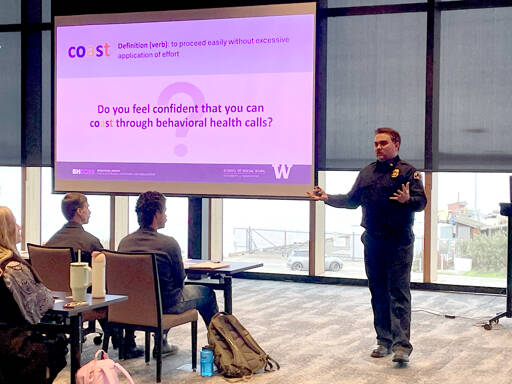
PORT ANGELES — Nearly two dozen emergency medical technicians and other first responders gathered at Field Arts & Events Hall for a daylong course aimed at strengthening their response to mental health and overdose incidents — and to their own and their fellow workers’ well-being.
The training — called COAST: A Roadmap for Fire/EMS — was sponsored by the Port Angeles Fire Department to help its workforce and those new to the field better manage crisis calls that are rising in number and complexity.
Port Angeles was one of nine agencies in the state awarded a behavioral health innovation grant funded through the state Health Care Authority and administered by the University of Washington School of Social Work’s Behavioral Health Crisis Outreach Response and Education — known as BHCore.
The department received $350,000 to develop an overdose response system and expand co-response partnerships with neighboring agencies. The grant also funded two COAST training seminars, two of the department’s four community paramedics and a utility terrain vehicle designed to reach patients in off-road or otherwise difficult-to-access areas.
Monday’s was the second PAFD-supported COAST training. The first, held in earlier this year, drew more than 30 first responders from 12 agencies in Clallam, Jefferson, Kitsap and Mason counties.
The training was intended to address a long-standing gap: Compared to other health-care professionals, EMS workers receive minimal formal education in behavioral health, crisis intervention and de-escalation.
“Traditionally, EMS providers have been trained to find and fix life-threatening emergencies,” PAFD Chief Derrell Sharp said.
“But what about the patients who meet us with fear, skepticism, shame or confusion? What about those who don’t respond to oxygen, but instead respond to empathy, compassion, patience and a warm handoff to someone who knows the road to recovery?”
The aim of COAST is to help responders assess what someone needs in the moment and match that person with the appropriate resource.
Another major focus — and one often overlooked — is highlighting responder well-being. Firefighters, law enforcement officers, paramedics and EMTs regularly face intense, often-traumatic situations that can lead to burnout.
“You can’t be a good first responder if you yourself aren’t doing well,” Sharp told attendees.
Friday’s class covered strategies for responding to opioid overdoses and suicide attempts, identifying behavioral signs and symptoms, interpreting body language and building trust with people in distress.
Port Angeles community paramedic Tatiana Hyldahl said she already had applied what she learned.
Medical training, she added, helps EMTs understand “the physical cause of the behavior,” but not necessarily the communication skills to connect with patients.
“This is super important,” she said.
PAFD EMS division chief Tyler Gage said the department is seeking an additional grant to expand behavioral health response training to Fire Districts 2 and 4.
________
Reporter Paula Hunt can be reached by email at paula.hunt@peninsuladailynews.com.
