
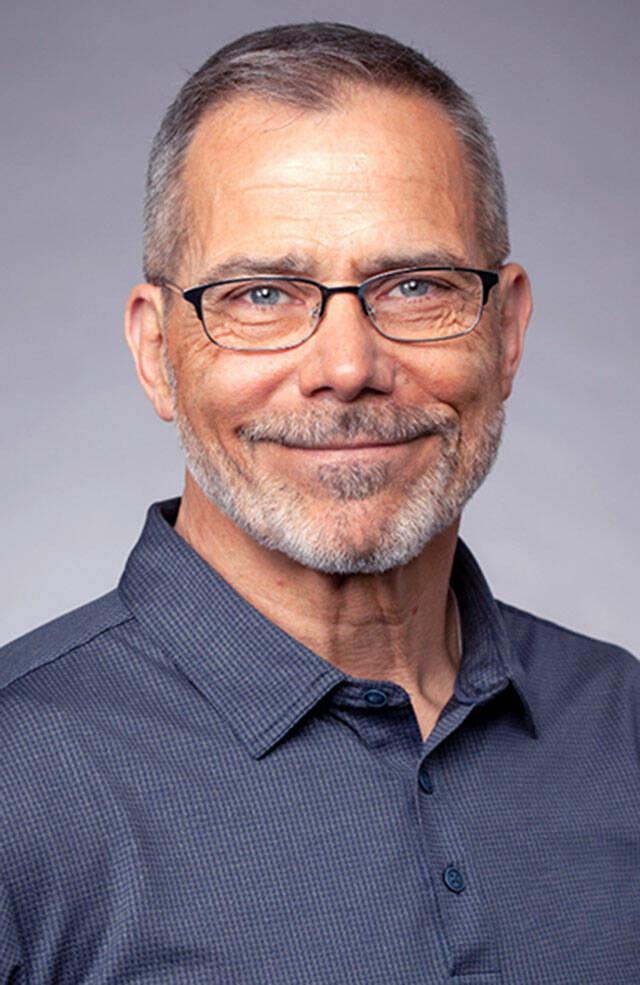
PORT ANGELES — First Fed’s new president and CEO says the 102-year-old community bank’s future depends on leaning into its local roots while using technology to better serve customers on the North Olympic Peninsula.
Speaking during a Coffee with Colleen online forum with Clallam County Economic Development Council Executive Director Colleen McAleer, Curt Queyrouze said status comes with responsibility.
“Every dollar we put into the community through a loan turns into multiple dollars as it circulates through the community,” Queyrouze said. “That’s the real beauty of community banking.”
Queyrouze, who grew up in New Orleans and has worked at large national institutions as well as small community banks, said First Fed aims to keep money in the area rather than sending deposits to distant markets.
“The larger banks that have branches here might be using those deposits to lend money for an office building in New York City, Chicago or elsewhere,” he said. “We’re using our deposits in the markets that we serve.”
Before joining First Fed, Queyrouze was president of Coastal Community Bank in Everett and earlier served as president and CEO of TAB Bank in Ogden, Utah.
He succeeded interim CEO Geraldine Bullard, who filled the role after former CEO Matt Deines resigned amid scrutiny of First Fed’s ties to Everett-based Water Station Management, whose founder was indicted by the U.S. Department of Justice and Securities and Exchange Commission.
Queyrouze was asked how he intended to restore confidence after a string of problems that predated his arrival, including the bank’s relationship with Water Station Management, two related lawsuits filed in King County Superior Court and an FDIC consent order tied to a fintech partnership.
Queyrouze said he was limited in what he could say about the litigation, but he said he reviewed the situation before accepting the job.
“I made a personal commitment,” he said. “I came here because of what I believe in.”
Community reaction to the bank’s troubles was telling, he said.
“The community feels very strongly about First Fed, almost to the point that there was anger about having put this bank at risk, and I get it,” he said.
“The passion for the ownership of this institution is strong. Now it’s up to us to regain that trust and respect and to keep this organization safe.”
Queyrouze said his priorities are “soundness, profitability and growth — in that order.”
He also fielded questions about cost-cutting moves that have stirred concern, such as one from a 39-year customer who said she was disappointed that senior perks such as free checks had disappeared.
“What you’re touching upon is something that I’ve actually been thinking about a lot over the last few weeks,” Queyouze said.
While he said not every legacy program can be preserved, he added, “What you’re talking about is, where can we do things that make a difference for our customers and don’t cost us a lot of money? And we should be doing those kinds of things.”
Looking ahead, Queyrouze said First Fed is working on a new data platform to better understand local spending and savings trends, and providing businesses tools such as cash-flow forecasting.
He said community banks needed to meet customers where they are — and that is increasingly in the digital space.
“We haven’t leveraged that technology fully to help serve our customer base, and that’s what we’re working on behind the scenes,” he said.
He said First Fed — which was established in 1923 — was the third bank at which he had worked that was more than 100 years old. Preserving that heritage is important — a focus on building personal relationships, serving local needs and reinvesting in area projects.
“Being involved with a bank like First Fed and that community impact is appealing for me,” he said. “And it’s a lot of fun.”
________
Reporter Paula Hunt can be reached by email at paula.hunt@peninsuladailynews.com.
