

EVERETT — This is the lesson that the working-class city of Everett has learned: It takes a community to rescue the hardcore homeless.
It takes teams of outreach workers — building relationships with men and women struggling with addiction or untreated mental illness, prodding them to get help. It takes police and other agencies, working together to provide for their needs.
Everett, hard-hit by the opioid epidemic, is trying an array of strategies to tackle homelessness, addiction, untreated mental illness and other problems on its streets.
For starters, the city put together a team that would track the 25 most costly and vulnerable cases, and hover over each one individually until he or she was in treatment or housing.
“It was when everything else seems to have failed,” said Hil Kaman, who left his job prosecuting the homeless about a year-and-a-half ago and took up the challenge of finding solutions as the city’s public health and safety director.
Officials also are pushing new permanent supportive housing and sending social workers out with police officers.
The city of 110,000 people north of Seattle and surrounding Snohomish County saw a 65 percent jump in people living outside in the past two years — among the largest increases on the West Coast in that time.
The number of unsheltered chronically homeless — those who have been homeless for longer than a year while struggling with a serious mental illness, substance use disorder or physical disability — has grown steadily in the Everett region, more than doubling since 2015.
The opioid epidemic, poverty, lack of unskilled jobs, rising rents and a shortage of affordable housing have made it harder for those who fall into homelessness to get out.
The problem is not limited to Everett. Up and down the West Coast, the high cost of housing has forced thousands of people to live on the streets, a trend that opioids have exacerbated.
“These are expensive places to live. It’s expensive for everybody. But the burden falls the hardest on people with the biggest problems,” said Steve Berg, vice president for programs and policy with the National Alliance to End Homelessness.
In 2011, roughly one in every five opioid-related deaths in Washington state took place in the city and surrounding Snohomish County. That was the peak, but heroin deaths remain high and deaths from synthetic opioids such as fentanyl are climbing.
The crisis had become so dire that Everett city officials became the first to sue the manufacturer of the painkiller OxyContin in January. The lawsuit blames Purdue Pharma for an addiction crisis that has overwhelmed city resources and deepened its homelessness problem.
While that case works through the court, outreach workers are fanning out to find people camping under the freeway or living in the woods and try to connect them to services. Many of them initially deflect treatment. Some are too ill to even know they need aid.
James McGee, a former heroin addict who is now more than three months clean, sought help after he overdosed in a parking lot.
Over the summer, he walked into a police station and pleaded for help. Kaitlyn Dowd, a social worker with Everett police, helped connect him to treatment.
“It took me losing everything,” said McGee, 27, who was living in his minivan but is now in sober housing and working, determined to fix his life.
For every person who finds a treatment bed or permanent supportive housing, many more wait.
Experts say lack of on-demand treatment and a shortage of housing to meet specific needs are the biggest barriers to helping people off the streets. Without permanent housing, advocates and city officials say the homeless will end up back on the street after completing their treatment, repeating the cycle.
That’s why Everett is breaking ground next month on a low-barrier permanent supportive housing project on city land. The project with Catholic Housing Services will house 65 chronically homeless people without requiring they first deal with substance abuse or other issues. Residents will have access to mental health, recovery and other services and around-the-clock, on-site staff.
Studies have found that such housing can save taxpayer money when compared to the costs of serving the chronically homeless in emergency rooms, shelters and jails.
But so many are on the waitlist that those units will fill up when it opens in 2019.
Hard cases resist easy solutions, but Everett’s team persists.
A specialized team of mental health professionals, housing and recovery experts, social workers and officers worked for more than a year to build a relationship with Joshua Rape, a chronically homeless man who has bounced in and out of jail and the streets.
When he decided this fall that he was ready for treatment, the team got him into a motel until a slot opened up. They took turns checking in daily. In October, they drove him to catch a bus to the recovery center 200 miles away.
“We’ve all been counting down the days until he’s been ready,” said Dowd, the social worker.
Now Rape is back in Everett, having finished 30 days of inpatient treatment. For the first time, the man who has been homeless for six years will have his own place — a one-bedroom apartment that he’ll move into this month.
“I had to make multiple attempts at doing this,” he said. “It can be done. You have to work for it.”

Robart Blocher poses for a photo on Nov. 8 near the two-story tree fort he built from discarded materials while living homeless in some woods near Everett. Blocher said he is addicted to meth and suffers from social anxiety disorder and other mental health issues, making it hard for him to go to places and seek help. (Ted S. Warren/The Associated Press)

Steph Gaspar, a volunteer outreach worker with The Hand Up Project, an addiction and homeless advocacy group, cleans up needles used for drug injection that were found at a homeless encampment in Everett on Nov. 8. (Ted S. Warren/The Associated Press)

Dominic, who battles mental illness, sits on a sidewalk under the Smith Ave. Bridge in Everett on Oct. 12. The area is a constant gathering place for homeless people battling addiction and mental illness. Dominic has been identified as one of the top chronic and costliest users of emergency and other services in Everett, but despite the efforts of a specialized team of experts, he remains on the streets. (Ted S. Warren/The Associated Press)

Paige Clem sits in the car she lives in along with her husband and three dogs outside a church where free food was being distributed in Everett on Oct. 12. In addition to being homeless, Clem said she has battled addiction to heroin and meth in the past but is now clean with the help of medication. (Ted S. Warren/The Associated Press)
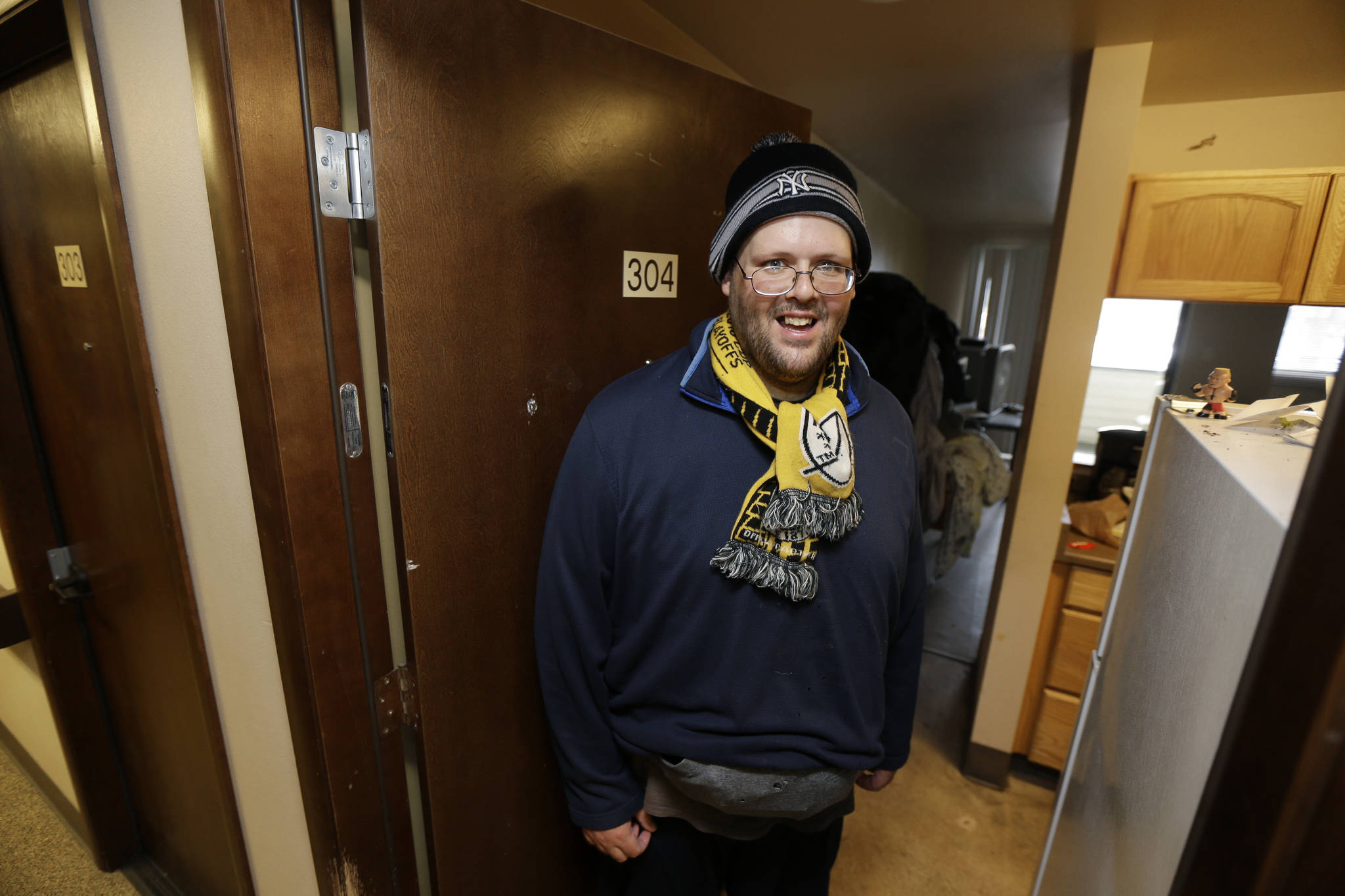
Garrick Heller stands in the doorway of his studio apartment in Everett on Nov. 1. Heller, who was diagnosed with paranoid schizophrenia, and has lived on the streets, in shelters and eventually in a locked psychiatric facility, has been able to transition into housing and mental health counseling run by Compass Health, a Snohomish County behavioral health provider. (Ted S. Warren/The Associated Press)
