
PORT TOWNSEND – Local governments struggle to engage the full spectrum of their communities in normal times – whether it’s because of residents’ time constraints or the challenges of parsing often mind-numbing bureaucratic jargon.
Now, the COVID-19 pandemic, and the resulting need to remain socially distant, is making that task even tougher. In-person meetings and public forums have fallen by the wayside, forcing local officials to rely more heavily than ever on digital, internet-based solutions.
Over the past week, the city of Port Townsend began rolling out its answer to that unprecedented challenge: It’s called EngagePT, and it aims to boost public participation while presenting otherwise complex issues in plain, easy-to-understand English.
“We’re in a very different situation in the time of COVID as far as how we can connect with and truly represent the interests of our community, and we’ve really been struggling with that,” City Manager John Mauro said.
“We’ve had to think hard about how can we innovate and allow the community to weigh-in on some of the city’s biggest issues.”
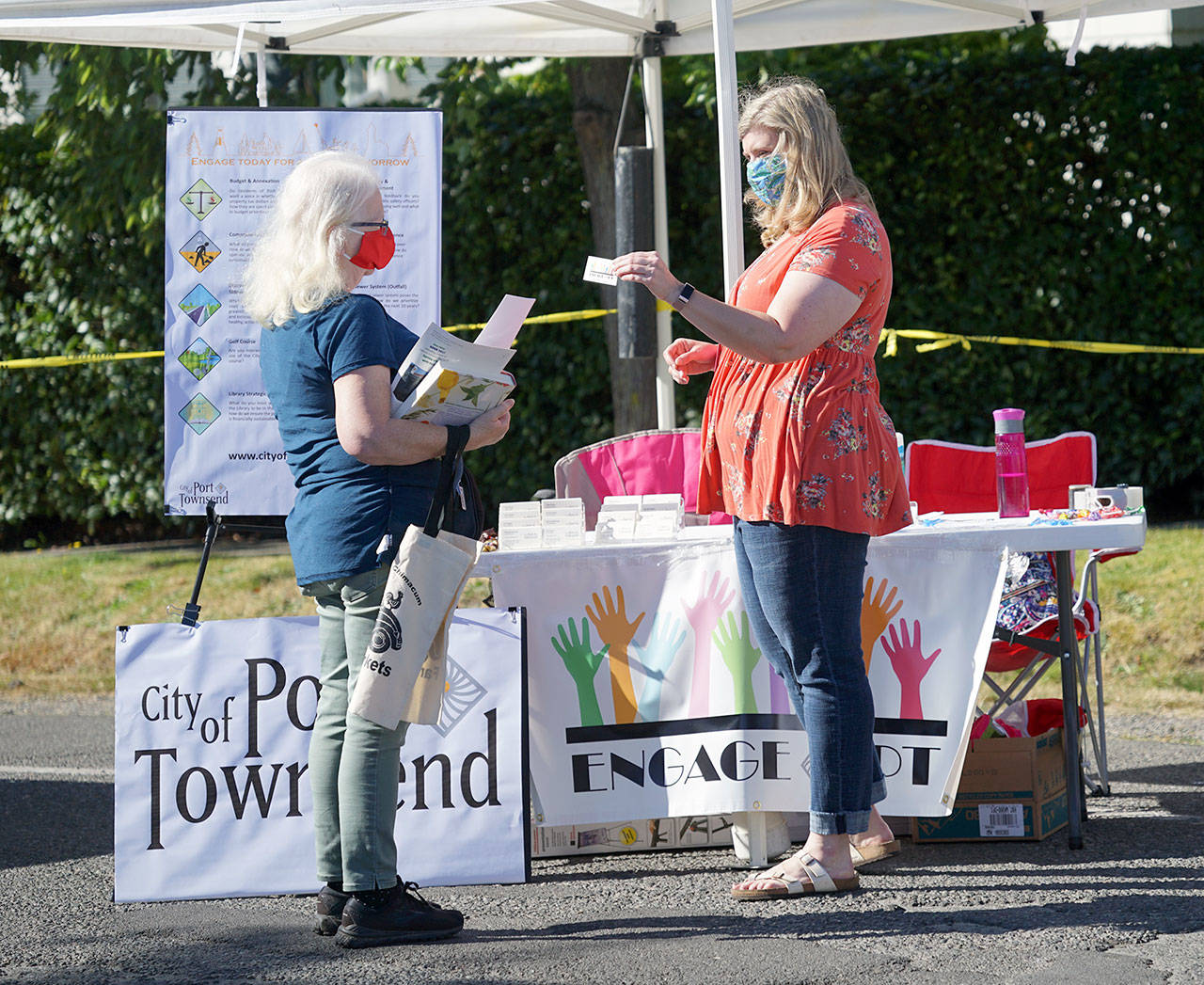
Port Townsend City Attorney Heidi Greenwood, right, hands an EngagePT card to Bonnie Walters, a painter and jewelry-maker who recently moved from Sausalito, Calif., to Port Townsend with her husband. “I can’t wait to get engaged,” she said. “This town is just so vibrant.” (Nicholas Johnson/Peninsula Daily News)
EngagePT consolidates 10 key policy issues facing the city — from budget priorities and transportation projects to sewer systems, water supply and public safety — into a single online platform designed to foster community-led decision-making.
“Instead of having 10 separate initiatives involving 10 separate departments, we decided it was important to bring it all together into a sort of one-stop shop,” Mauro said.
“Hopefully the result will be that more people in our community feel they can access and participate in addressing all of these issues.”
The city has begun promoting this all-in-one initiative via its Facebook page and its newsletter, as well as at the Port Townsend Farmers Market, where it has been encouraging residents to hop online and visit cityofpt.us/engagept to read up on the issues and take a survey.
“Talking with people at the market has been really rewarding for me,” Mauro said, noting that one question on the survey asks whether respondents would be interested in pitching in as an ambassador.
“It’s about fostering community conversations more than being subject-matter experts,” he said, adding that the ambassador idea was in part inspired by the use of informal conversations held over coffee in 1993 to solicit feedback on a proposed Comprehensive Plan.
City staff are currently developing a toolkit to help ambassadors reach out to and collect input from the community, which could begin as soon as early September.
Since each of the 10 issues is on its own timeline, the online engagement tool will remain in place for months, Mauro said. But one issue is particularly pressing: budget priorities and the potential levying and use of additional property tax dollars over the next few years.
On Monday night, the City Council will consider extending the deadline to Oct. 31 for Mauro to recommend whether to levy and how to use as much as $300,000 in property tax revenue in 2021.
In February, voters approved the city’s annexation into East Jefferson Fire and Protection District No. 1. That meant the fire district would be able to tax property owners directly rather than contracting with the city to provide services, which freed up the city’s capacity to tax its residents and use the revenue elsewhere.

Port Townsend City Attorney Heidi Greenwood, right, hands an EngagePT card to Justin Lake, center, of Discovery Bay, and Brandon Chappell, left, a former Port Townsend resident now living in Poulsbo, on Saturday morning at the Port Townsend Farmers Market. (Nicholas Johnson/Peninsula Daily News)
However, an agreement between the two stipulates that if the city decides to use that new-found taxing capacity, it must do so in a phased approach over several years, returning in 2024 to full capacity, or $908,000 annually.
“The question now is do we want to levy that one-third next year,” Mauro said, “and if so, how much of it and for which of the eligible uses.”
The agreement between the city and fire district stipulates that any tax revenue collected must be used in certain areas, specifically transportation capital projects, the housing trust fund, utility tax relief, or parks and recreation capital projects.
Mauro said feedback on this specific issue received through the EngagePT initiative will inform how the city constructs its budget for the coming year, a process due to start in November and wrap up sometime in December.
“We are in a fiscally difficult situation,” he said. “We have increasing responsibilities as a local government and we have shrinking revenue. It’s our job to explain what all these things mean and how they play into how we levy taxes and use that funding, and so this new tool is critical to giving everyone in our community an opportunity to weigh in.”
______
Jefferson County reporter Nicholas Johnson can be reached by email at njohnson@peninsuladailynews.com or by phone at 360-328-1222.
