
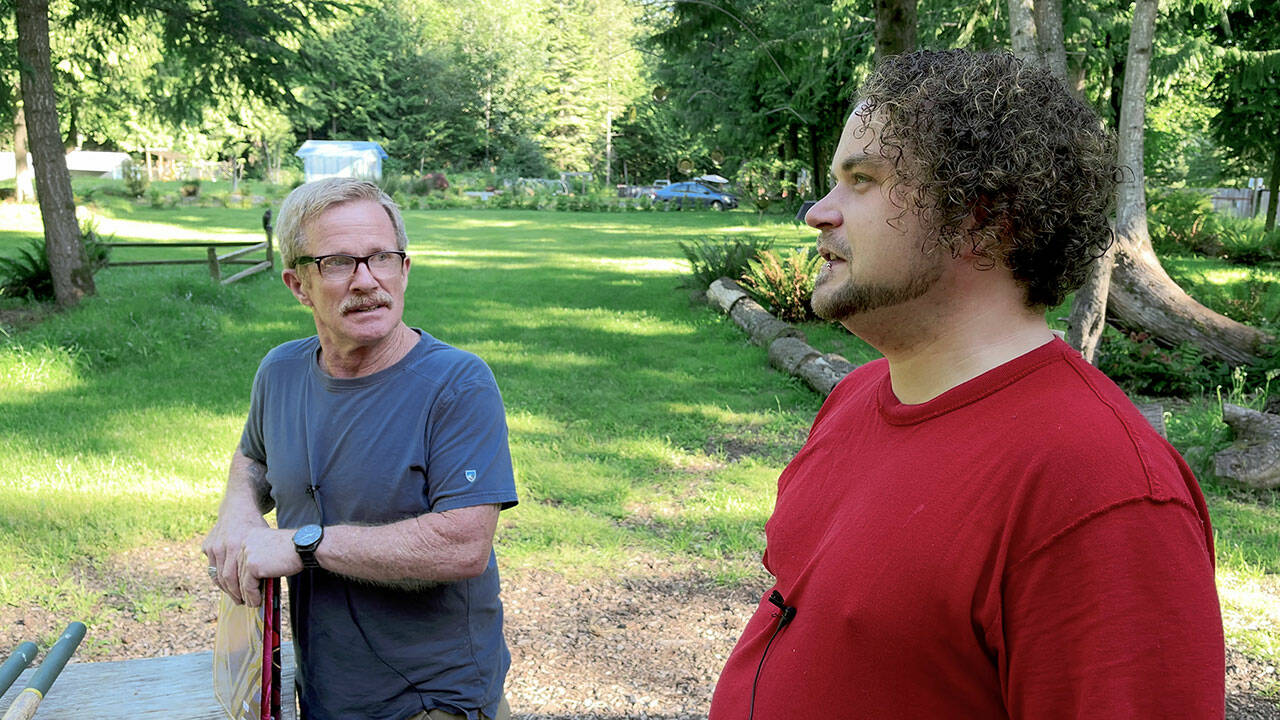
PORT TOWNSEND — “Michael and Damian,” a documentary which explores the relationship between a social worker and an unsheltered Port Townsend man, will screen at the Port Townsend Film Festival later this month.
“I didn’t set out to make a film that has all the answers,” director Gabe Van Lelyveld said. “I wanted to make a film that asks the questions and explores the nuance and complexity of people’s lives and the issues they’re dealing with.”
Van Lelyveld met social worker Michael McCutcheon and unhoused man Damian Eldritch in a homeless encampment at the Jefferson County Fairgrounds early in the COVID-19 pandemic.
The film was shot over three years and focuses on the men together and separately, through a range of high and lows.
The film will screen at 1:30 p.m. Sept. 19 at the American Legion Port Townsend, 209 Monroe St.
Individual tickets will be available for $15 on September 15, if those holding festival passes haven’t already filled the theatre.
Festival passes can be purchased for the screening at ptff2025.eventive.org/passes/buy. Prices range from $42 to $850.
The festival also makes free passes available for those with limited financial resources. Interested parties should email info@ptfilm.org.
A free discussion on housing will be hosted by the film festival at 4 p.m. Sept. 19 at the Cotton Building, 607 Water St.
Van Lelyveld said he and McCutcheon will be on the panel. It is not yet clear if Eldritch will join, he added.
Early in the pandemic, Van Lelyveld started noticing a growing encampment of unsheltered people living at the fairgrounds on his regular runs and walks. He lives 10 minutes from the grounds.
As winter approached and snow hit the ground, he wondered how the inhabitants were doing. Knowing that the Recovery Cafe was bringing food and supplies to the grounds a few times a week, he reached out to ask if he could tag along on some visits.
While he was looking for his next project, Van Lelyveld wasn’t interested in making a film about an issue. He didn’t bring his camera for a long time, he said.
“I didn’t even mention being a filmmaker for quite a while,” he said.
Van Lelyveld noted McCutcheon’s charisma early on, and when he eventually decided to work on the project, McCutcheon was immediately on board.
Taking a sensitive approach to how he included Eldritch in the film was important to Van Lelyveld, who said he erred on the side of over-communicating. Eldritch was very supportive of the process, Van Lelyveld said.
Van Lelyveld said he wanted Eldritch to know that, in addition to being there to make a film, he cared about him and was willing to put the camera away and help at any moment.
Early in the film, McCutcheon is driving around in Port Angeles, making contact with unhoused people.
In a scene captured from McCutcheon’s truck, McCutcheon speaks with a crying young man in front of Jim’s Pharmacy. McCutcheon encouraged him to give himself a chance and requested that the man stand up to hug him.
When McCutcheon returned to his truck, from where the camera was capturing the scene, he admitted that he doesn’t always like his work.
“That is no fun,” he said. “How can people look at him and just say, ‘He’s long haired, he’s dirty, he’s got mental problems.’ If they only sat there and listened to him and saw that he’s a 24-year-old kid and he lost his dad. His whole world was crushed.”
Elsewhere in the film, McCutcheon shares about his own history of using drugs.
“Sometimes I wonder if I’m doing it for them or if I’m doing it for me,” McCutcheon said.
“If I don’t do this, what will happen to me?”
Eldritch moved to the area in the hopes of improving his life and moved onto the streets when the family he lived with became abusive, he said.
“How I got here is through heartache,” Eldritch said. “When you’re in a situation like this, it gets magnified.’”
The first apparent qualities in seeing Eldritch on the screen are that he is friendly and funny. He has a quick wit.
In one scene immediately following the eviction of the fairgrounds, Eldritch drives his RV to the newly established Caswell Brown Village. After he arrives, he meets and speaks to a site monitor in an English accent.
“I’ll have you know, I’m quite a ragamuffin,” he said.
The man laughs.
“I cause quite a bit of trouble,” he continued. “Graffiti, everything, kick rocks, and if I see a can on the ground, I kick that too. Watch out for me.”
Then he breaks and laughs. I don’t do anything, he said.
In another scene, Eldritch performs a stand-up comedy set at a Port Townsend open mic in which he introduces himself as one of the lovely homeless. His set got laughs.
“Whether I was funny or not doesn’t matter. It comes back to that whole having a voice thing for me personally,” Eldritch said in the scene following the open mic.
In a later scene, McCutcheon asks Eldritch why he jokes about his situation.
Because things have been so bad for so long that it’s laughable, Eldritch said.
“When I laugh, it’s usually because I’m insecure,” McCutcheon said. “You think you’re different. You’re not different. We’re all all the same.”
Throughout the film, Eldritch also expresses his relationship to a deep and abiding depression, self-esteem issues, struggles with substance abuse.
One scene shows Eldritch scrubbing dishes at the Recovery Cafe. He talks about his loneliness.
“When I say I don’t talk to anybody, I mean it,” he said. “I haven’t had any good conversation in a long time.”
Sarcastic, Eldritch said the days he washes the dishes in the cafe are the best days of his life.
“‘It’d be fun,’ they said. It’d be a laugh riot.”
On a number of occasions, McCutcheon and Eldritch discuss the idea of Eldritch working a job. Largely, Eldritch discusses the idea as being painful and dissatisfying. He mentions considering working a few times. At one point, he said he would like to find work where he is helping others, like McCutcheon does.
One particularly difficult scene is preceded by a shot of McCutcheon driving away from the fairground. Text on a black screen says McCutcheon’s mic was left on when he was called to a trailer where someone had overdosed. You can hear but can’t see McCutcheon working on the person and requesting that someone call 911.
At Caswell Brown, Eldritch set his RV on fire.
Security footage shows Eldritch approaching his RV, disappearing behind it and walking away. Plumes of smoke can then be seen rising from the RV. Emergency fire vehicles are shown arriving on the scene.
“At first (he was) saying that there were three other guys in his motorhome with him that lit a fire,” McCutcheon said. “Then he changed his story to, the three guys told him to light the fire. What he really needed is to go in for psychological evaluation, just for the fact that he was lighting a fire and then he casually walked away. That’s not normal behavior. I do believe he’s becoming suicidal because he told me that researched assisted suicide. We’re failing him.”
Body cam footage shows the aftermath of an incident when windows of vehicles behind the Department of Social and Health Services building were smashed. Port Townsend Police Department officers approached people sitting on a sidewalk to ask them if they smashed the windows.
Eldritch later confessed that he was responsible for the windows when the officers arrested him on a warrant for setting his RV fire.
Eldritch also reported hearing voices during the production of the film.
Speaking to the broader issues of homelessness and housing instability in Port Townsend, Van Lelyveld stressed that he is a storyteller, not an expert. He said his perspective was expanded and that he came to care about a lot of people in the vulnerable community.
His main focus on McCutcheon and Eldritch, Van Lelyveld said he was keeping up with the larger picture, reading local news, keeping an eye on policy changes and listening for different perspectives in debates about homelessness.
The community seemed largely interested in ensuring a good outcome and a landing place before the residents were evicted from the fairgrounds, Van Lelyveld said.
During the production of the film, Van Lelyveld came into contact with a number of neighbors who said they were negatively impacted by the situation.
In a meeting about the county-owned parcel that would become the Caswell Brown Village, hosted by county commissioner Greg Brotherton at the fairgrounds, several people aired hard feelings toward those at the encampment.
“I’m gonna just call it like it is,” one masked and unnamed woman said. “Our community is spending a lot of time and resources to help a group of people, and why is it that if an individual does not want to be helped, are we wasting our time, our energies and our resources trying to help someone who does not want to be helped?”
The woman continued by saying that people who know her know that she is all about helping people.
“But people are not being responsive and they’re shooting up and they don’t want help and they don’t want to be a part of the group. They need to leave the community. I have no interest in helping them”
Angela Wilkinson, a local realtor, voiced her feelings.
“I want to see heavy-handedness. If you’re not going to get the treatment you need, mental health or drug addiction, then get out,” she said. “There’s no reason that we should be coddling these people that aren’t producing anything but are withdrawing everything from our community.”
An unnamed man said he found Wilkinson’s characterization of every homeless person being a drug addict offensive.
“To categorize everybody that’s homeless as having a mental health issue is just wrong,” said another unnamed man, who identified as working in mental health for 30 years. “It’s very wrong to characterize that there is a large drug problem at the homeless camp right now. Many of these people that end up homeless might have lost their job, lost their house.”
Wilkinson requested a comment from former Jefferson County Sheriff Joe Nole, who attended the meeting.
“I don’t blame people for having this idea that (if) you’re a homeless person, you have mental health problems and you’re on drugs, and it’s really not true,” he said.
Van Lelyveld said the county really stepped up in finding the property for the people in the encampment to land after they were evicted from the fairgrounds. He gave credit to Brotherton for his efforts.
“I don’t know how many hours he put into trying to find a piece of property that would meet the conditions to be able to invite folks who wanted to go somewhere else once the eviction moratorium was lifted,” he said.
Van Lelyveld said he hoped the film would combat the stigma and stereotypes facing unhoused populations.
“There are a lot that really do negatively impact how people treat this population and how they see themselves,” Van Lelyveld said. “Internalized stigma is a real thing also.”
Following his arrest and release, Eldritch lived in shared housing with a woman in the area in exchange for cleaning up around the house. The credits say he lost that housing in 2023 and was living in a tent in Port Townsend.
McCutcheon continues to bring food to people and formalized his work by creating a nonprofit called Reach Out. Donations can be made to support his work at reachoutcommunity.org.
________
Reporter Elijah Sussman can be reached by email at elijah.sussman@peninsuladailynews.com.
