
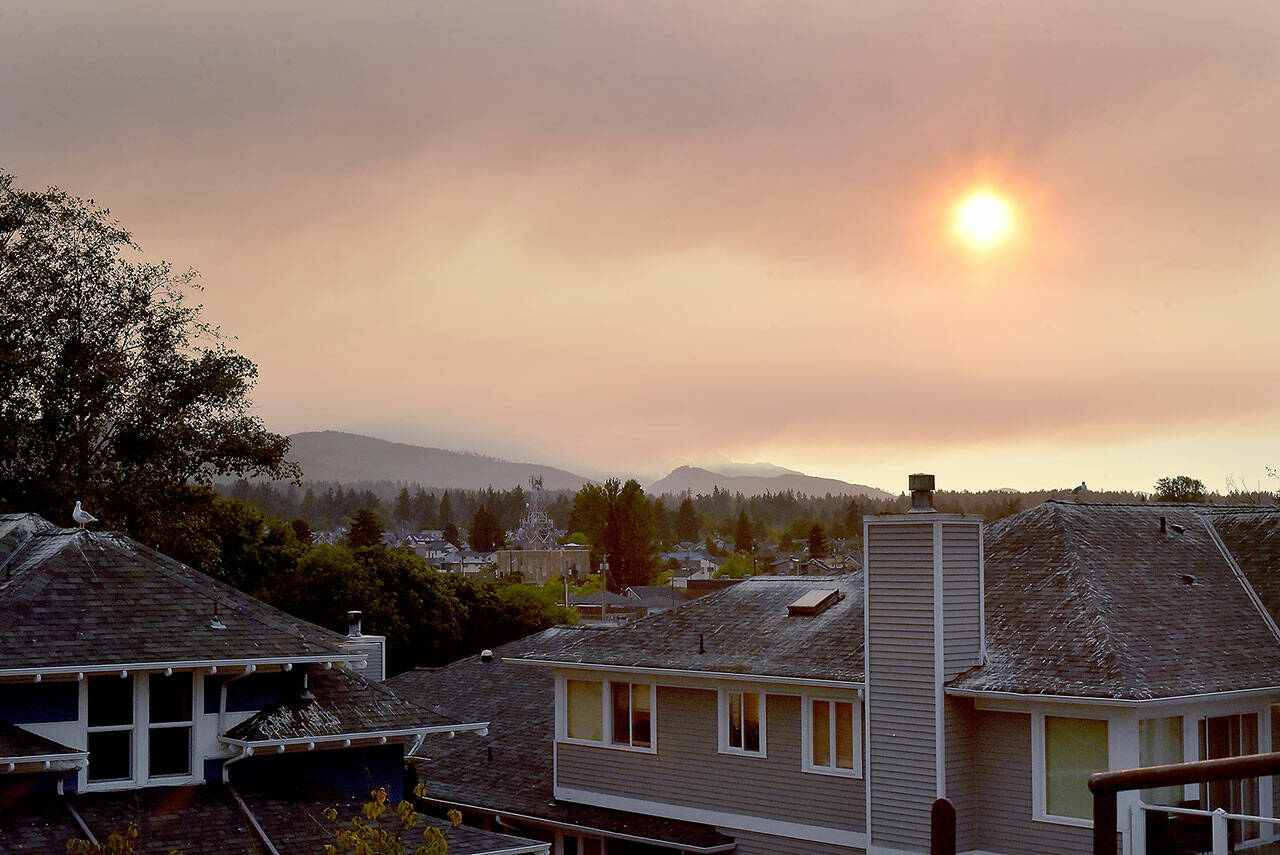
PORT ANGELES — Air quality reached unhealthy levels on the North Olympic Peninsula as smoke and ash from the Bear Gulch fire in the Lake Cushman area blew north late Tuesday night.
“(Tuesday) evening, the Bear Gulch fire grew significantly, producing dramatic images while sending a smoke plume northward,” read a Washington Smoke Blog post. “The fire spread was driven by warm, dry conditions and strong easterly winds, with the majority of the fire growth occurring to the north.”
The Air Quality Index (AQI) measured unhealthy levels for all people between the 11 p.m. on Tuesday and 3 a.m. on Wednesday. Air quality was unhealthy for sensitive populations between 3 a.m. and about 5 a.m. Air quality remained moderate until about noon, when it returned to good, according to readings from Olympic Region Clean Air Agency (ORCAA).
State Department of Ecology air quality forecaster Beth Friedman said while lingering smoke remained, surface smoke has and should continue to improve.
“There might be smoke visible at higher elevations,” she said. “Haze will likely be visible over the region.”
Westerly winds already started to clear the smoke Wednesday, bringing in cooler and more moist conditions. It is unlikely that the clearing smoke will have detrimental effects on air quality to the west, Friedman said.
Jefferson County air quality did not seem to be affected notably. The area’s official state-managed monitor was not functioning during the spike in smoke, but other publicly owned air quality sensors, which can be viewed on the Environmental Protection Agency’s fire and smoke map, showed either good or moderate air from Tuesday into Wednesday.
ORCAA Senior Air Monitoring Specialist Odelle Hadley, who also contributes to the Washington Smoke Blog, was in the field troubleshooting the agency’s malfunctioning Port Townsend monitor. The monitor, which had been replaced a week before, was experiencing a number of issues, Hadley said.
“It was Murphy’s Law, just a series of breakdowns,” she said. “It worked for about two days after I left, then the power supply failed, and we also had a problem with part of the quality control system. Multiple failures all at once caused it to go offline.”
Hadley said she expected the monitor to be up and running by Wednesday afternoon.
Dr. Allison Berry, the public health officer for Clallam and Jefferson counties, said that while the worst of the smoke has likely passed, certain groups, including those sensitive to air quality, should minimize outdoor activity.
“The first most important (priority) is to minimize outdoor exposure as much as possible, particularly for sensitive groups — young children, the elderly and those who have underlying chronic conditions like heart disease and lung disease,” Berry said.
In smoky conditions, people can use HEPA filters, she recommended.
“You can also build your own with a box fan,” she said. “If you can’t cover your whole house, making one bedroom as clean as possible makes a huge difference.”
For people who cannot stay indoors, wearing N-95 or KN-95 masks can help; surgical masks cannot, she said.
Since the smoke is not expected to return in the immediate forecast, no clean air shelters are opening, Berry said. If conditions worsen, Jefferson County has the capacity to open clean air shelters. Clallam County does not, she added.
“When we have serious smoke events, community spaces like libraries and public buildings can be a good option for a place to cool down and get some clean air,” Berry said.
________
Reporter Elijah Sussman can be reached by email at elijah.sussman@peninsuladailynews.com
