
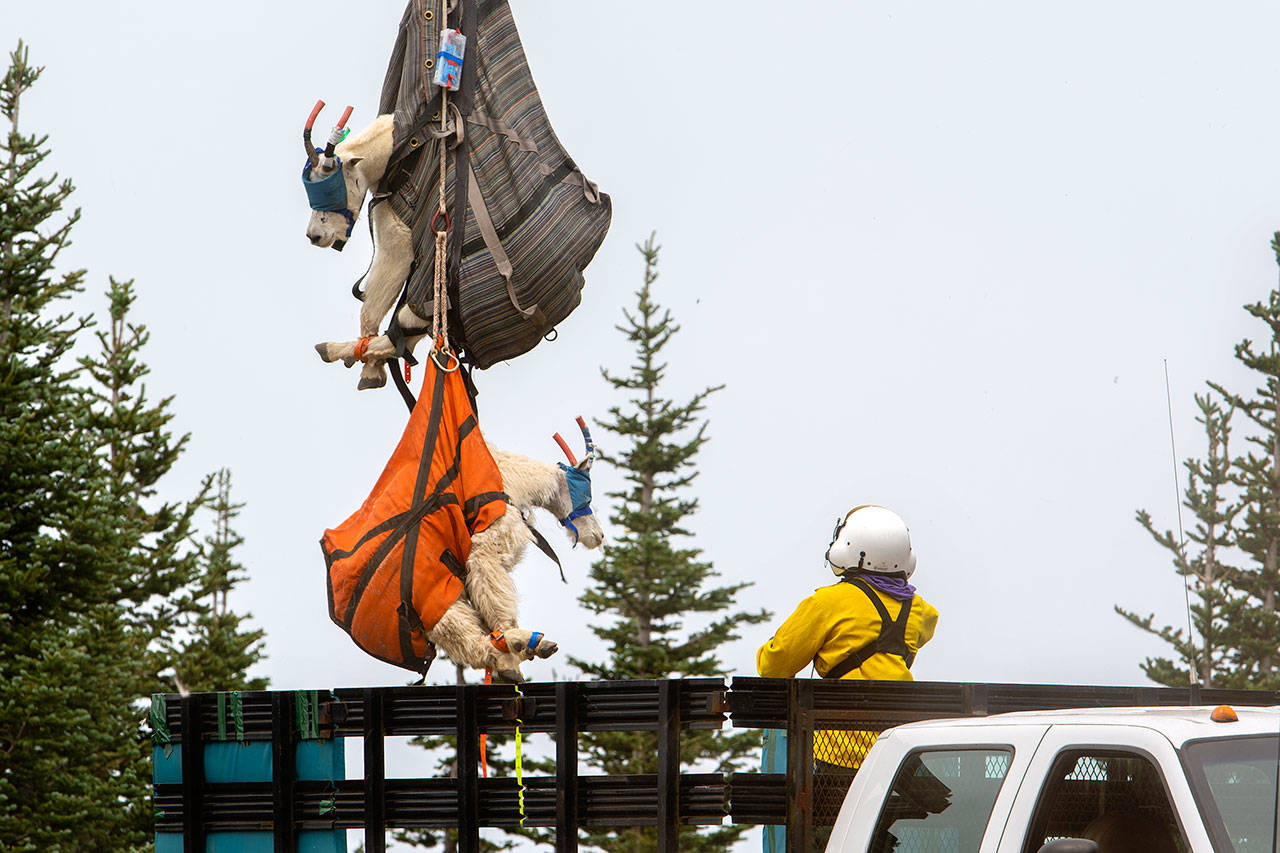
OLYMPIC NATIONAL PARK — Mountain goats in Olympic National Park are learning what happens when helicopters roar overhead, making the second round of goat catching more difficult than it was last year.
That helicopter means they will journey far away to the North Cascades — their native habitat — only after first having been darted or netted, blindfolded, drugged, flown across the mountain range and then placed in a refrigerated truck for transport.
Jenny Powers, one of the veterinarians examining goats after they are caught said officials are doing everything they can to make the experience as easy as possible for the goats.
“As you can imagine, it’s pretty stressful hanging from the belly of a helicopter, being hobbled, put in a bag and then being worked on up here,” she said.
“We have a short-acting and a long-acting sedative. By the time they are released [24 hours later] the long-acting sedative is wearing off.”
Crews with Leading Edge Aviation — referred to as muggers — either net or dart the goats to capture them.
That dart is filled with a cocktail of strong opioids that immobilize the goats within minutes.
Before the goats fly across the mountain range, crews use a drug similar to Narcan to reverse the opioids. The blindfold is critical for keeping the goats calm, Powers said.
“We’ve taken these mitigation measures to take the edge off that stress,” she said. “You can never remove it completely, but I’d say these animals are less stressed than the average animal that has been chased and darted and held for an extended period of time.”
This week marks the second round of operations as crews work to remove as many of the non-native goats from the park as possible. By the end of the day Tuesday, officials had removed 17 mountain goats from Olympic National Park, 12 of which were caught Tuesday.
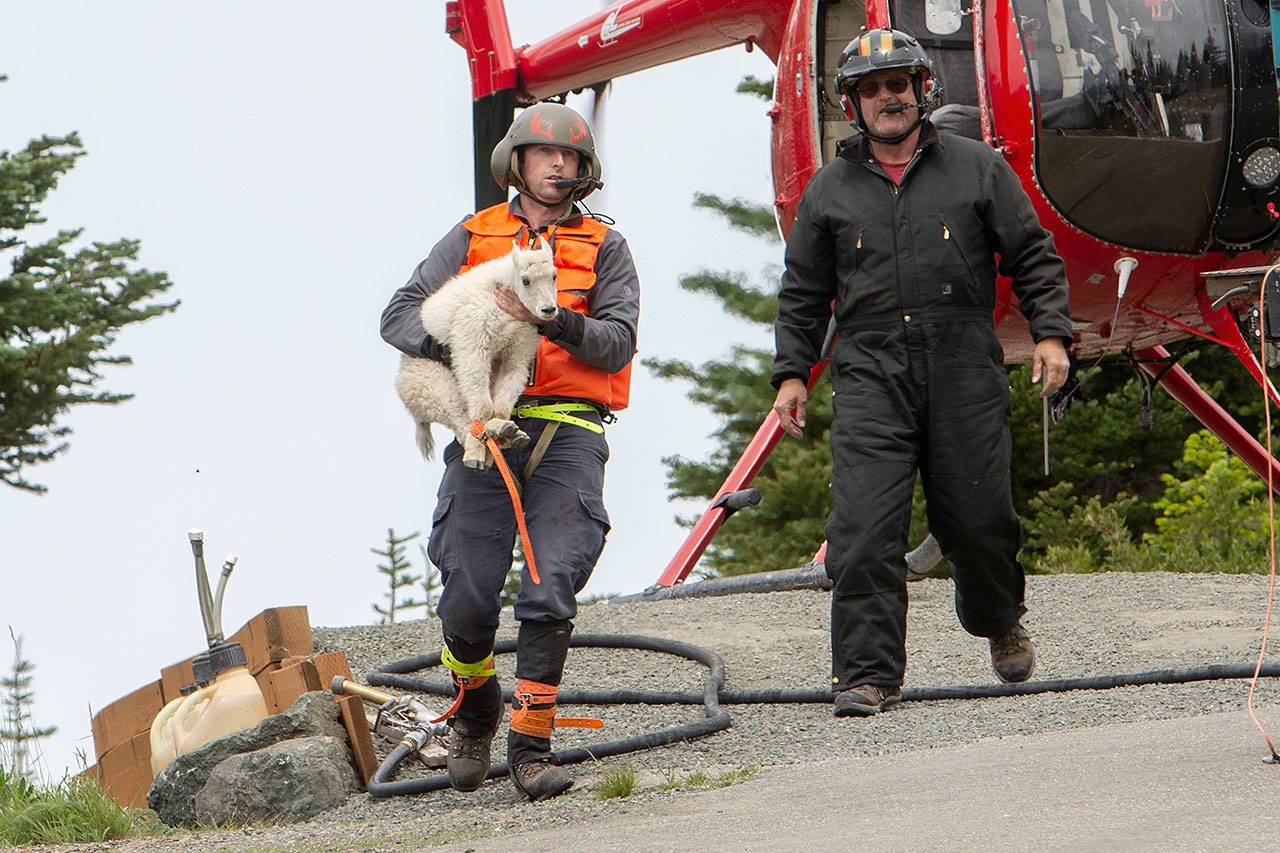
Derrick Halsey of Leading Edge Aviation carries a mountain goat kid to be transported to the North Cascades on Tuesday. (Jesse Major/Peninsula Daily News)
The operation is budgeted to cost $480,000 this year, officials said.
This summer, two operational periods will have visitor impacts throughout the park. The first started Monday and lasts through Friday, July 19 and the second is Aug. 19-30.
Hurricane Hill Road, beyond the Hurricane Ridge Visitor Center parking lot, will be closed to all access during the operational period, including the Hurricane Hill Trail, Little River Trail and Wolf Creek Trail.
Last year, crews were able to remove 115 goats from the more than 700 goats that reside in the park. Of those, 98 were released into the North Cascades.
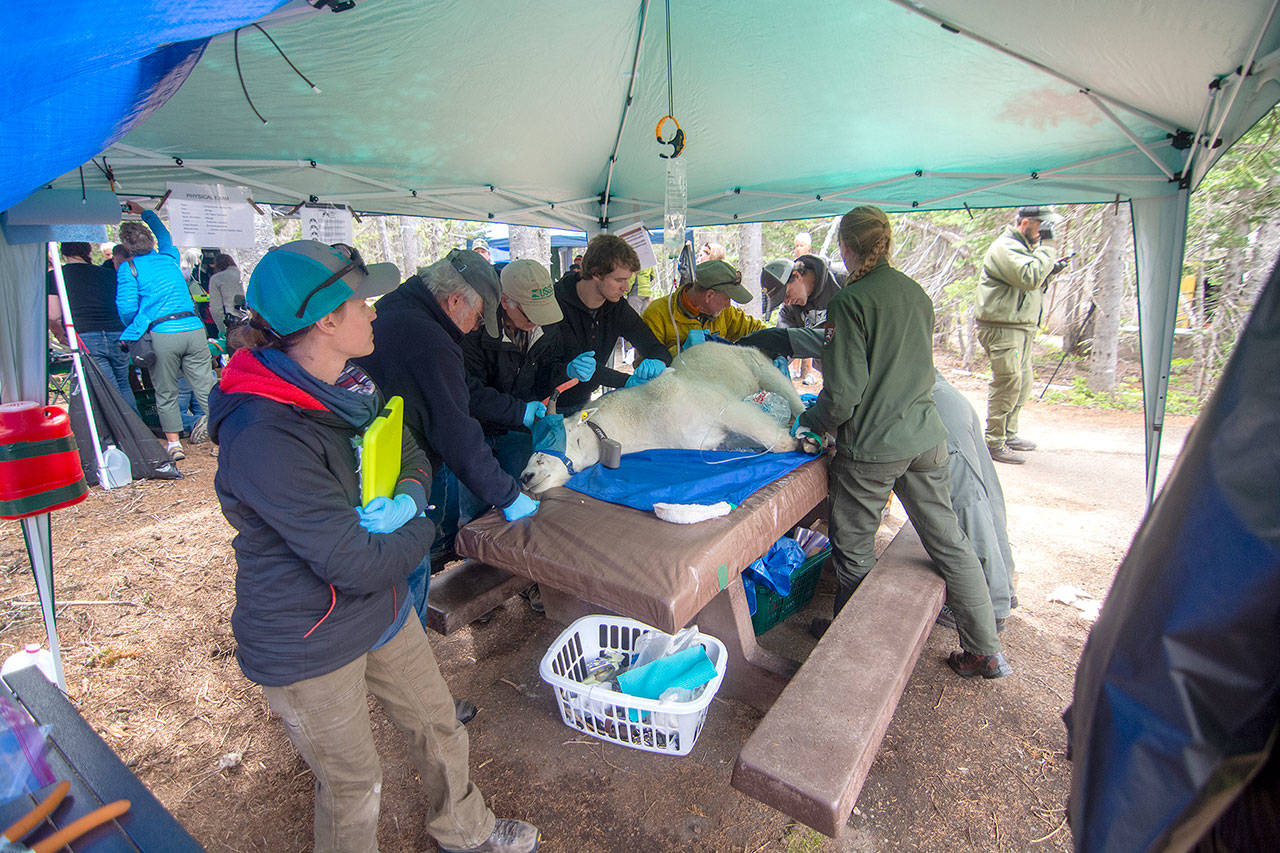
Crews hold down a blindfolded mountain goat as veterinarians examine him before transport Tuesday. (Jesse Major/Peninsula Daily News)
One of the goats fell off a cliff and died, five more died of injuries and three were euthanized. One of the three killed was a billy that was known to be aggressive toward humans and the other two appeared to have a disease.
There were six orphan kids that were taken to Northwest Trek Wildlife Park to be cared for.
How are they doing?
Overall, the goats appear to be adapting as well as could be expected to their new homes in the North Cascades, officials said.
About 70 percent of the relocated mountain goats survived through the winter, a number that is lower than typical, but about what was expected after relocation, said Richard Harris, section manager for the state Department of Fish and Wildlife.

Crates that mountain goats are transported in. (Jesse Major/Peninsula Daily News)
“Preliminary analyses indicate that no activities related to capture/translocation and under our control predicted whether an adult goat would survive to June 2019,” he wrote in a June 28 memo. “For example, we have no evidence of differences in survival by whether a goat was captured using immobilizing drugs or a net gun, whether it was injured during the capture or not, or how long it took for it to be transported and released.”
He said that kid and mother pairs that were moved are generally no longer together. Most of five kids that were still alive — out of 10 kids that were tracked — had found other goats to follow.
“We find this encouraging because 50 [percent] mortality is typical of mountain goat kids that have not been moved or lost contact with their mothers,” he said.
Crews hold down a blindfolded mountain goat as veterinarians examine him before transport Tuesday. (Jesse Major/Peninsula Daily News)
The primary difference in operations this year is that there are two staging areas on opposite sides of the mountain. Again this year there is a staging area at Hurricane Ridge, but there is now a staging area on U.S. Forest Service land near Hamma Hamma.
Goats from around Mount Olympus are flown to Hurricane Ridge and goats near Chimney Peak are flown to Hamma Hamma, said Patti Happe, Olympic National Park wildlife branch chief.
“The goats don’t recognize administrative boundaries,” Happe said. “We’re now able to minimize that ferry time.”
Why they need to go
The mountain goats are not native to the Olympic Mountains, which do not naturally have the salts that the goats crave. Originally 12 goats were introduced to the region and their population eventually grew to more than 1,000.
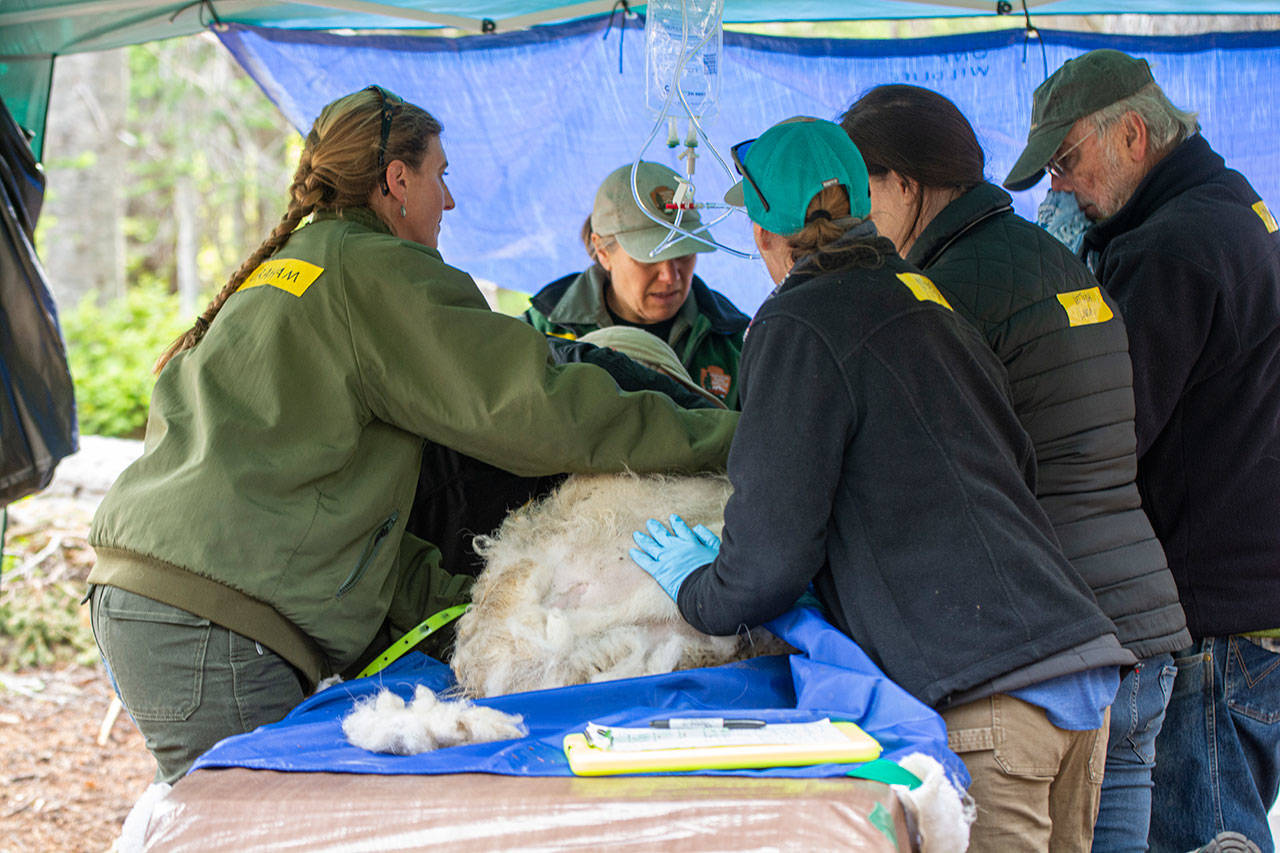
Officials prepare a recently captured mountain goat for transport during goat relocation efforts in Olympic National Park on Tuesday. (Jesse Major/Peninsula Daily News)
Officials have said the goats damage the fragile alpine and sub-alpine ecosystem and that they are dangerous to humans.
Bob Boardman, a Port Angeles man, was killed by a goat that gored him as he hiked Klahhane Ridge in October 2010.
“They have learned an easy ready source of salts is people and they’re not afraid of people because we’re a National Park,” said Happe. “They will follow you on the trail until you urinate and some goats get aggressive.
“In the Cascades there’s natural sources of salts, so that is less of an issue.”
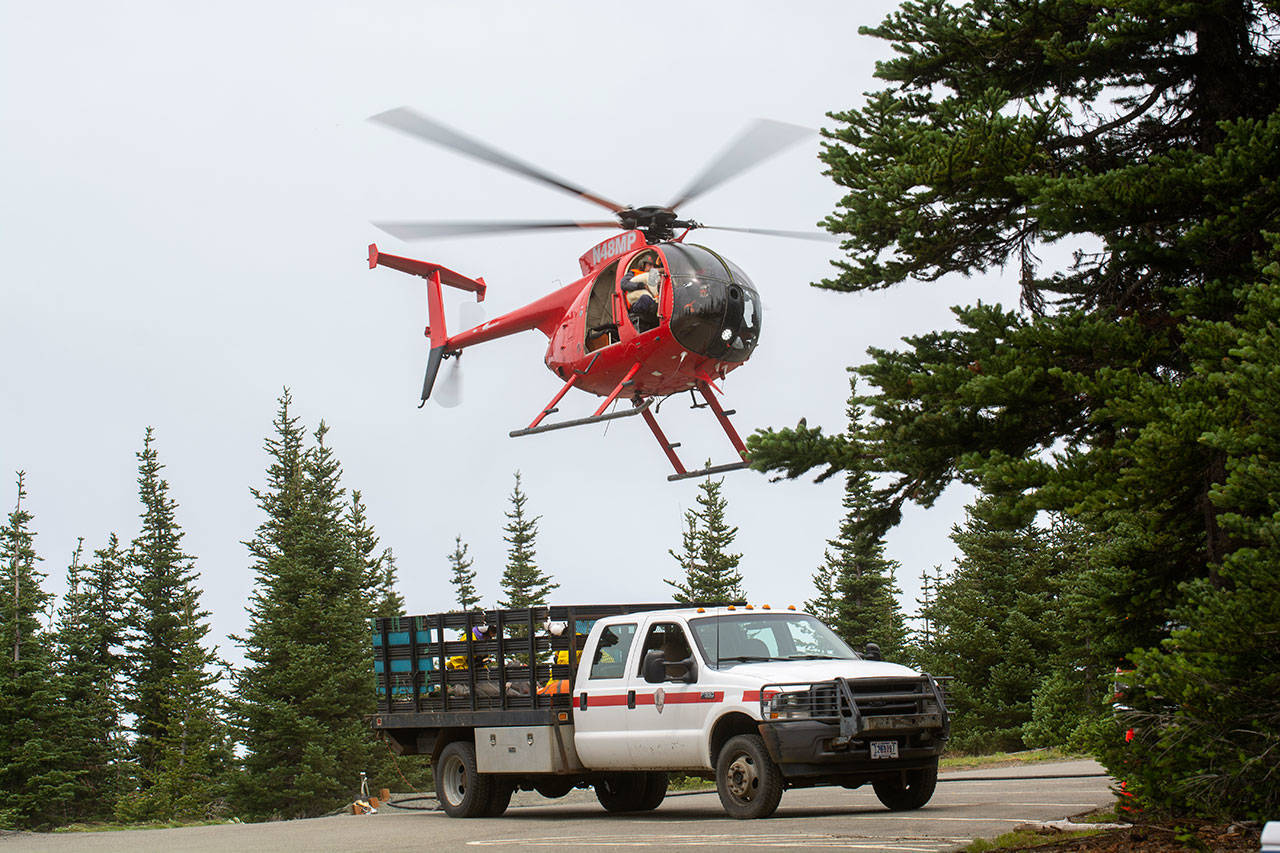
A helicopter flies overhead as crews load goats into the back of a truck in Olympic National Park on Tuesday. (Jesse Major/Peninsula Daily News)
She said that before relocation began, the goat population was growing at about 8 percent each year and that it could have easily grown to more than 1,000 again.
Last year, officials focused on the removal of goats at Klahhane Ridge, which had the shortest helicopter ride to the helipad at Hurricane Ridge, she said, calling those goats the “low hanging fruit.”
There are still some goats at Klahhane Ridge and they will be more difficult to catch, she said.
“The remaining goats, they’re wise to what we’re doing and they’re just not catching them,” she said. “I’d be surprised, especially with this weather, if we get 100 this year.”
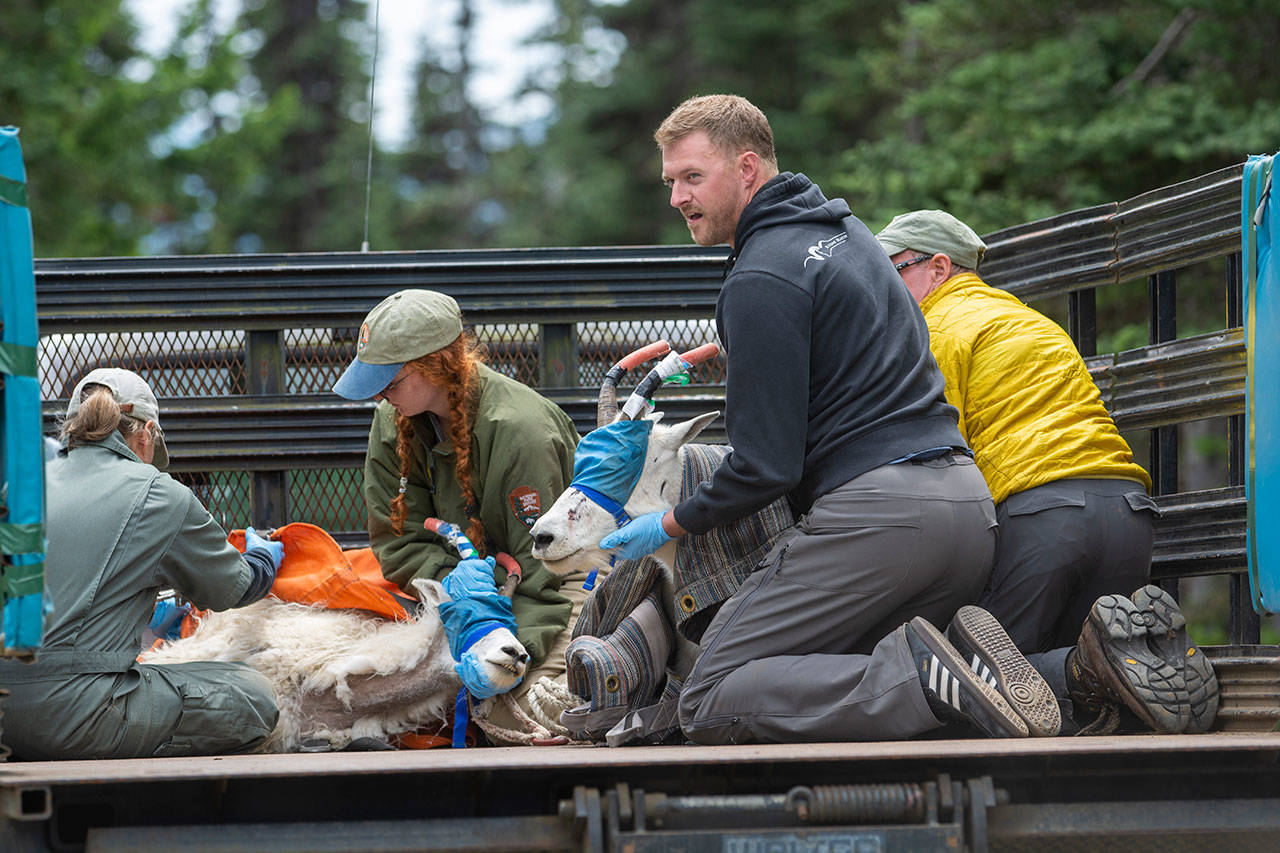
Crews hold down mountain goats in the back of a truck in Olympic National Park on Tuesday. (Jesse Major/Peninsula Daily News)
Not all the goats will survive. Like last year, some might die in transport, during capture or might be killed because they can’t be caught. Happe estimated up to 10 percent of goats removed this year could be killed.
“We want to capture as many goats as we safely can,” she said. “There will be a time and a place … where goats are elusive and we can’t catch them. Once you fly over a goat and they learn what the helicopter means, they are more elusive.”
For more information about closures related to goat removal operations, visit nps.gov/olym.
________
Reporter Jesse Major can be reached at 360-452-2345, ext. 56250, or at jmajor@peninsuladailynews.com.

Officials load a mountain goat into a crate Tuesday so it can be transported to the North Cascades. (Jesse Major/Peninsula Daily News)
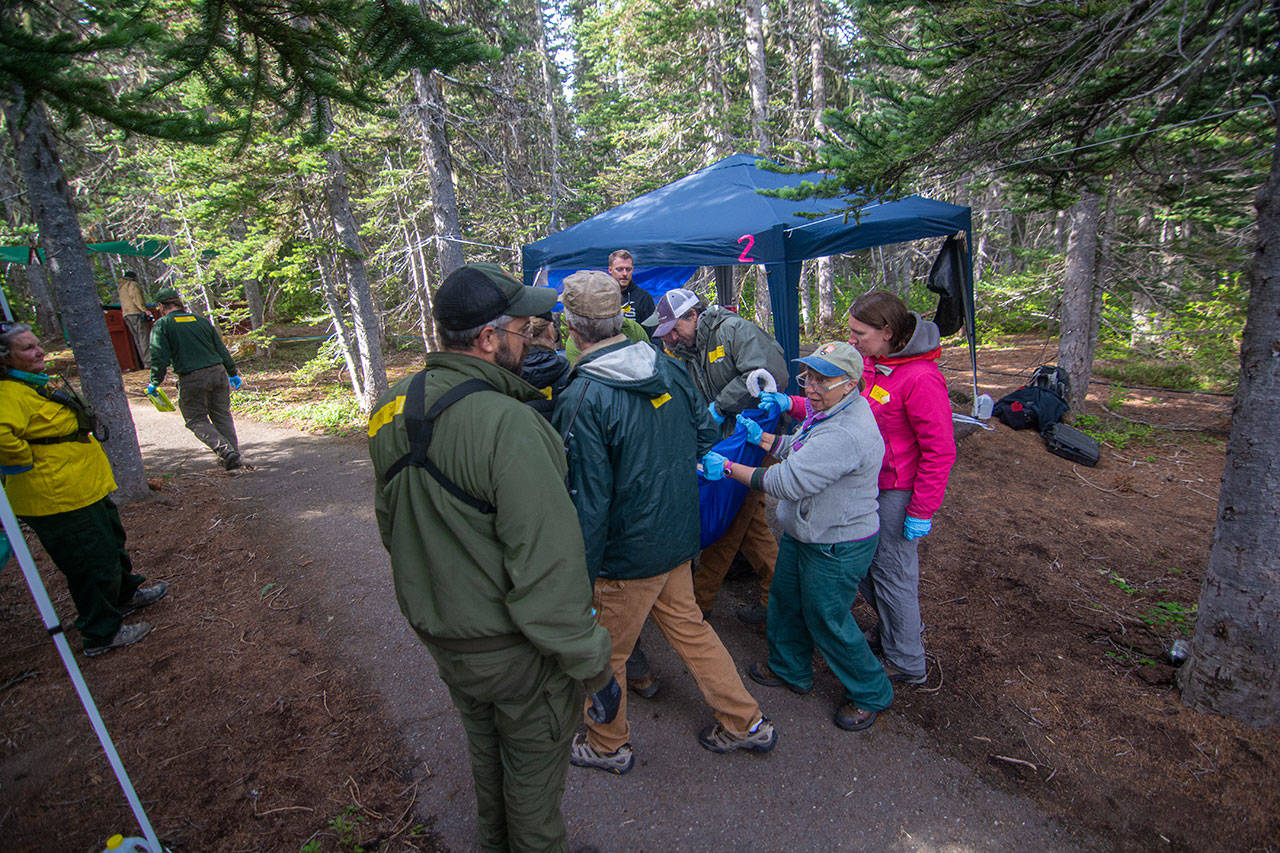
Officials carry a mountain goat to a crate Tuesday so it can be transported from Olympic National Park to the North Cascades. (Jesse Major/Peninsula Daily News)
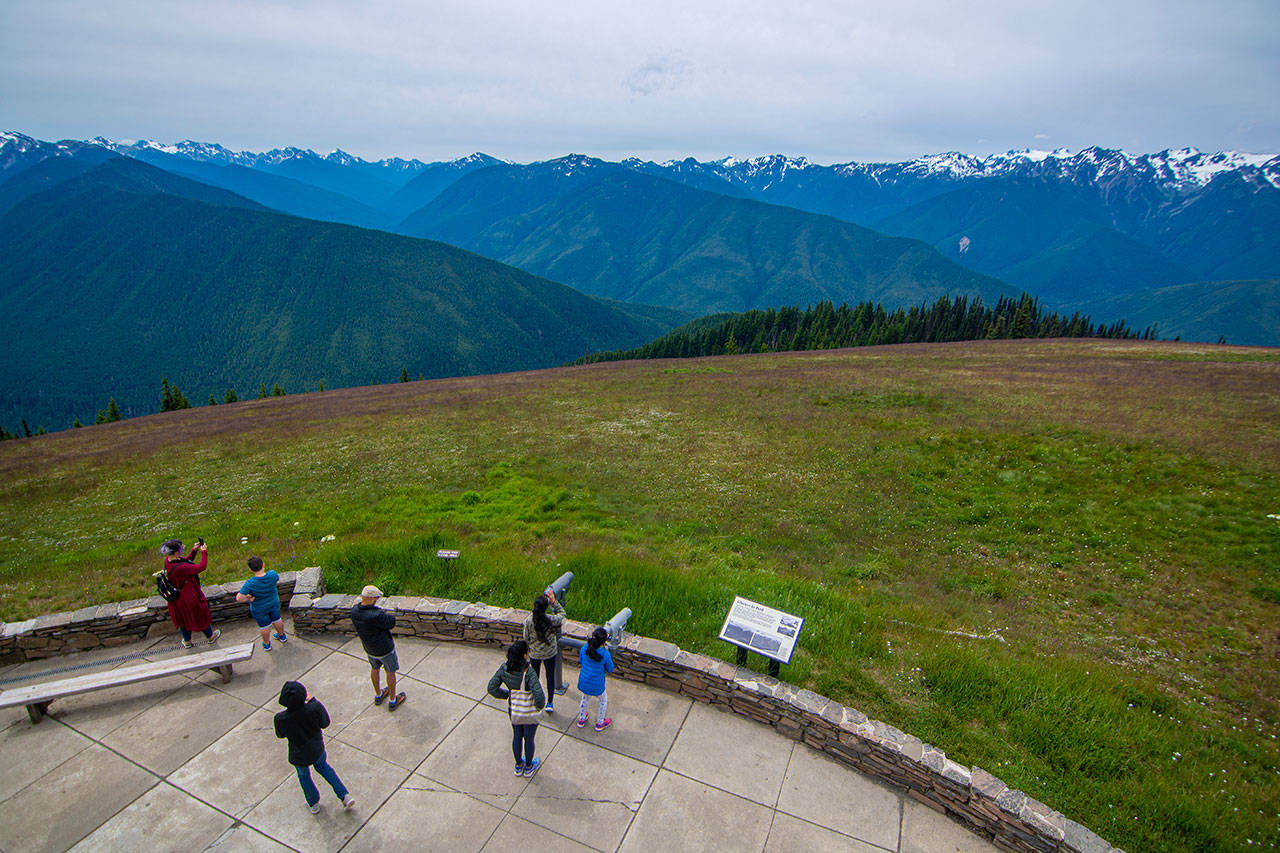
Visitors at Hurricane Ridge view the sights of Olympic National Park as park officials continued to remove mountain goats from the park on Tuesday. (Jesse Major/Peninsula Daily News)
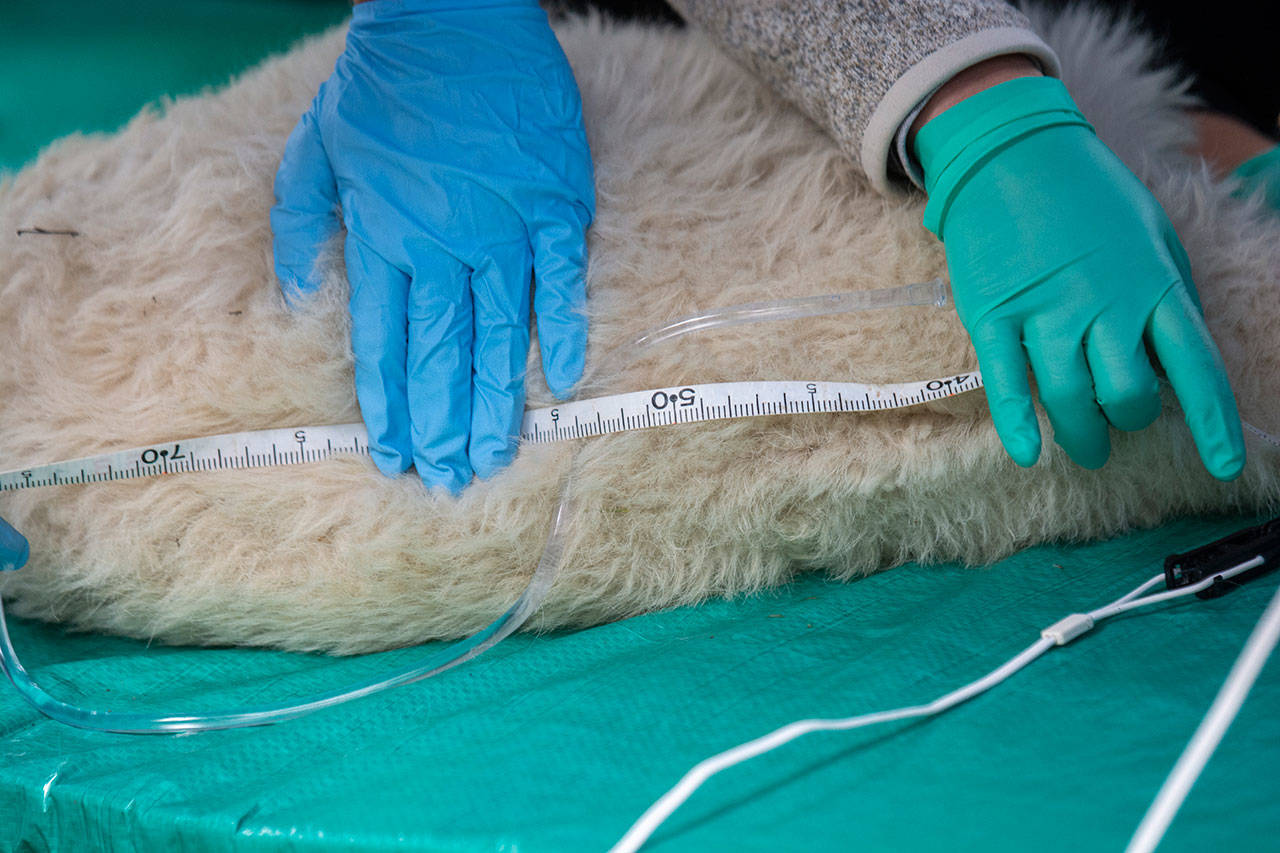
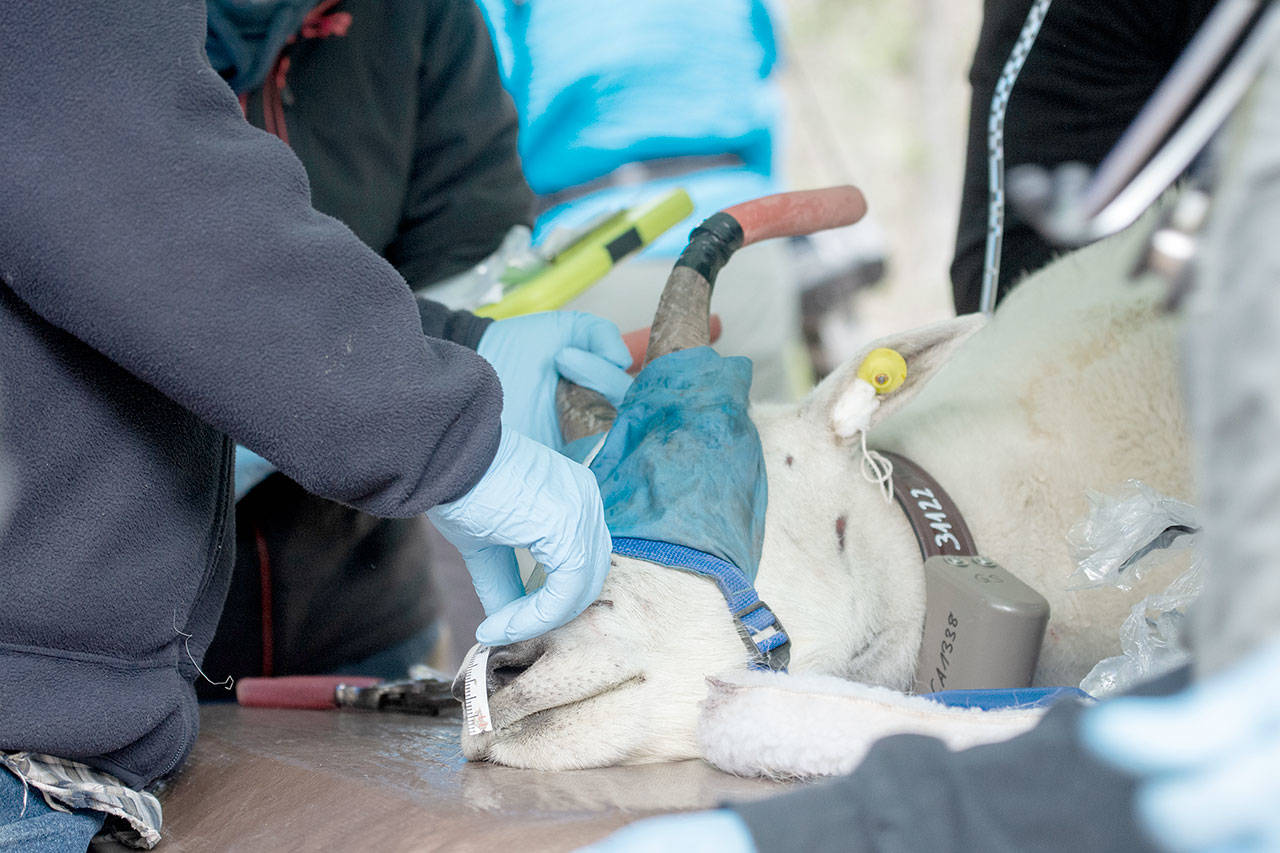
A mountain goat is measured during its examination at Olympic National Park on Tuesday. (Jesse Major/Peninsula Daily News)
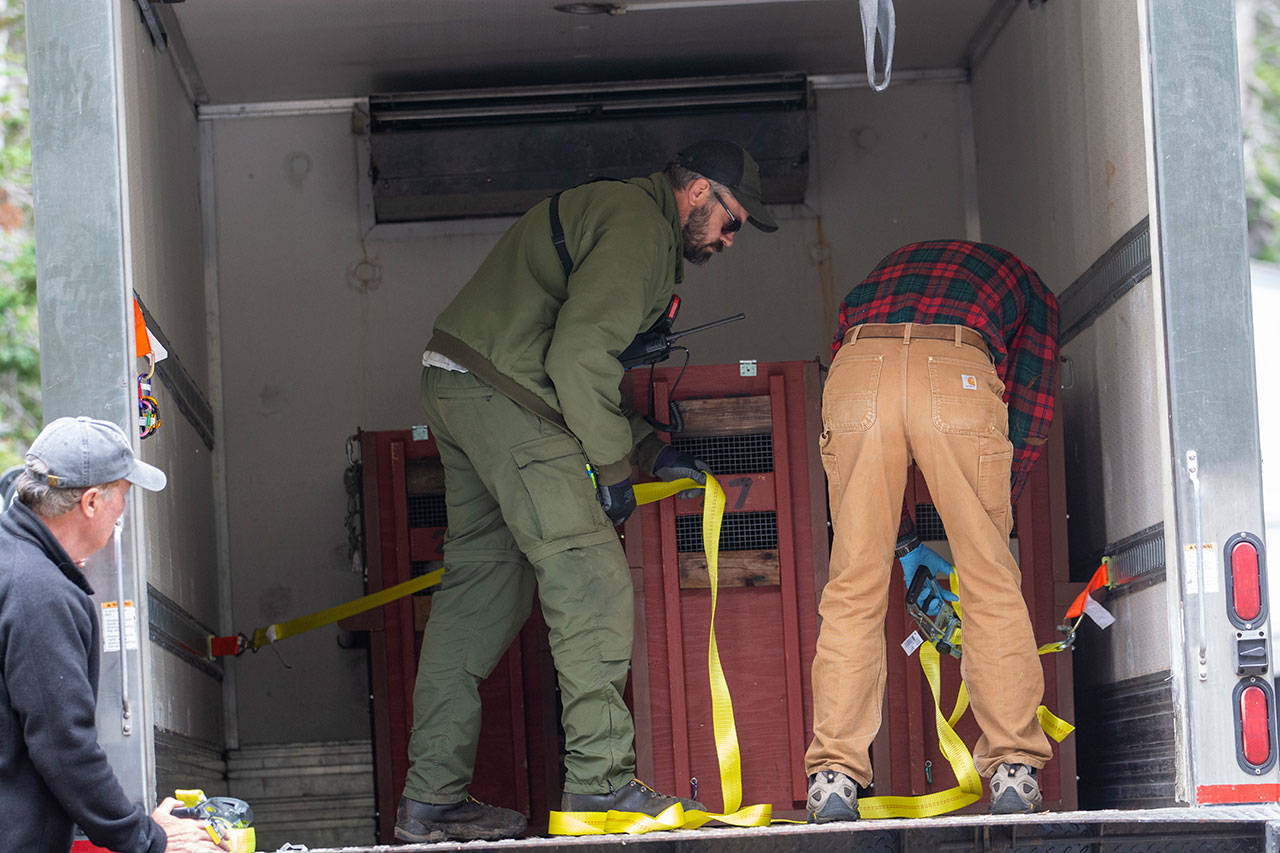
Mountain goats are loaded into a refrigerated truck Tuesday. (Jesse Major/Peninsula Daily News)
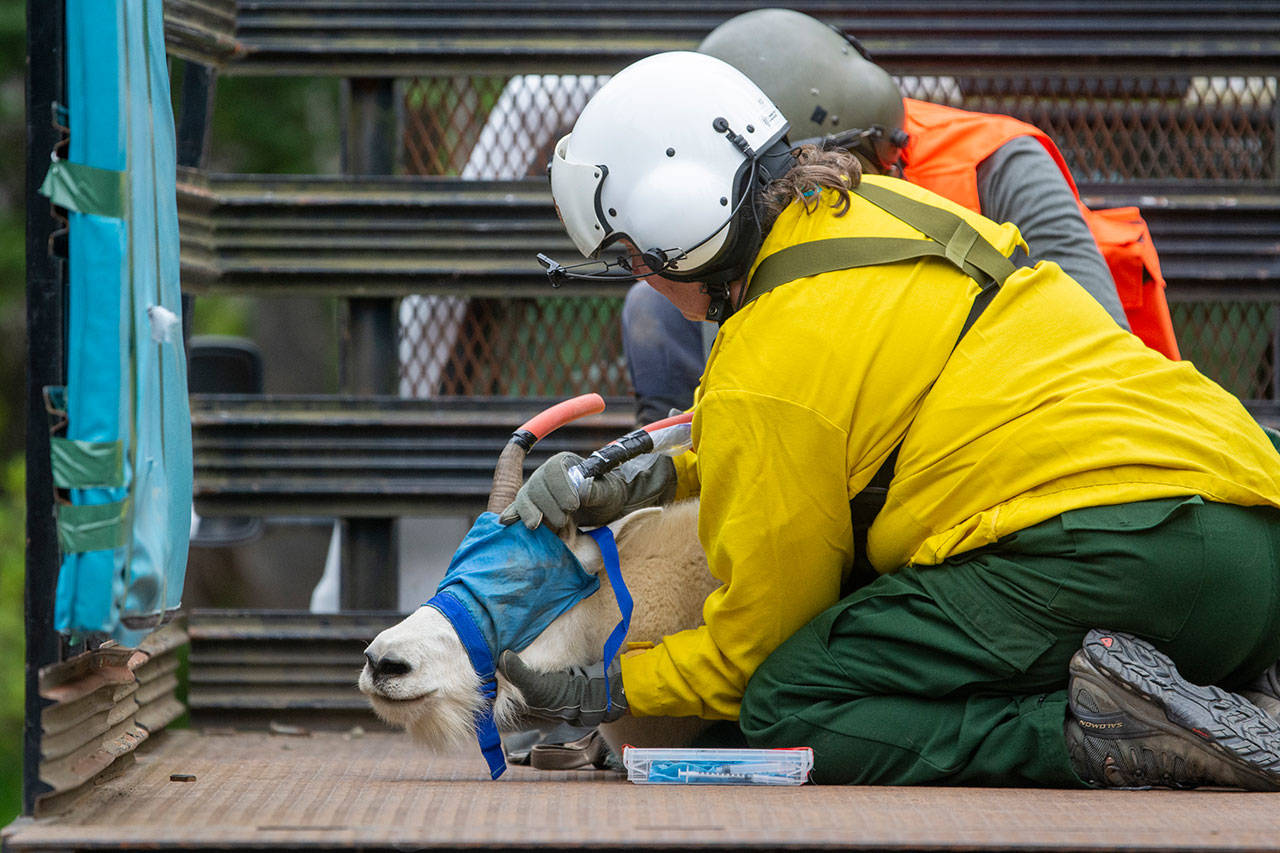
Patti Happe, Olympic National Park wildlife branch chief, holds down a goat in the back of a truck Tuesday. (Jesse Major/Peninsula Daily News)

Crews carry a mountain goat in Olympic National Park on Tuesday. (Jesse Major/Peninsula Daily News)
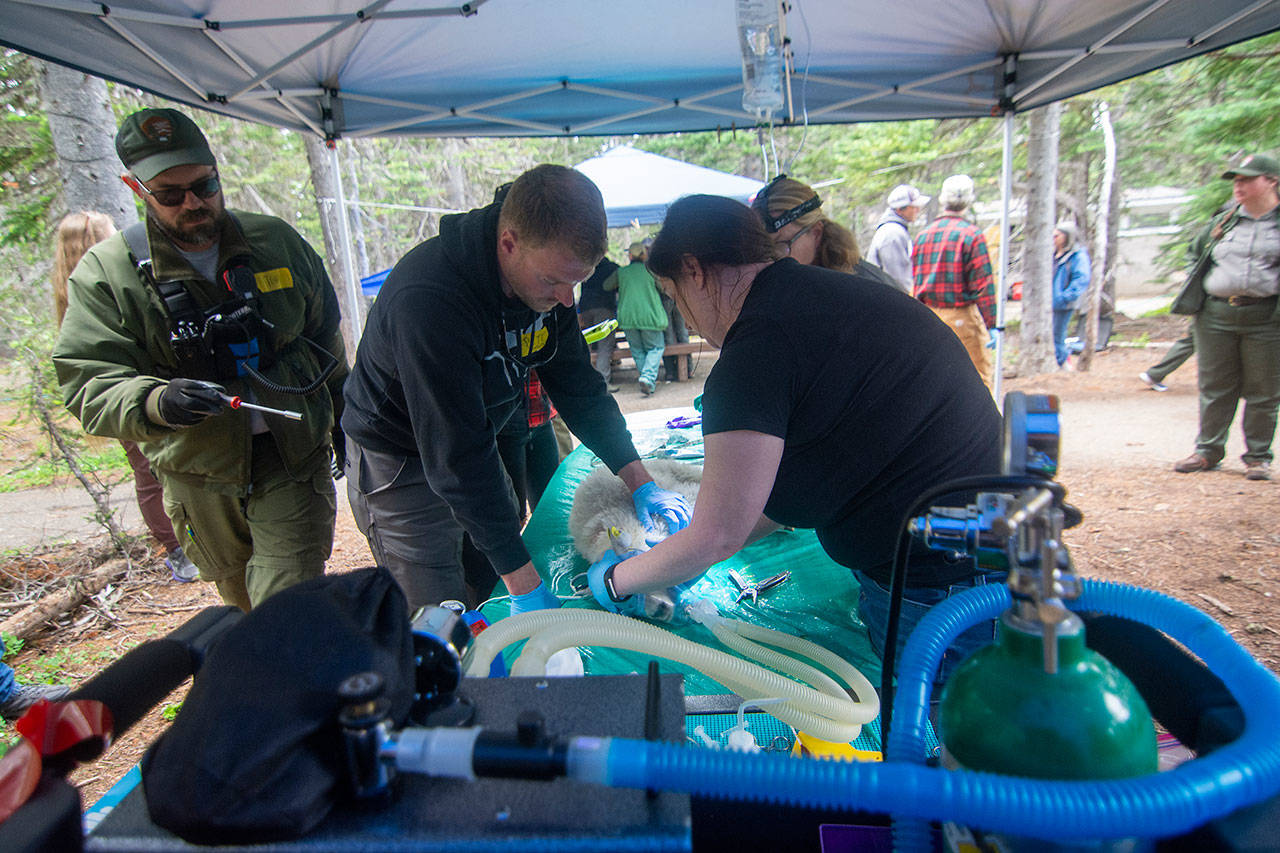
Crews hold down a blindfolded mountain goat kid as veterinarians examine it before transport Tuesday. (Jesse Major/Peninsula Daily News)
