
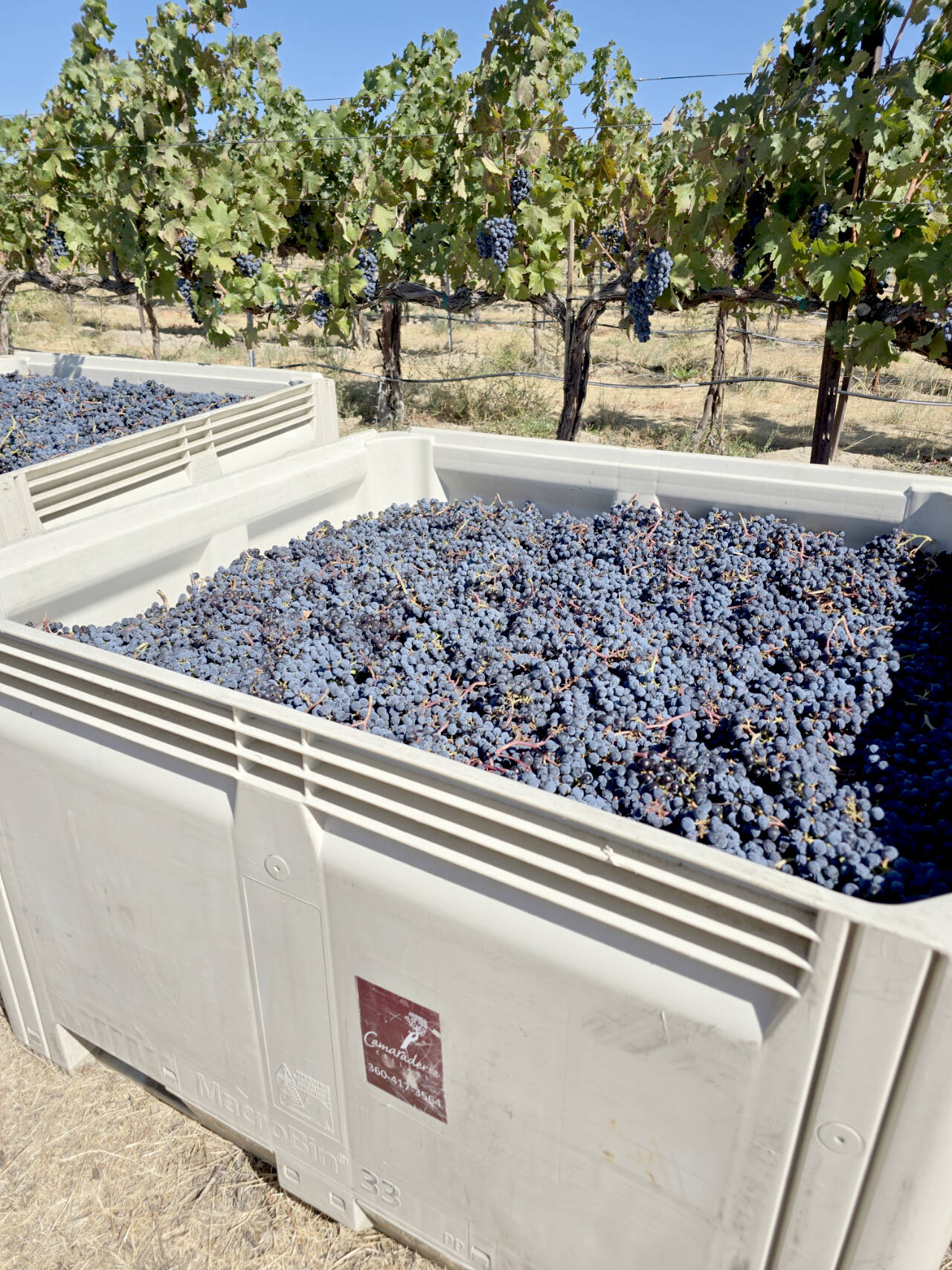
IT WAS A couple of years ago, but I still remember the call vividly.
It was toward the end of harvest, like it is now, and I got a call from the owners of the last vineyard to be picked for the year.
Connie said, in a bit of a concerning tone, “Don, I don’t know if you are tracking the weather report, but this time next week we are supposed to have snow here, maybe a lot.”
Snow? It was way too early to have snow. I’d never had snow this early in all my 30 vintages!
Connie followed up, saying they were getting a crew together for a pick the next Tuesday. “If you want that Tempranillo, you’d better be over here.” Connie always had a very direct way of communicating.
“OK, I’ll be there,” I said, still thinking that snow this early was way out of the ordinary.
As I got into the back roads of the Yakima Valley, where Connie’s vineyard was, I found the roadsides bumper to bumper with pickups and cars from people arriving to pick the rest of the apples, too.
Pickers were in short supply this late in the year, and vineyard and orchard managers put out signs everywhere “Pickers Needed,” (Rocogedoras necesarios in Spanish) to augment their regular crews that had year-round work arrangements.
I had never seen the valley so active before. Whole families, old and young, were out to meet the need for workers and to make some extra cash.
I wove my way to the vineyard, got the Tempranillo loaded and covered with a heavy-duty tarp in case I ran into weather over the pass.
After a few miles on the road back on the interstate, I wondered how the workers got paid. Did the emergency pickers get paid a bonus to help? Did the regular workers grumble, wondering over dinner that night if the temporary workers were paid more than them?
That reminded me of Jesus’ parable, recorded in Matthew Chapter 20, of the landowner who needed workers in his field to bring in the harvest.
Was there a storm coming? Regardless, the parable implied to me an urgency, at least if you have had an experience like I had a couple of years ago.
The owner in the parable kept going back to town over and over to find more workers. At the end of the day, regardless of how long they had worked, he paid them all the same. Some workers, Matthew reports, grumbled at their sense of the owner’s unfairness.
Most commentaries on this passage focus on the landowner’s equal pay for working unequal time in the fields as a glimpse into God’s economy and sense of justice. When it comes to the Kingdom of God, all of us are equal no matter when you enter. “The first shall be last and the last first” … kind of thing.
OK. That’s one insight, but I’m guessing that none of these commentary writers have ever been in the boots of a farmer who has just heard that a major storm is coming and that his entire year’s crop will be lost if he doesn’t get it in pronto.
From my experience, that storied landowner did everything he had to get the crop in and didn’t care much what he had to pay to get enough workers to help him.
I don’t think this parable is as much about equality of wages as it is about another aspect of God that is much more important.
I think it’s about what our Lord, as the landowner in the parable, did to bring in the harvest, and it’s anything he had to.
That fits right in with other parables of Jesus about how a shepherd will search for a single lost sheep or a poor woman’s search for a lost coin (Luke 12).
Remember those stories?
The one sheep and the one coin is a metaphor for you and me when we go astray or choose to hide out in a corner someplace.
So, what is the “harvest” to mean in this parable? I think it is you and me!
Our Lord will go to any extent, pay anything, to bring us home before the storm hits. This isn’t necessarily apocalyptic, end-of-the-world language, the storm could be any number of events or things that seem like the end of the world to you.
As you read this, I will be scheduling my next trip to bring in grapes from another Eastern Washington vineyard. No harvest-ending storms are predicted, but, with climate change, there might be soon, just like a couple of years ago.
If there is, I won’t care at all what I have to pay to get those grapes picked.
The vintage is everything to me, just like you are to our Lord.
_________
Issues of Faith is a rotating column by religious leaders on the North Olympic Peninsula. Don Corson is an Ordained Deacon in the Lutheran Church (ELCA) and the winemaker for a local winery. He is also the minister for Prince of Peace Lutheran Church in Forks. His email is ccwinemaker@gmail.com
