
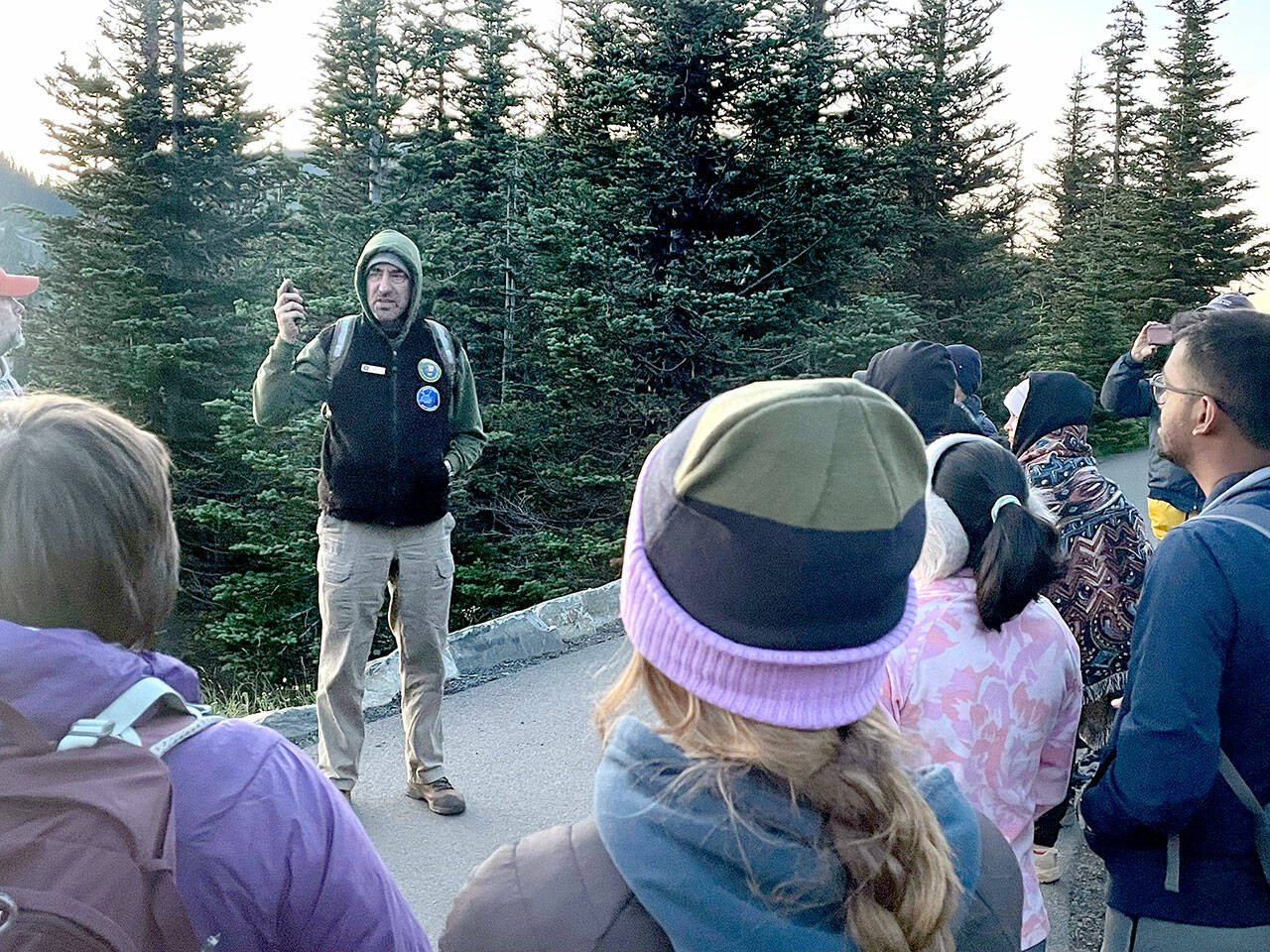
PORT ANGELES — For John Goar, Olympic National Park is at its best when it’s at its darkest.
While most of the attention on national parks is focused on their flora, fauna and landscapes, Goar would like people to recognize that one of their most beautiful and overlooked resources is right above them.
Since he established the Hurricane Ridge astronomy program in 2010, Goar has guided thousands of visitors on tours of constellations, galaxies, nebulae, planets and stars while advocating the importance of protecting dark skies.
It is one of more than 40 astronomy programs at national parks across the country, many led by volunteers like Goar, a certified Astronomical League Master Observer.
The program is free. All that’s needed is a visitor’s pass to enter Olympic National Park.
On a warm Thursday night, when the temperature dropped in cadence with the sinking sun, about 40 people gathered at the Hurricane Hill trailhead for a Full Moon Hike, one of three programs Goar spearheads, along with the Dark Sky and It’s Your Moon! telescope programs.
After a brief introduction from Goar — and a note that a cougar recently seen in the area had been trapped and relocated — the group set out on the 1½-mile paved trail to Victoria Overlook with its view of the Strait of Juan de Fuca to the north and the Olympic Mountains to the south.
An hour later, when everyone had reached the chilly and windy destination, Goar began his 20-minute talk, describing the moonlit sky and identifying with a green laser pointer Cygnus, the Big Dipper and North Star, the Summer Triangle stars Altair, Deneb and Vega, Arcturus, Spica and Antares.
Paul and Jordan Williams from Houston had set out on the hike early to make sure they and their three young children weren’t overtaken by the others on their way up the hill. It didn’t seem to matter.
The entire family — mom, dad, Abram, 9, Audrey, 6, and August, 3 — all made it to the top far ahead of the rest of the group (although August did ride in a carriage).
Jordan Williams said she found the astronomy program on the Olympic National Park website. It was the kind of experience the family enjoys doing together: outdoors and memorable.
“I do a lot of research when we go on vacation,” she said. “The Full Moon Walk looked like so much fun.”
For both Paul and Jordan Williams, the walk reminded them of the starlit skies they grew up with in their small hometown of Salem, Ill.
That experience of a natural nighttime environment is disappearing.
“Thanks to Thomas Edison and the light bulb, we aren’t familiar with the night sky now,” Goar said.
For thousands of years, people depended on stars for navigation, to tell time, as a calendar and for telling stories that entertained and explained their beliefs and history, he said.
Reconnecting with that past is important.
“I really enjoy sharing these things that I’ve learned,” he said. “There’s value in exposing people to the universe.”
Goar’s passion is the Dark Sky Telescope Program that runs through Sept. 21, and that takes place in the Hurricane Ridge parking lot (no hiking required). There are three to four telescopes set up for people to view whatever is in the sky that night: Planetary Nebula M57 (Andromeda Galaxy).
There’s also an It’s Your Moon! telescope program that examines a gibbous or half-moon, and people can observe its features like mountains, craters, valleys and seas.
Goar lives in Silverdale, but during the summer, he mostly stays in a tent at Heart O’ the Hills Campground. His compensation for running the program is a free campsite. In 2016, he received the George and Helen Hartzog Award, the highest honor given to National Park Service volunteers.
The retired middle and high school math and physical science teacher said it isn’t unusual for more than 100 viewers to come to a single event. Last year the program attracted 2,877 participants.
“The numbers continually go up,” Goar said.
Hurricane Ridge isn’t the darkest of the national parks thanks to light pollution from the Seattle metro area. It’s a three on the nine-level Bortle dark-sky scale, which measures the brightness of the night sky. Great Basin National Park in Nevada, for example, is a Bortle scale 1.
Nonetheless, Hurricane Ridge is still a good place to stargaze, even if you don’t own a telescope.
“We can see the Milky Way with the naked eye, which most Americans can’t see at all,” he said.
________
Reporter Paula Hunt can be reached by email at paula.hunt@peninsuladailynews.com.
Hurricane Ridge astronomy program
Reservations aren’t needed, but call after 2 p.m. for program status that day at 360-565-3131, ext. 1.
Programs are free, although visitors must have a pass to enter Olympic National Park.
Dress warmly. It’s always cold and usually windy.
Be on time for the introduction to each program.
Dark Sky telescope program
Meet at Hurricane Ridge parking lot.
July 15-21 at 11 p.m.
July 22-29 at 10:45 p.m.
Aug. 15-18 at 10 p.m.
Aug. 19-24 at 9:45 p.m.
Aug. 25-29 at 9:30 p.m.
Sept. 12-18 at 8:45 p.m.
Sept. 19-21 at 8:30 p.m.
Full Moon hikes to Hurricane Hill
Meet at the Hurricane Hill trailhead, which is 1.5 miles past the Hurricane Ridge parking lot.
Parking is limited, so arrive early.
Wear sturdy shoes; bring hiking poles if you want them.
Aug. 8-9 at 8:50 p.m.
Sept. 6-7 at 8 p.m.
It’s Your Moon! telescope program
Meet at Hurricane Ridge parking lot.
Aug. 2-3 at 9:15 p.m.
Aug. 31 and Sept. 1 at 8:30 p.m.
