
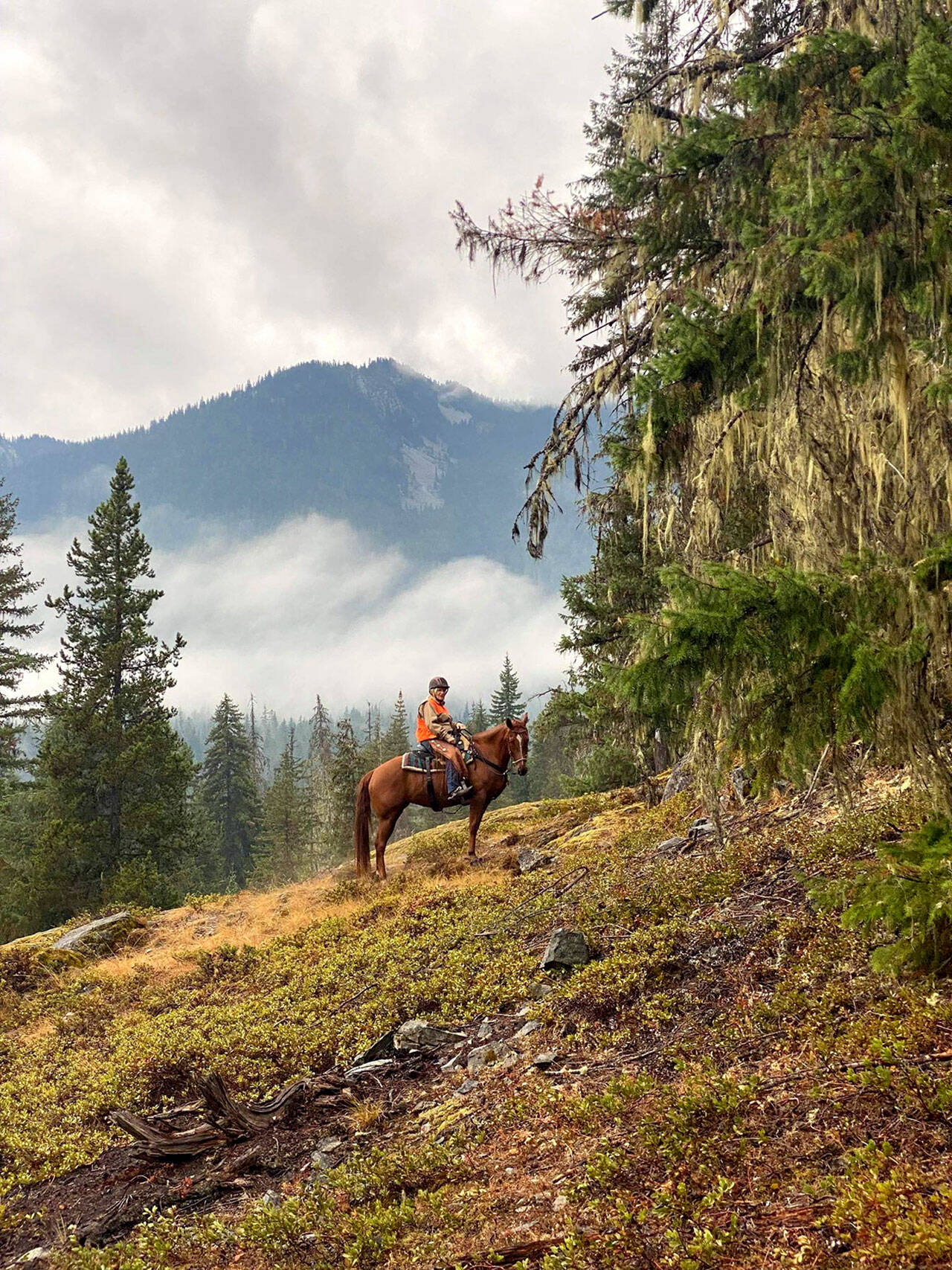
BEWARE RIDING MOUNTAIN trails this time of year, because chances are, someone else is nearby stealthily stalking a stag to kill.
“Bullets from those high-impact hunting rifles can travel far distances fast!” warned avid trail rider and Back Country Horsemen member Judy Dupree. “And while there aren’t as many hunters around here as there used to be, rifles today can be much more powerful.”
Meaning they can travel a farther distance, and faster. And while it’s a law in this state that hunters must pass a safety course before obtaining a license, hunters in general don’t seem to be as experienced as yesteryear.
Hunting season runs from September to December in these parts. A hunter might mistake you for game or miss the target and a bullet (which can travel up to a half-mile) can find you instead.
Back in the day, not only were hunters’ rifles not as powerful, but how far and fast heir bullets would go was estimated by sight and experience. The average rifleman could consistently make good first-shot kills on game out to 250 yards or so, and an experienced shooter out to 400. Beyond that, it was a crapshoot.
Today’s hunting rifles are sleeker, more lightweight and have more areo-dynamic bullets. Shots from a high-impact hunting rifle can typically travel 1,000 to over 3,000 yards, depending on the rifle type and bullet design. A bullet shot from a 222 Remington can travel up to 3,167 feet per second, or over 2,150 mph, and with amazing accuracy when equipped with a laser rangefinder that instantly gives an accurate range reading, plus atmospheric information and ballistic corrections, as well as a scope with a very high magnification of 5X, 6X and even 8X zoom ranges.
Despite all that high-tech gear, accidents continue to occur. Why? While shooting with accuracy has vastly improved, experts say stalking and hunting skills seem to have suffered.
What happens when a new hunter no longer must work for a shot by stalking their target until within a couple hundred yards to make a clean kill? They tend to take long-range shots they are not capable of, resulting in wounded and lost game.
I’ve no objection to humanely killing a deer or elk if the person needs the meat to feed himself and/or the family, but to kill for sport I find a horrible waste of life; it’s unacceptable.
Tragically, thinking they were aiming at a deer, some hunters have mistakenly shot other hunters, horses and dogs in their own pasture, as well as riders on horseback on a trail ride. It’s hard to imagine that a hunter can’t distinguish a horse from a deer or elk, isn’t it? Or that people with such poor eyesight are out hunting with a powerful rifle.
Horrific events such as those likely could have been avoided if those shot were wearing bright orange or pink highly visible vests during hunting season; if the dogs had worn bright neon orange collars and vests when accompanying their owners on trails. If the horses in their pastures wore brightly colored turnout blankets and then a bright orange saddle pad and headstall when ridden.
It’s only common sense that all trail users should wear bright orange or pink during hunting season.
And remember: There are people out there who think it’s OK to hunt without a license, and they don’t care about the rules and regulations, so stay safe and wear those bright colors.
The plan
Good news! Thanks to the help of my fellow volunteer committee members — Mark Bowman, Ed Banuck, Kathie Coakley, Eileen Damien, Shari Hamilton, Lisa Hopper, Julie Kustura, Mel Marshall, Ed and Mary Oquendo, Debi Pavlich-Boaz, Judy Sarles, John Temple and Shell’ey Van Cleave — our work on putting together Clallam County’s new Animal Disaster Plan is now completed and in the process of review by Emergency Management, Sheriff’s and Auditor departments. I’m told the process will take about three months. Once completed, it will go to the county commissioners for final approval. Then it becomes part of the county’s Comprehensive Emergency Management Plan (CEMP), which is enacted when a mega disaster occurs.
Now, under the name of Clallam Animal Response Team (CART), we begin organizing our group to better enable us to help the county by offering temporarily shelter and care for large and small animal issues during any disaster, not just mega disasters.
First step, formalizing CART into a 501(c)(3). Then, we can start taking donations to help us purchase needed supplies. More on that later.
I enjoyed greeting many of you at the Sequim Safety Fair on Oct. 4. We had 26 people sign up to help CART with disaster response. Please note that anyone signing up now is in no way, shape or form obligated to help during a disaster. Situations and circumstances are constantly changing. We get that.
The point is, if you think you can help, want to help or have a burning desire to help in the future, please email us at clallamanimalresponse team@gmail.com.
________
Karen Griffiths’ column, Peninsula Horseplay, appears the second and fourth Saturday of each month.
If you have a horse event, clinic or seminar you would like listed, email Griffiths at kbg@olympus.net at least two weeks in advance. You can also call her at 360-460-6299.
