
SEQUIM — Faith Lutheran pastor Roger Stites reflected on a challenge that has become all too familiar for congregations across the country: the scarcity of skilled church musicians, especially those steeped in the Lutheran tradition.
“Church organists and church musicians don’t grow on trees, and Lutheran ones really don’t,” Stites said.
For decades, Faith Lutheran’s answer to that challenge was Pat Marcy, a dedicated organist whose service spanned half a century.
“Pat had a level of experience that I was not familiar with because she had been here 30 years when I came here,” Stites said. “She just kept saying, ‘I’ll just keep playing. I’ll just keep playing.’”
Marcy’s devotion was legendary — she played at her mother’s funeral, and then her husband’s, never missing a Sunday, even as age and health challenges mounted.
“Being on the bench was who she was, and that was a real example to me to see her dedication and her devotion to her craft and to everything,” Stites said.
But time, as always, pressed forward.
“As she got older, as she had more personal health problems and other things, as we faced COVID and other things, she came to me a couple of times expressing her desire to retire,” Stites said. “And I always said, you know, there’s other electronic options that we can do,” such as hooking a computer to the organ.
For Marcy, though, that simply wouldn’t do. She told Stites, “I will gladly play the organ every Sunday until you have a human being to replace me.”
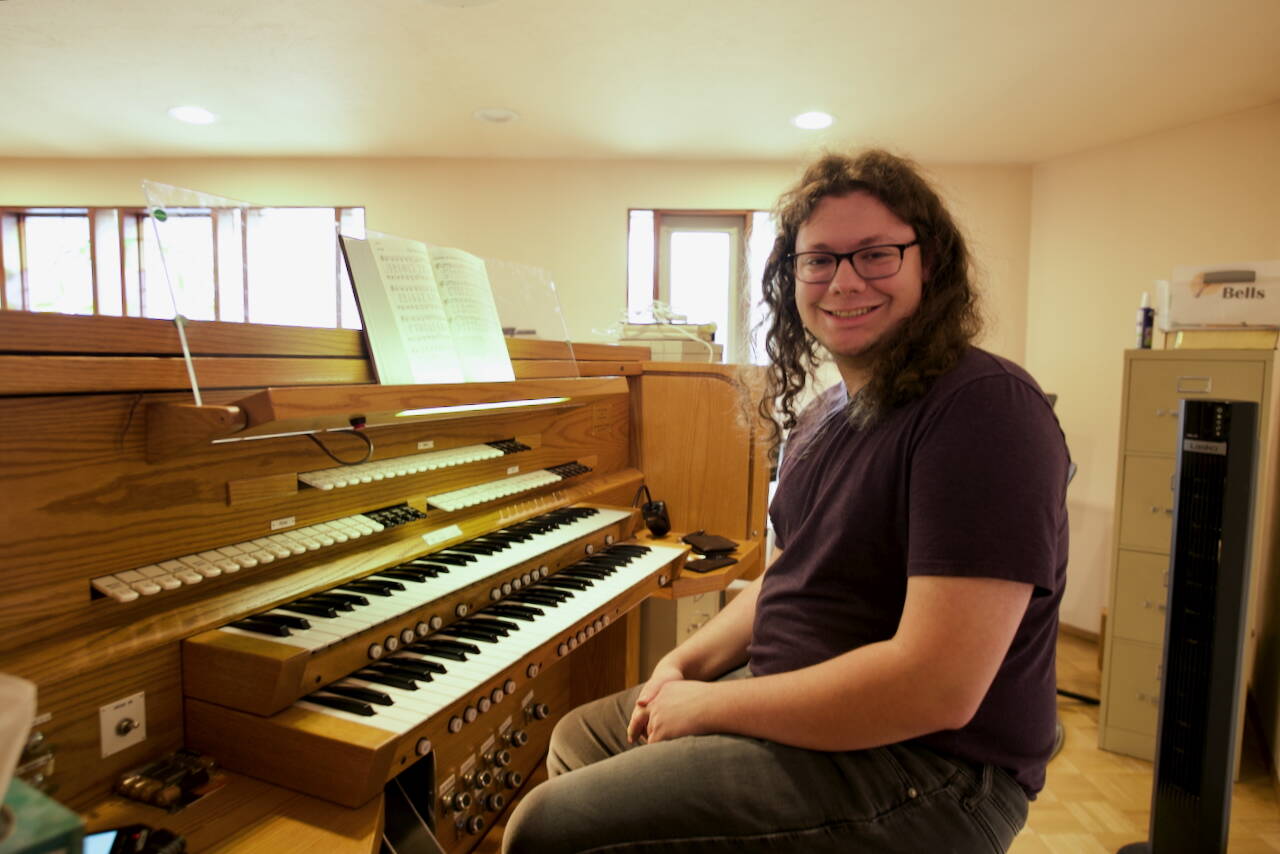
Stites made some calls and found Ryan Edinger, a 23-year-old Lutheran organist from Wentzville, Mo.
“We all knew it was supposed to be. So it all worked out,” Stites said, describing the congregation’s relief and joy at finding a successor.
The congregation was surprised that Marcy’s successor was so young.
“Young Lutherans, again, are not — they’re not grown on trees,” Stites said.
“It’s a lot of generational Lutherans who, when they have time in their retirement, they come to church, and young families are busy, and in a post-COVID world, ever more busy.”
The arrival of a young, classically trained organist was a rare and welcome event.
Edinger’s journey to Faith Lutheran is a testament to the power of tradition and calling.
“I was 3½ or so when I started piano, and 6 or 7 when I started organ,” he said. “So this has been a long time coming, a lot of practice, a lot of talent and a lot of prayer.”
After graduating high school in 2021, Edinger attended Concordia University in Nebraska, a Lutheran institution, where he was director of the parish music program. He earned an undergraduate degree that included music and theology courses.
The unique blend of skills prepared him to lead a congregation in worship, and he’s been welcomed warmly in Sequim.
“Everyone here at Faith in particular has been very welcoming and been nothing but encouraging and generous to me so far,” Edinger said. “They made sure that I would have no choice but to fit in … in the best way.”
As he reflected on the legacy he inherits, Edinger said there is “definitely an element of passing the torch.” When the Faith Lutheran sanctuary was built in 1975, “praise bands were taking American Christianity by storm,” he said, “which is why (Faith Lutheran’s) sanctuary wasn’t built to have an organ put in it.”
Nonetheless, the church retrofitted the space with an electronic organ, and in 1991, purchased a custom-built instrument from Associated Organ Builders of Auburn.
A marvel
The organ itself is a marvel of analog engineering, with 57 speakers for different ranks.
“One of the speakers was buzzing when certain notes were played because a part of the casing had come unglued … so we just swapped out,” said Tom Brittani, who is skilled at repairing organs. “The octron speakers are in very good shape, and the part that holds the paper cones in place is made of treated fabric. It lasts forever.”
Edinger brings not only technical skill but also a deep sense of the organ’s role in worship.
“The organ is the king of instruments in the sense that it’s close to the human voice and is used as accompaniment to lead the congregation in liturgy and to help them sing on pitch,” he said. “If I were doing my job right, I could drop out … and the congregation would just keep singing like nothing happened. That’s my goal, basically, is to inspire confidence, blend in as much as possible, and even the role of coloring the music, just by coloring the way that I’m playing, becomes secondary to that.”
Edinger wears special shoes while playing the organ.
“The shoes have a narrow toe and a wooden block on the heel, and suede on the bottom” he said. “These help you for playing (the organ) with your feet. So, with your narrow toe, you have more accuracy. The pedal board allows for deep bass notes, and a skilled organist can play entire passages with their feet alone — a technique that has evolved over centuries.
“Using the heel and pedal technique was not common in early Baroque and prior … some Baroque and Renaissance organ teachers will teach alto technique. You don’t get to use your heel, so you really don’t, unless you’re playing some sort of, like, late Bach work, where it’s required, and those aren’t too common. That was very much an innovation that happened after the Baroque period.”
But the organ’s power is not just technical — it is spiritual and historical. Edinger’s repertoire includes the Nunc Dimittis, a traditional liturgy that predates musical notation.
“Almost certainly, back then, it would have all been oral tradition,” Edinger said.
The chant connects the congregation to the earliest days of Christianity, when monks would sing in stone halls and chambers, filling the space with sound that compels deep contemplation and listening.
The history of worship music is, in many ways, the history of the church itself.
“The traditional hymns and the organ mimic the human voice, and it’s sort of an accompaniment for the village, right?” Stites said. “I guess, in a way, to have the singer sing on key, so even if the organ stopped, they could keep singing in this proper pitch.”
At Faith Lutheran, the organ playing didn’t stop with Marcy’s retirement. The torch was passed to a 23-year-old man who is determined to keep it burning.
________
Jacques Star is a reporter with the Olympic Peninsula News Group, which is composed of Sound Publishing newspapers Peninsula Daily News, Sequim Gazette and Forks Forum. He can be reached by email at jacques.star@sequimgazette.com.
