

AN OLD FRIEND of mine sent me some old Port Angeles newspapers. It was fun to rummage through them. My attention was quickly drawn to a headline written in bold capital letters, “AN APPEAL TO CONGRESS!” This was in the January 17, 1933, edition of the Port Angeles Evening News.
The subheadline read, “STOP Making America ‘The Financial Milk Cow of the World.’” Considering the political and financial turmoil in our current context, I had to read it.
I was also drawn to consider the context under which this article was written.
First, it was the Great Depression (1929-1939). The world was in a severe economic downturn.
Second, there were high rates of unemployment and drastic reductions in industrial production.
Third, there was widespread business failures.
There had been a period of industrial growth prior to the Depression. The industrial production needed in the United States to fight in World War I turned into post-war industrial growth.
The Mexican Repatriation Program of 1929 resulted from the Depression. Under the Government’s belief that they were creating jobs for “real Americans”, people were rounded up and sent to Mexico. Some were even American citizens.
During this time, immigration was very limited due to the economy and tight policies. The fear was immigrants would take much needed American jobs.
Things seemed so desperate that there was serious consideration to giving President Roosevelt dictatorial powers. Roosevelt stated he was ready to assume extraordinary powers if Congress failed to act against the financial emergency. That was a bit terrifying since Roosevelt had very broad support. Yet, President Roosvelt chose to stay the course with democracy.
Even then, there were conspiracy theories out there. A member of my family, Lewis R. Thompson, had his grave marker made well before his death. On it was written, “A money changers planned depression of 1930s robbed us financially.” Lew’s family made it clear that they would not use that grave marker when he died. Lew died in 1974, and his official grave marker has only name and dates on it. The offending grave marker currently sits quietly beside my house. (Yes, that is a level of weird.)
You can argue that war ended the Great Depression. Quite rapidly we had to increase production in our factories to support World War II. It also required a significant increase in the employment of women. Unemployment dropped from the 15-20 percent range to around 5 percent.
This provides some context for this 1933 article.
The article was written by William D. Welsh, who was a publisher of the Evening News along with E. B. and Jesse Webster.
I do not know if this was an actual letter to Congress, or simply an article written in that style. Regardless, Welsh held some strong views.
“Gentlemen of the United States Congress:
This appeal comes from Port Angeles and the vast Olympic Peninsula of Washington State, where industry, fisheries, mining, farming, shipping, commerce and labor of a once prosperous people have been trampled underfoot by a devastating and unfair competition from nations operating under depreciated currencies.”
In other words, the value of other currencies was far below the U. S. dollar. One solution supported by Welsh was to ask Congress to pass H. R. 13999. I do not have the details of this resolution, apparently it would attach a duty onto foreign products counteracting the differences in the value of other currencies.
Both tariffs and customs duties are a form of tax on imported goods.
Welsh’s specific concerns were also enlightening.
“MOUNTAINS OF AMERICAN MANGANESE” “Thirty miles west of Port Angeles, millions of tons of manganese ore have been located and staked out in the Olympic mountain ranges awaiting a day when congress halts the flow of Siberian-mined manganese from being dumped onto the American market.”
In hindsight, manganese never became an economic boon to the Olympic Peninsula. I wonder where it all is.
“COAST FLEET BEING SCUTTLED” Welsh laments loss of Washington’s fishing fleet. Welsh estimates it to be 1,000 salmon purse seiner and trolling boats, plus halibut boats. The value of the Japanese yen was so low that their salmon and other fish damaged our markets. “For the first time in history government vessels and charity organizations donated fuel and food to Pacific coast fishermen.”
Welsh laments that our salmon canners could normally sell their product at 75 cents for a dozen cans. Yet canned salmon imported from Japan sold for 30-37½ cents for a dozen cans.. These prices seem remarkable, but 75 cents in 1933 is equivalent to $18.45 today.
“PULP AND SAWMILLS CLOSED DOWN” Welsh writes that the wood and paper industries employed 1,200 people, with an equal number employed in the woods. Yet, wood products imported from Canada, Sweden, Denmark, and Norway were cheaper and reduced our production by about 80 percent.
Welsh added, “Gentlemen, within one mile of where this is written, stand four great sawmills, shingle mills and pulp and paper mills that in 1929 employed 1,200 men. These mills are idle – gray, smokeless ghosts of a prosperous day existing before slumbering American leadership ‘sold them down the river’ to an economic foe.”
This has a familiar ring to it in today’s context.
“MENACE OF CHEAP FOREIGN BUTTER” Butter? Really? According to Welsh, cubes of butter produced in New Zealand undercut American prices. Even after the cost of shipping butter 6,000 miles, plus a 14 cents per pound tariff, New Zealand butter was selling for 26 cents per pound, well below the American price.
With more than a faint hint of hyperbole, Welsh also wrote, “Within eight blocks of where this is written, a tiny girl fainted from hunger on school one December day, and when revived by her teacher and asked what was wrong, said: ‘Teacher, it was brother’s turn to eat today.’ What is written in tears and suffering in Port Angeles is written in the same indelible fluid in every city and hamlet in America.”
In bold text across the bottom of the newspaper, Welsh wrote, “Passage of H. R. 13999 Will Take Millions of Americans Out of the Bread Lines.”
When I read this 92-year-old article I saw similarities to today’s political environment. Yet, most people do not realize that issues from the past may rise up again in our day. A look at the past can help us understand the present. Successes and failures from the past can help us make the right choices in the present.
________
John McNutt is a descendant of Clallam County pioneers and treasurer of the North Olympic History Center Board of Directors. He can be reached at woodrowsilly@gmail.com.
John’s Clallam history column appears the first Saturday of every month.
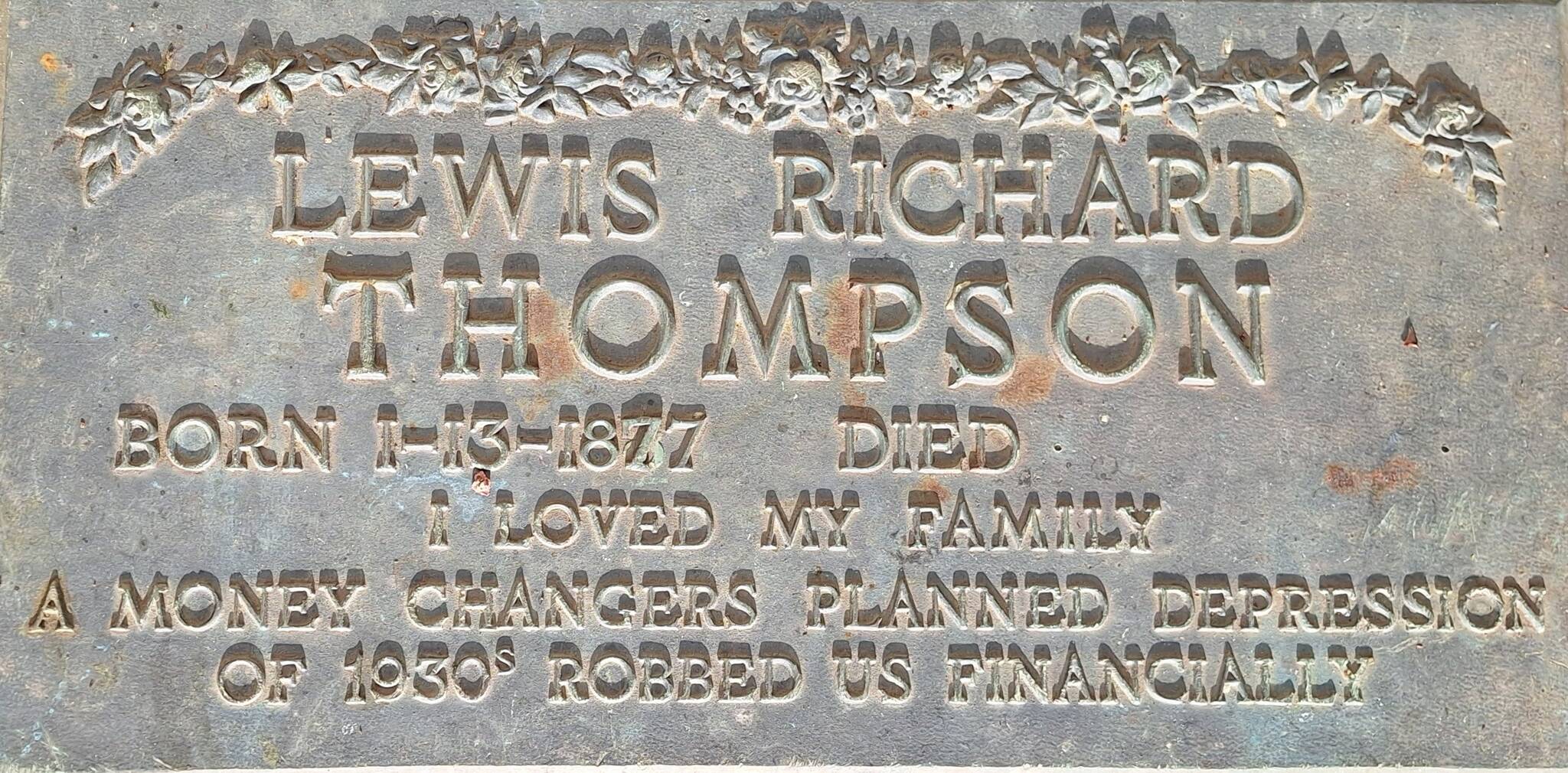
The gravestone of John McNutt’s relative from the 1930 that references the Great Depression, but wasn’t used by his family.
