
WHAT’S IN A name? We do live in an area with many interesting names. Some of those names have roots in indigenous language. Other names can be simply geographic descriptors, such as Burnt Mountain. Some names came from the families that homesteaded there, such as Hecklesville.
Hecklesville is along US 101 in the Soleduc valley. All that remains of Hecklesville is a WSDOT maintenance shed.
So, where did Sappho get its name?
What makes Sappho interesting is that the source of its name is not absolutely clear, although some pioneer families will disagree on the source. There is also some fog surrounding who named Sappho.
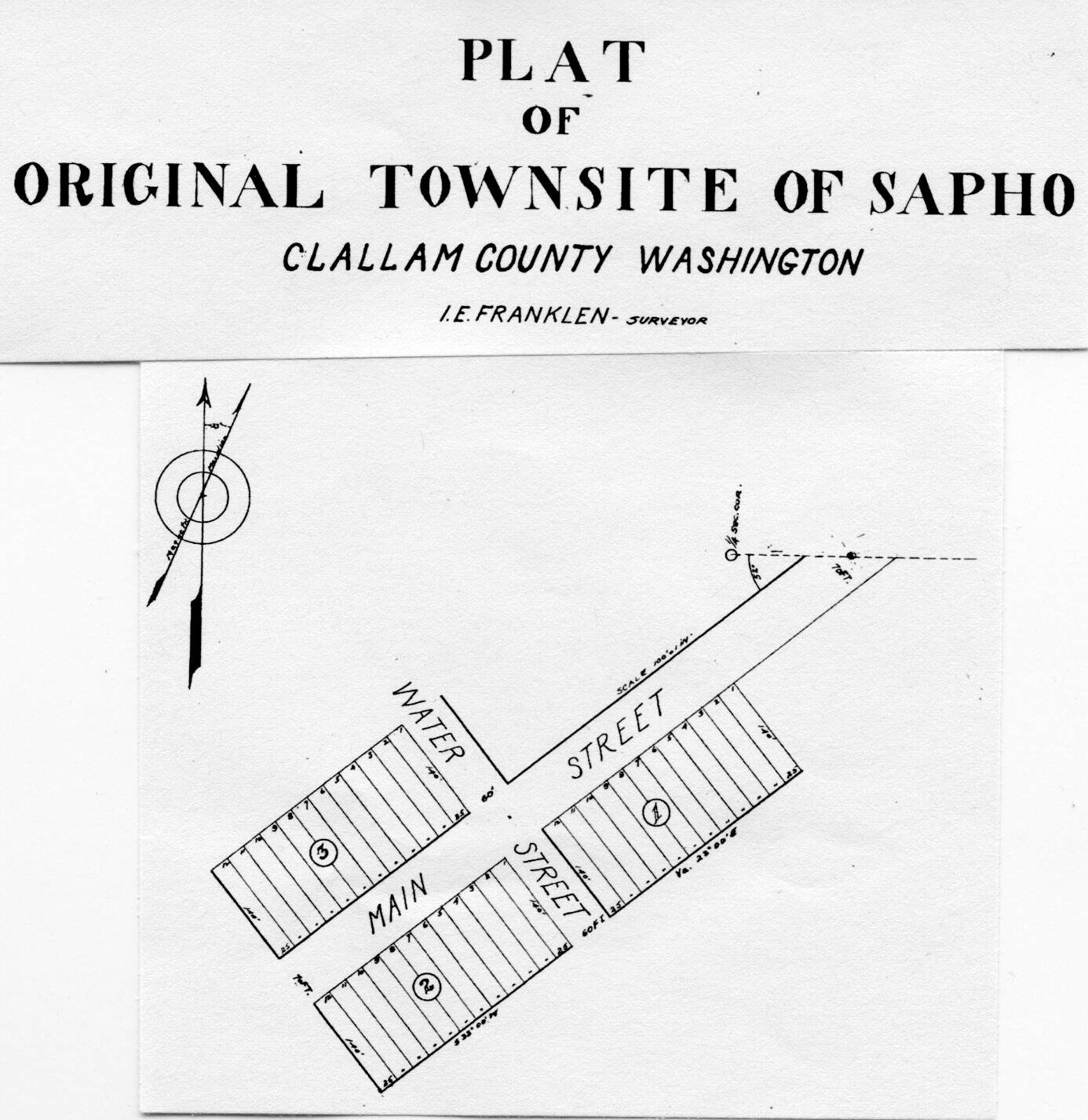
Street and property layout of Sapho. (PHOTO SUBMITTED BY JOHN MCNUTT)
I will give you two options regarding the source of Sappho’s name.
Option 1: Sappho was named after a Greek woman poet who lived around 600 B.C. (c. 630 – c. 570 BC).
Harriet Fish described Sappho as a poet “whose poetry showed intense but controlled emotion expressed in down to earth, everyday language.”
Sappho was an archaic Greek poet from Eresos on the island of Lesbos. Sappho was known for her lyric poetry, which was written to be sung. She was regarded as one of the greatest lyric poets. Her best-known and best-preserved fragments explore personal emotions. Sappho was known for her clear language, vivid images, and positive feelings towards other people.
Sappho was a prolific writer possibly composing around 10,000 lines of poetry. That is an estimate based upon references by other writers. Only about 650 lines of her actual poetry have survived.
The word “lesbian” is an allusion to Sappho. The word originated from the name of Sappho’s island home of Lesbos.
In modern culture, Sappho is seen as lesbian. She was not always viewed that way. In classical Athenian comedies, Sappho was viewed as a promiscuous heterosexual.
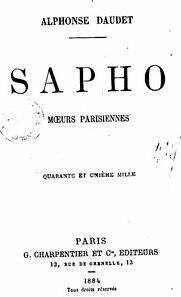
Cover from the book “Sapho” by Alphone Daudet. (PHOTO SUBMITTED BY JOHN MCNUTT)
Daudet was born in 1840. In 1856 he left home and became a schoolteacher. Teaching was intolerable for Daudet. For months after leaving teaching behind he would wake up in the middle of the night believing he was still among his unruly pupils. I suppose some teachers can relate to this.
Alphonse then began writing poetry and his first collection of poems was published in 1858. By 1876 Daudet turned to writing novels and writing for the stage. His first novel was titled “Jack,” which was about an illegitimate child who was a martyr to his mother’s selfishness.
He became a successful “man of letters” and wrote several novels, including “Sapho” in 1884. Daudet dedicated this book to his sons, to be read by them when they reached the age of 21.
James L. Ford, in his forward to an English translation of Sapho states, “I do not see how any intelligent young man can fail to be influenced by the reading of this great book, which is strong with truth and strength of Hogarth and permeated throughout with the subtle keenness that we look for in the highest forms of French art. It is, above all, a book to be read and felt, and then remembered for all time.”
Quite an endorsement, I must say.
Poverty and venereal disease eventually cost Daudet his life.
Where do you think Sappho’s name came from?
The next question is, who named Sappho?
The Spring 1987 edition of the Columbia Magazine stated that “The name was reported to have been bestowed on the former logging camp headquarters in west-central Clallam County by Joe Meeley, a construction worker of Greek origin.” This was gleaned from Robert Hitchman’s Place Names of Washington published in 1985. Hitchman also noted that “Sappho would not have enjoyed life in Sappho.”
For historians, Meeley is not the predominate choice since there is no corroborating evidence.
Rather, the naming of Sappho boils down to two individuals, Frank M. Ackerly and Martin van Buren Lamoreaux. Kay Lamoreaux believes Lamoreaux established Sappho in 1889. The first documented name was established by Frank M. Ackerly in 1895.
I think the answer sits in plain sight. Follow the chronology. The Feb. 15, 1895, edition of the Democrat Leader published an article titled “Sapho”. It highlights the establishment of a townsite in the interior to afford better accommodations and services for local settlers.
“This will be the object of the promoters of the new town to be established two miles northeast of Beaver, and which will be christened “Sapho.” Sapho was platted at a halfway point between Pysht and Mora to accommodate travelers and freight.
Even before it was officially platted some lots were already spoken for and buildings began to spring up.
Frank M. Ackerly owned the land and dedicated the land as the Original Townsite of Sapho. Like today, the person dedicating a plat also names it. He signed it on May 25, 1895.
The plat was acknowledged by the area’s Commissioner of the United States Circuit Court, Martin van Buren Lamoreaux. He also signed it on May 25, 1895. The plat was finally approved and filed by Clallam County on Feb. 17, 1896.
It is easy to conclude that “Sapho” was the original intended name since the names of both Ackerly and Lamoreaux appear on the plat of the Original Townsite of Sapho.
Newspapers noted in 1900 that Frank M. Ackerly was commissioned as Postmaster at “Sapho.” Local telephone directories from 1915 and 1916 listed “Sapho” as a location requiring a toll call. By the 1930s telephone directories were using the name “Sappho.”
In contrast, an old undated photo shows the “Sappho Hotel.”
Research is important since time can cloud things and memories can fade.
Piecing the puzzle together is what can make history so much fun and interesting.
Oh, by the way. My vote goes to Daudet’s novel as the source and Ackerly as the person who named “Sapho.”
I could be incorrect.
Names sometimes change over time.
________
John McNutt is a descendant of Clallam County pioneers and treasurer of the North Olympic History Center Board of Directors. He can be reached at woodrowsilly@gmail.com.
John’s Clallam history column appears the first Saturday of every month.
