
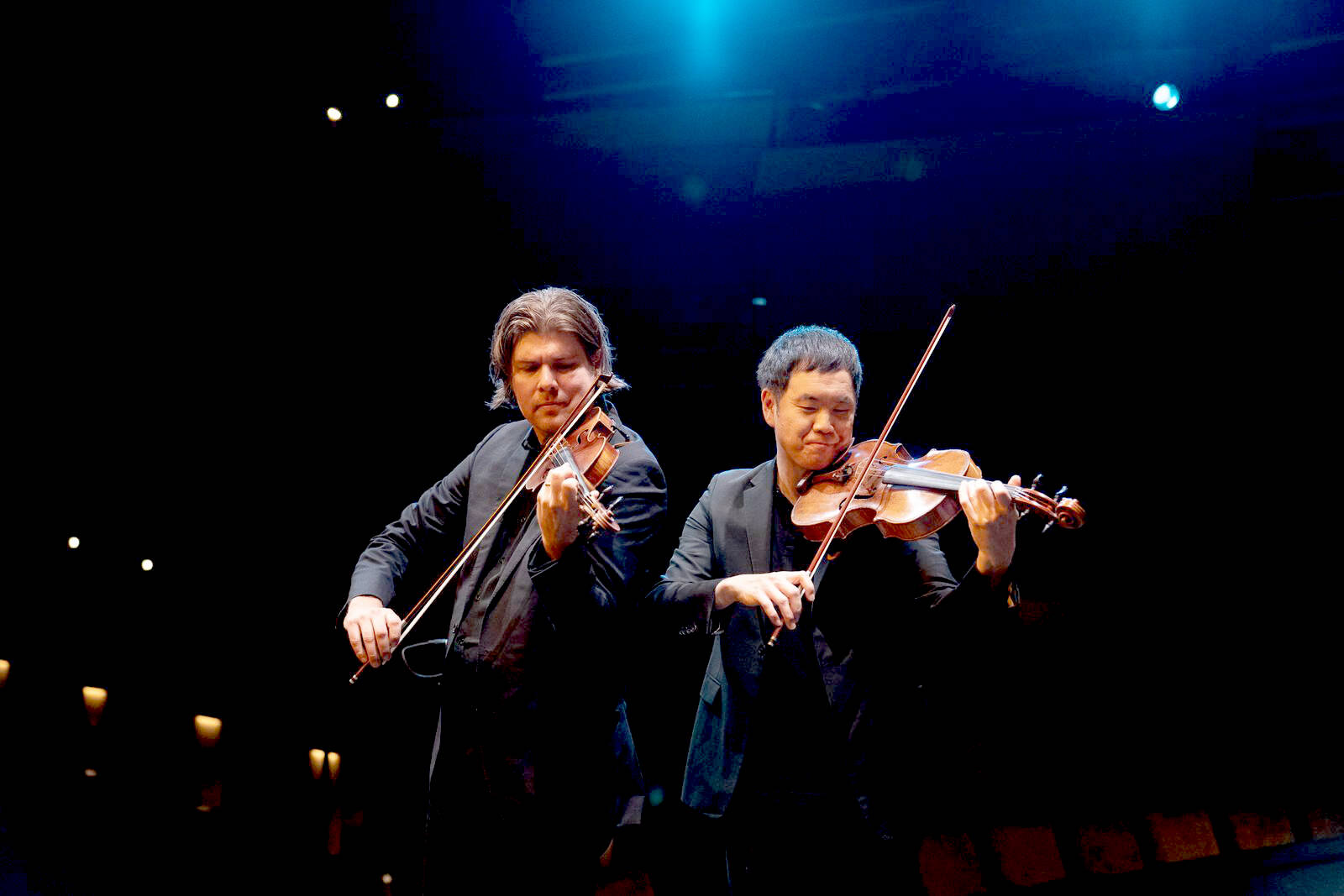
PORT ANGELES — A quartet of renowned classical musicians will play a concert to honor Alan Iglitzin — violist, teacher and founder of Concerts in the Barn and Olympic Music Festival.
Iglitzin passed away on Sept. 15 in his home on Bainbridge Island. He was 93 years old.
“Iglitzin was a force, a true force for good for all things chamber music in Washington state, the Pacific Northwest and Seattle,” said Sequim-raised, grammy award-winning violist Richard O’Neill, who now performs on Iglitzin’s viola.
Iglitzin gave O’Neill the viola about 10 years ago, he said. Iglitzin also gave O’Neill his first viola as child, previously he was a violinist.
The concert will take place at 7 p.m. Tuesday at the Field Arts and Events Hall, 201 W. Front St.
Ticket cost ranges from pay-what-you-want starting at $5 to $56.78 including fees, and can be purchased at tinyurl.com/9pxr6ssa.
A free livestream will be available at musiconthestrait.org/ or on Music on the Straight’s Facebook page.
The evening will feature pianist Jeremy Denk, violinist James Garlick, violist O’Neill and cellist Efe Baltacigil.
Garlick called Denk one of the most in-demand classical concert pianists alive. O’Neill may be the greatest living violist, he added. Balatacigil is the principal-cellist of the Seattle symphony, he said.
The evening’s program includes three pieces, each by French composers: “Sonata for Cello and Piano” by Claude Debussy, “Harold in Italy for Viola and Piano” by Hector Berlioz, arranged as chamber music by Franz Liszt, and “Piano Quartet No 2 in G minor, Op 45” by Gabriel Faure.
“Sonata for Cello” was written late in Debussy’s life as one of six sonatas he intended to complete. He died having only written three, Garlick said.
“Harold in Italy” is a piece with many layers of personal and musical significance for O’Neill.
The titular character in the piece is not an extroverted character, he is more like an anti-hero, O’Neill said. This makes the viola, which often acts as a support instrument, the perfect casting.
The piece was commissioned by Italian violinist and composer Niccolò Paganini, who was unsatisfied by the composition. He wanted something more showy, O’Neill said.
“When it’s active, it’s not showing off and being like a type-A extrovert,” O’Neill said. “It’s sort of ruminative and contemplative, and then it’s a little bit manic.”
The piece swings from being very depressed to being incredibly jubilant, almost hyperactive, O’Neill continued. The viola is very active in the first movements.
“Later in the piece, rather than experiencing the world in his own terms, (Harold is) sort of swept into things and he is taken along by hedonism. He becomes absorbed and actually, the viola doesn’t play by itself anymore,” he said.
As a student at the University of Southern California, O’Neill won a competition. The prize was performing with the Los Angeles Philharmonic. A teacher and mentor of his, Donald McInnes, guided him to perform “Harold.” McInnes was himself known for recording the piece with composer and conductor Leonard Bernstein.
McInnes also passed away this year, O’Neill said.
“When you get to your 40s, you start to see the people that gave you the tools that set you up so you can do what you do and make a life of your own,” O’Neill said. “When you start losing those people, what do you do? It’s like they gave you all these gifts that allow you to survive and potentialize. What greater gift is there than that? How do you honor these people, the people that really meant so much to you, that planted all the seeds all those years ago, that have now come to bear fruit?”
Faure’s piano quartet is a stormy piece, which embodies the evolution of musical language present at the end of the romantic era, Garlick said.
“In the slow movement, there’s this memory,” O’Neill said.
Faure grew up in this small town in France, and in the middle of this forest there was a cathedral, and that was a very special place for him.
The music envokes a long and fading sunset, not unlike the one’s in Sequim, with distant church bells ringing, O’Neill said.
“You hear that at the very beginning of the movement—these distant bells and the piano—and this sort of music of memory,” he said.
O’Neill remembers his life in Sequim-Dungeness as beautiful. He rode his bike to the Dungeness River, viewed the Olympic Mountains from his window and practiced violin with an egg-timer before catching the school bus in the morning.
As a student musician, O’Neill traveled to Port Angeles to play in the Port Angeles Youth Orchestra where he met Garlick and played with former representative Derek Kilmer.
As he advanced, Phil and Deborah Morgan Ellis, who led the orchestra, advised him that he should seek more education and recommended taking part in taking weekly lessons in Seattle or Victoria, B.C. He was also advised to go to the Olympic Music Festival in Quilcene in the summer, where he met Iglitzin.
Iglitzin played in the Philadelphia Orchestra and started the Philadelphia String Quartet after moving to Seattle.
He would bring serious musicians to the camp to coach the students and would also coach himself, O’Neill said.
“He was a musical pioneer,” O’Neill said.
Often busy with extensive travel, or otherwise obligated, the group is limited in their ability to practice together.
The musicians often swim or get into the hot tub between practicing, Garlick said.
“We can really focus on our friendship and focus on our art form,” Garlick said. “We usually have a condensed period of time to rehearse in the week or days leading up to the concert. That intensity is really what I think makes the performance really special for all of us.”
Garlick and O’Neill founded Music on the Strait in partnership with the Port Angeles Symphony in 2018.
The two were invited to play with the Port Angeles Symphony in 2016. That experience planted a seed for Garlick and O’Neill to return to the area to perform some chamber music.
The first concert took place in 2018, Garlick said.
“The community response was super strong,” Garlick said.
Denk took part in the first show, He has returned for the concert series frequently since it began.
Over the last four years Music on the Straight has administered the Rapasky Scholarship which awards $500 to student recipients for private lessons. Since its genesis, the scholarship has awarded $25,000. This year the scholarship will be paid out to 40 students, totaling $20,000.
Student scholarship recipients Diego Waterkotte, Harper Waterkotte, Alice Shields, Eve Dry, Camille Bringhurst, Danielle Woodhouse, Connor Cammisa, Felix Hammar, Haverly Herr and Chloe Fitzsimmons will perform upstairs preceding the chamber concert.
The Music on the Straight holiday concert will take place on December 14 at 4 p.m. at Holy Trinity Lutheran Church, 301 E Lopez Ave.
________
Reporter Elijah Sussman can be reached by email at elijah.sussman @peninsuladailynews.com
